|
» »
How to burn extra calories, or how to enhance weight loss
Author: Mikhail Ziborov - author of the site makefitness.pro. All articles by the author ➤
Surely you already know that to lose weight, you need to eat less. This means consuming fewer calories overall or reducing fats and carbohydrates. Alternatively, you can leave your diet as is, continue eating as you have been, and just start exercising, which will lead to weight loss. Everyone knows this. However, I want to discuss how to start losing weight faster if you are already training and following some diet. We share all this information in our Telegram, so subscribe to receive helpful info daily. Regarding workouts and nutrition (for those still searching for the best): - Here are effective meal plans tailored to your goals (ready-made menus, caloric content, general principles, etc.); - Here are professional workout programs (for home, gym, or complete courses). Enhanced Weight Loss: How to Burn Additional CaloriesLook, any movement you make expends energy, i.e., it uses up calories that you have eaten. This is precisely why we train: the output is huge, which allows us to get ahead. Yet, you can increase your physical activity, which will allow you to burn an additional 100-800 calories per day. What are we talking about? Non-Exercise Activity or NEAT (Non-Exercise Activity Thermogenesis) – this encompasses all your activity, all your movements throughout the day, excluding workouts, exercises, and specific physical activities (running, swimming, cycling, etc.). For example, cleaning the house counts. Constantly shifting from side to side while watching a movie also counts. Non-exercise activity refers to everyday, spontaneous activities that do not involve structured workouts. By increasing this, you can dramatically accelerate your weight loss. 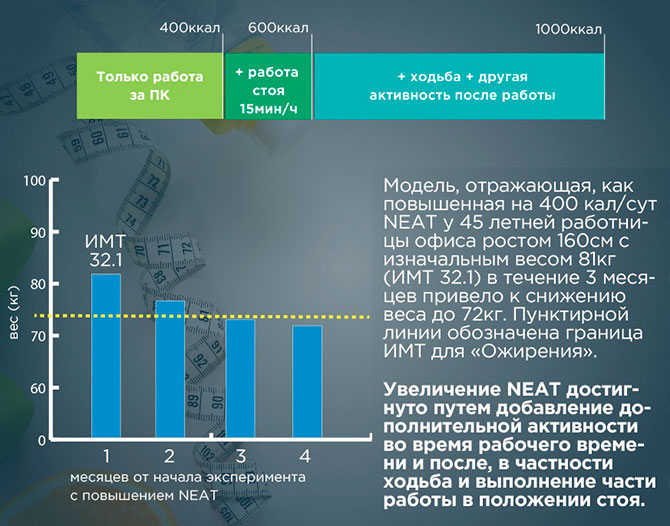
How to Increase Calorie Burning?Why can one person's NEAT burn 100 calories while another's burns 800? Because even with the same living conditions (identical diet, same weight, similar workouts), one person's daily physical activity might be lower than that of the other. For instance, one person might eat well and train regularly, but when they get home, they sit on the couch and do not move at all in front of the TV. In contrast, the other person, with the same diet and workout plan, is restless on the couch, frequently runs to the kitchen for water, fidgets, and cannot stay still. The second person has higher non-exercise activity, and this all will lead to faster weight loss. It’s hard to believe, but it’s a scientifically confirmed fact. Moreover, if you are sitting rather than lying flat on your back, you burn more calories. If you are standing, you burn even more; if you fidget while sitting, you consume as much as 50% more calories (compared to lying down). And if you are standing and shifting from foot to foot, you burn almost 100% more. Furthermore, walking also burns calories. The faster your walking speed, the higher the calorie burn. You can find more precise results in this study. The message is simple: to lose weight faster, move more at home, at work, in school, etc. But this is on the condition that you eat properly and train (otherwise, whatever you burn will likely be regained). Household Activity: What Not to Do1. Cardio training reduces NEAT efficiency. Why? Because cardio accelerates the body’s adaptation to increased calorie expenditure (both during workouts and at home). Consequently, at some point, the body will begin to try to conserve every calorie. In sports, this is referred to as a plateau when you eat little and train until blue, yet fail to lose weight: Interestingly, strength training in the first half of the day increases calorie expenditure during non-training activities in the afternoon. Confirmation. 2. If weight loss slows down, do not dive into an even larger calorie deficit (eating even less than you do now). When you hit a plateau, there’s no point in starting an even stricter diet. It won’t lead to anything but disappointment and potential health issues. Better to temporarily increase caloric intake. But this is a complex topic. However, it is explained in detail in our professional meal plans. They clearly illustrate how to play with caloric content to avoid a plateau. 3. Don't increase the intensity of your workouts. Neither the frequency per week, nor the workout load, nor the speed of exercise should be modified. Do nothing differently if you reach a weight loss plateau. Continue to train as you have been. The only thing you can change is to switch up your workout program for variety (ideally every 2-3 months). Just understand one key thing! NEAT is an additional tool, not the primary one. The main factors are training and nutrition. Don’t think that eating a piece of cake means you can just wiggle your leg while sitting on the couch and burn off what you’ve eaten. That’s probably not going to happen. If it were that simple... SIMILAR ARTICLES
COMMENTS |