|
» »
The relationship between muscle growth and center of mass: a scientific approach
Author: Ivan Yakovlev - amateur athlete. This article is aimed at beginner athletes to optimize their training process. Almost the entire article is based on personal experience, so I might be mistaken in some aspects. Most young individuals who enter the gym start by eagerly pumping their biceps, doing bench presses nearly every day, and performing any exercises they can find, but after failing to achieve results (aside from potential injuries), they give up and stop training. Why does this happen? Why is there no progress? To answer this question, let’s pay a bit of attention to anatomy and physics. From our school physics course, we know that any physical body is characterized by two parameters: mass and position in space. Specifically regarding the latter: “The center of mass is the geometric point that characterizes the movement of a body or a system of particles as a whole.” The human body is no exception in this regard. The center of mass is located around the navel (see the image). 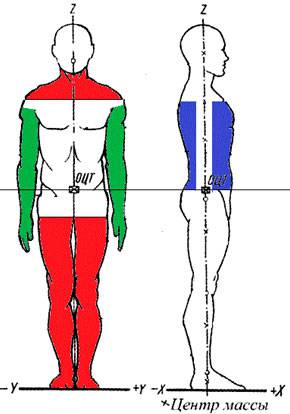
What relation does this have to mass? A very direct one! Nature has ensured that, no matter how much you train or how much you load your muscles (be it your shoulders, chest, biceps), the center of mass will never change (surgical intervention is excluded). Our bodies are designed to expend as little energy as possible during any movement. That’s why, in people with excess weight, this weight accumulates around the abdomen (in women, it accumulates around the buttocks due to the “natural” counterbalance of breasts). If we create frontal, horizontal, and sagittal cutting planes (see the image), we can draw certain conclusions:
Given that we cannot change the center of mass, to increase training efficiency, it is most reasonable to work on these equally distant muscle groups within the shortest time frame possible, that is, if not in one workout, then at least consecutively (one workout following another). It should be noted that working on only one group (for example, training only legs and shoulders) will yield results, but they won’t be as pronounced as if all groups are worked on evenly. Naturally, more time and effort should be allocated to the legs. It turns out like this: “Either we grow evenly, or we don’t grow at all” (genetics, steroids, sport nutrition, silicone not included). As long as I can remember, I have always had a lean physique, and gaining mass was merely a dream for me. However, after I began training using this algorithm, progress came swiftly. In 9 months, I managed to increase my weight from 68 kg to 88 kg, which is an increase of 20 kg. I want to emphasize that this result was achieved without sports nutrition and without steroids (and my genetics are clearly not in my favor). Conclusion The greatest results from training are achieved through working on antagonist muscles, namely “legs + shoulders,” “chest + back,” and “arms.” SIMILAR ARTICLES
COMMENTS |