|
» »
Strength training at a young age: examples, features, nuances
Author: Nikolai Borisov - coach, champion of Russia in powerlifting. All articles by the author ➤
Visit the author's website for this article Early Training and Children's GrowthThe most common scare tactic used by opponents of weight training in youth is: lifting weights stunts growth. Likely, the layperson associates a teenager with a doll that gets crushed under a barbell. So, what happens to a living organism? This question was answered by a study conducted in the USSR in 1978. For several months, two groups of boys aged 16-18 were observed, each consisting of about 20 people (if the reader knows of more extensive studies, please share). One group engaged in athletics, while the other did weightlifting. During the observation period, the group of athletes grew an average of 5 mm, while the weightlifters grew by 1 cm. At first glance, this scientific study lacks a control group of non-athletes. However, there was no need for this. In Soviet times, schoolchildren and students underwent medical examinations at least once a year, and growth statistics were available from any local clinic or educational institution. There was consolidated statistics by region and nationwide. Comparison with this data showed that the average boy grew slower than the athlete. Why does this happen? Short-term (a few minutes per workout, broken into 10-20 sets) work with weights stimulates cartilage tissue, causing it to grow faster. Prolonged continuous stress can lead to the opposite effect. It's not for nothing that A. Schwarzenegger, during his time as the Governor of California, banned schoolchildren from carrying textbooks; all necessary information was placed on disks. Daily carrying several kilograms of textbooks in a backpack or a bag on one shoulder is likely to warp a child's spine for life. Examples of Children Who Started Training Early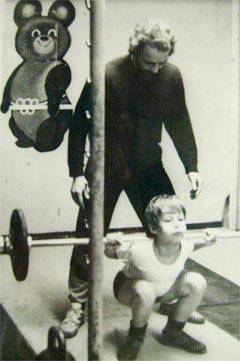
All the children listed below were trained by their fathers. Don’t rely on hired instructors for this. What is known about training at preschool age? Not much. The overall experience is positive, confirming that lifting weights does not turn children into dwarfs or cripples. In order of age: 1. Grigory Borisov - born in 1984, Khimki. Started training at 5 years old. He has won the Moscow region championships multiple times among younger boys according to IPF standards. After finishing school, he moved to another city to study and drifted away from the sport. No harmful consequences from training have been noted. He grew taller than his father. (Photo left: Zelenograd, probably December 1993). 2. Ekaterina Matveeva - born May 1989, Mytishchi. Started training at 5 years old. She competed in her first competitions at 7 years old. Champion of Russia among girls in equipped powerlifting in 2003. Other performances can be viewed here at http://allpowerlifting.com/lifters/RUS/matveeva-ekaterina-15876/. She achieved the Master of Sports qualification in weightlifting, which is significantly more challenging than powerlifting. She caught up in height with her mother and is now 7 cm taller than her grandmother. 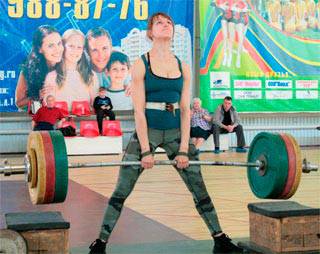
3. Yulia Borisova - born November 1989, Khimki. Started training at 5 years old. She has been competing in powerlifting since she was 7. Training plans are still only on paper. The oldest recorded video: Victory in the absolute category at the World Cup in 2012, acquiring the Master of Sports qualification in deadlifting according to WPA standards, other performances, and an unbeaten record held by Yulia since 2007 can be seen here. Numerous victories in RDFPF competitions before 2007 were not included in the database. She grew taller than her mother. In 2014, she gave birth to a son weighing 4,250 g. Eleven months after giving birth, she placed 2nd in the regional tournament in Russian bench press. And in the 14th month after giving birth, while continuing to breastfeed her son, she won the strength show "Senezh Deadlift" with a result of 230 kg (photo above). 4. Viktor Matveev - born 1991, Mytishchi. He had his first training session before his fourth birthday. A year-long break from strength training was due to preparation for long-distance running. In 1998, he set the Russian record in running 20 km for boys under 7 years, a record that still stands! His time for the distance was 1 hour 39 minutes 04 seconds. After setting the running record, he returned to powerlifting. Competitions from recent years can be found here (not all). He grew taller than his father by 8 cm. 5. Varvara Akulova - born 1992, Kryvyi Rih. She began training at 4 years old. I have read for a long time that in her preschool years, Varya competed in Ukrainian powerlifting tournaments. I didn’t find her in the database at http://allpowerlifting.com. It is likely that Varvara currently continues the family business in the circus. Judging by the materials available on the internet, her health seems to be fine: http://oppps.ru and http://fishki.net. Features of Strength Training for ChildrenThese features are primarily due to differences in children's psychology rather than physiology. The younger the child, the more challenging monotonous, repetitive work becomes for them. It is easier for a child to do 3 exercises with 2-3 sets each than to do one exercise with 5-6 identical sets. Squats with a barbell on the shoulders should definitely be limited to 2-3 working sets and supplemented with single-leg squats and lunges with a barbell or to the side. The same applies to pressing. And 1-2 more pressing exercises. For the same reason, it's best to avoid high repetitions. Performing an exercise more than 8 times can be challenging for adults to control each movement. An adult athlete can usually summon the willpower to push through, but a child might simply neglect proper technique. In the progress charts of Katya and Viti, generously provided by Vasily Matveev, it can be seen that in the first six months of training, squats were performed only with the barbell on the chest. This method of mastering technique through preparatory exercises helps avoid many technical errors in the future. For the row, the preparatory exercise is standing bends with a barbell on the shoulders. It is not advisable to perform rows for the first six months of training. Learning the row should begin only after the back technique in bends and squats is perfected (this rule also applies to adult beginners). Rows should not be done for more than 5 repetitions and not more frequently than once every 2-3 weeks. The child's back will grow stronger: When starting strength training for a child, you should be prepared for the fact that almost all equipment in a standard gym will be too large for them. You will need to: - place blocks or stacks of plates under their feet for bench pressing, - assist in lifting and receiving the barbell during presses and squats, - support their legs during hyperextensions, - help them on bars and parallel bars, and much more. When adding working weights for a child, consider the percentage increase. For them, moving from 15 kg to 16 kg is equivalent to your transition from 150 kg to 160 kg. You will need a set of plates and dumbbells starting from 0.5 kg. Is an Early Start Necessary?If one identical twin starts training at 5 and the other at 10 years old, their strength levels will probably equalize by the time they are 18, or even by 15. So, what does an early start in training provide? A more stable technique? Indeed, the earlier a skill is acquired, the more stable it becomes, all else being equal. It’s unlikely that an adult can ride a bike as confidently as someone who learned to do so in childhood. The missed age of 5 to 7 years in football coordination is practically irretrievable. It would be foolish to try to teach adult men to play football by changing the national team coach. However, the technique of powerlifting exercises is relatively primitive compared to most sports. It can be mastered and automated even in veteran age. On the other hand, weightlifting—specifically the snatch and clean & jerk—is much more complicated than squatting, and teaching these movements before the age of 8-9 can be quite problematic, as motor skills may not have matured yet. It is probably more rational to use the period between 7-10 years for developing coordination skills. The table of sensitive development periods shows: 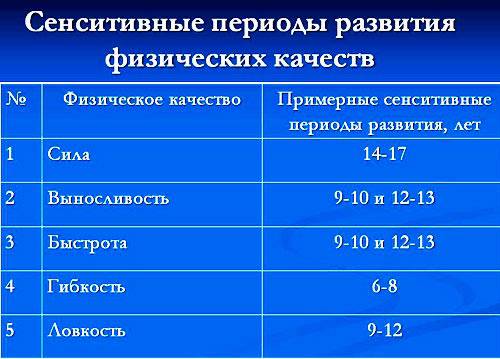
the age when a child is most receptive to developing certain physical qualities. It is advisable not to miss these favorable periods, as they may not be retrievable later. According to some authors, a “drop” in receptivity to developing coordination occurs between ages 10.5 and 13.5. Don’t forget about flexibility as well. Often, insufficient mobility in the joints hinders the mastery of technically correct movements. Based on the above, I’m not advocating a mandatory early start with weights, especially if the child is inclined towards team sports. I simply presented examples that convincingly demonstrate that there is no harm in well-planned strength training at any age. Developing agility and flexibility in a child can be aided by gymnastics and various forms of wrestling. Unfortunately, it is not easy to find a children’s section available at a nearby location with a suitable training schedule. And the main question is—who will train your child? I wouldn’t entrust my child to an unfamiliar trainer without recommendations. On What Is More Important Than Strength IndicatorsIn my opinion, the primary benefit of early acclimation to training lies in the realm of psychology rather than physiology. Firstly, stepping onto the platform for the first time in front of an audience and judges at age 7 is easier than at 12-14. As one approaches adolescence, various self-consciousness and doubts can interfere. It’s better if the habit of performing in front of an audience is formed earlier. This habit of performing in public is invaluable. Secondly, training in the same gym with a parent has a positive educational effect, unlike the situation when a parent drops the child off at a class while they themselves are slouching in the lobby. Thirdly, city preschoolers quickly become accustomed to spending time on computer games and other less useful activities, including watching television. Here, an early habit of training regularly can serve as a good counterbalance. Fourthly, the social circle. Children’s circles can vary greatly, from smoking to hanging outside on a train. In a proper sports club, a child enters a community that trains together, competes, and relaxes together. This does not apply to all sports clubs. There are some where it is not customary to even say hello; they sit in silence with their headphones while using the machines. I’m not talking about those. When placed in an environment of like-minded individuals, a person typically gains friends within it, and some may even find spouses. SIMILAR ARTICLES
COMMENTS |