|
» »
Do you need to surprise your muscles by changing exercises?
Author: Mikhail Ziborov - author of the site makefitness.pro. All articles by the author ➤
Surprising the muscles means changing exercises (even if they target the same muscles) almost every workout. For instance, on one day for chest, you do a bench press, the next day for chest - dips, and the third day - dumbbell press. Some trainers (and the novices who listen to them) claim that for muscle growth, you must surprise them. To learn how to train correctly without making common mistakes, read our Telegram. It's concise and to the point. 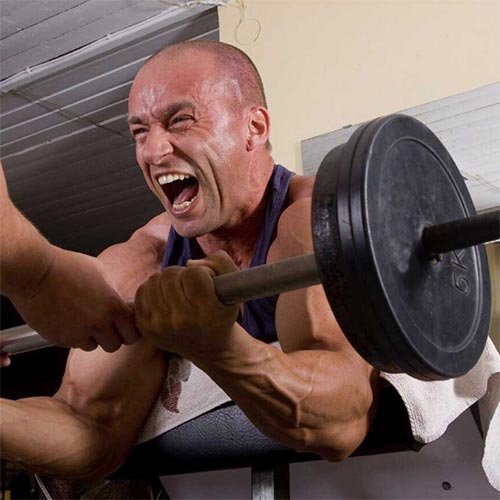
Do you need to change exercises frequently?There are several problems with the statement "surprising the muscles" (i.e., changing exercises frequently, almost at every workout), which bring this principle into question. First, the muscles couldn't care less about the weights you use. For example, if today you worked with a barbell and tomorrow with dumbbells, the muscles are not thinking, "Wow, this surprised me so much, I think I'll grow now." No, it doesn’t work like that: muscles don’t think or get surprised. Muscles can only perceive the load: if the load is sufficient – they will grow; if it is inadequate – they won't. Second, if on the first day for chest you did a barbell bench press and on another day for chest – dips, you can’t be sure that you received the same load on dips as on the bench. It might happen that with the barbell you stimulated muscle tissue growth, but with dips, you didn't (simply because you didn't work hard enough). Third, by changing exercises too frequently, you don’t have time to develop a movement pattern – the precision of movements during execution. Roughly speaking, during bench pressing, the body tries to get used to performing that specific exercise. But at the next workout, you change the exercise to dips, and the nervous system now tries to adjust to dips. Then you change the exercise again, for example, to dumbbell bench press. The body has to adapt again to the new movement. As a result, in none of the three exercises does the body achieve any adaptation. To be fair, I can say that even this type of training will lead you to the development of physical qualities and muscle mass. However, it will be a longer path. It is much more effective and faster to progress in one exercise first, and after a certain period, start progressing in another movement. In simpler terms, it will be easier for the body to get used to performing one exercise (such as the bench press) rather than three different exercises. How often to change exercisesExercises for the same muscle groups should be changed every 2-3 months. This is necessary for: 1. Progress in training 2. Maintaining motivation to train. According to a study, training men progressed better when they had a fixed set of exercises (i.e., they didn’t change them, performing the same movements) than those who randomly chose exercises for the same muscle groups. More details about the study: - 21 men were divided into 2 groups – with fixed exercises and with random ones; - trained for 2 months, 4 times a week (a total of 32 workouts); - both groups were equalized in training volume, despite the differences in exercises. The researchers concluded that it's better to progress with a fixed set of exercises than to change them at every workout. However, at the same time, individuals who trained differently each session maintained better motivation to engage. Analyzing this study, we can conclude that: - for better progression, it’s essential to train based on a clear training program rather than changing it every session; - changing the training program every 2-3 months is necessary to maintain high motivation. And after just one year of this approach, you won't lose interest in training and will significantly improve your strength, endurance, and muscle mass, as well as develop movement patterns. So, should you surprise the muscles? No. But you should change the set of exercises after a certain period. This is necessary both for further improvement of physical condition and for mental health (motivation). Let me remind you that results depend not only on how you train but also on how you eat. You can spend all your time in the gym but not build muscle effectively if you neglect obtaining sufficient protein and carbohydrates. SIMILAR ARTICLES
COMMENTS |