|
» »
Eccentric Phase: Eccentric Exercises for the Whole Body
Author: Mikhail Ziborov - author of the site makefitness.pro. All articles by the author ➤
The eccentric phase of movement is the moment of lowering the weight (or your body), relaxing the contracted muscles. It is also known as the muscle relaxation phase or negative phase of the exercise. It is the opposite of the concentric phase of movement (positive phase of the exercise), when you lift the weight.
Remembering which phase is which is quite easy: 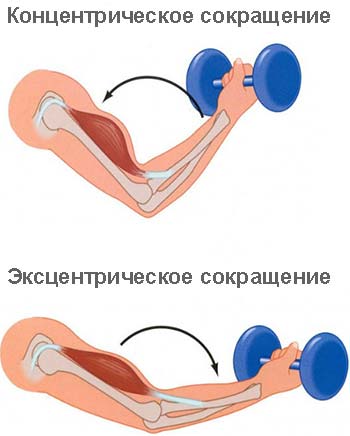
The concentric and eccentric phases together make up the movement (exercise)! The Importance of the Eccentric Phase of MovementOften, beginners neglect the eccentric phase: you can see them pulling their chins to the bar during pull-ups, but then they just drop down without any control while lowering their bodies. The same can be observed during the bench press: the lift is normal, but when lowering, the barbell almost falls as a dead weight onto the chest. This is a poorly executed negative phase. Neglecting this phase is unwise; you deprive yourself of a significant portion of progress since the entire movement (lifting and lowering, up and down) affects your results, not just a part of it. By the way, in bodybuilding (and slightly less in other strength sports), the eccentric phase is often used as a means to increase progression – muscle mass gain, strength indicators, and overcoming plateaus. Eccentric repetitions in sets are called negative repetitions: first, you perform regular repetitions until failure (lifting and lowering the weight yourself), and then after failing, you do negatives (your partner lifts the weight for you, and you only lower it). However, many confuse the concepts of eccentric repetitions and eccentric exercises! Eccentric Exercises for the Entire Body
There are no eccentric exercises! The essence of these exercises/repetitions is simple – to give additional load to the muscles at the moment of stretching. Simply put, stretch the muscles and thereby load them. For the vast majority, this type of load is unusual, which triggers the body’s adaptation – strengthening, muscle tissue growth, and increased strength (and during the execution – burning).
As we've already understood, there are no negative exercises. There are negative repetitions. Negative repetitions can be performed in all familiar exercises: In general, you can use all standard and familiar exercises while additionally doing negative repetitions within them. The key is to maximize the ease of the concentric (positive phase) with the help of a partner while performing the eccentric phase independently. There are no special exercises: these are all well-known basic and isolating movements. But there is one important point! If in squats with the barbell on your shoulders, you can manage with one partner to help (standing behind you and holding you), for deadlifts, you will need two assistants (each at the ends of the bar), because it’s difficult and inconvenient for one person to help. By the way! In straight-legged deadlifts, the greatest tension in the muscles is achieved when leaning forward, with the hamstring maximally stretched. That is, the greatest stimulus for muscle growth occurs at this moment. Now imagine what happens if you emphasize only the stretching phase of the movement! The results promise to be impressive. Advantages, Disadvantages, and Other Nuances of Negative RepetitionsThe use of negative repetitions can lead to an increase in muscle mass by about 3-4%. The drawback is the increased recovery time (due to greater micro-trauma to the muscle tissue). For details, see the link. By the way, negative repetitions allow you to engage muscle fibers along their entire length, including at the very ends, while the concentric phases of muscles (positive repetitions) increase the diameter of the muscles. For more information, click here. And while this technique helps improve training effectiveness, the foundation remains crucial. This includes a training program, nutrition, and recovery. You can find a weight gain meal plan here. Some of the best training programs for any conditions can be found here. Additional tips for muscle growth and improving progress are available here. SIMILAR ARTICLES
COMMENTS |