|
» »
What weight are we lifting when we do push-ups?
Author: Mikhail Ziborov - author of the site makefitness.pro. All articles by the author ➤
At first glance, it may seem that this question can be answered in one sentence: during floor push-ups, we press about 64% of our body weight. But push-ups can be done in different ways. For example, from the knees. This is easier than regular push-ups. And what percentage is that? Or you can place your hands on an elevated surface. That gives different numbers. 
Subscribe to our Telegram or Max so you don’t lose the channel. Whether you need it or not—you can check it out and decide for yourself. For simplicity: if you weigh 100 kg, then during classic push-ups you work with 64 kg (64% of 100 kg). If you weigh 70 kg, then in push-ups it will be almost 45 kg. Do you weigh 60 kg? Then in push-ups, you could say, you are lifting 38.4 kg. You can calculate your personal results yourself if you know your body weight. 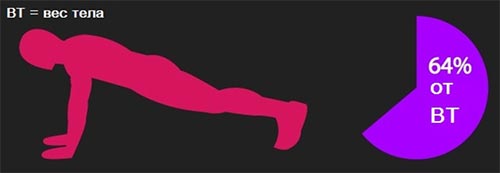 Knee Push-Ups: How Much Weight Are We LiftingScientists looked into this question. They selected 23 volunteers (14 men and 9 women) and asked them to do push-ups in 6 different variations. The results showed that from the knees, we lift on average 49% of our body weight. 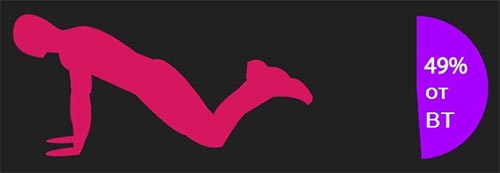 Push-Ups with Feet ElevatedTo start with, I’ll answer simply: the higher your feet are, the harder the push-up will be. If you place your feet on a platform 30 cm high, then you will be lifting about 70% of your body weight. This is somewhat more than 64% in regular push-ups. And if the height of the platform your feet are on is 60 cm, then the load increases to 74% of your body weight. 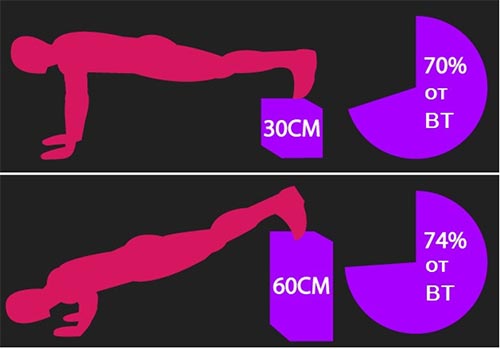 Push-Ups with Hands ElevatedIf you place your hands on an elevated surface, then the numbers change in the opposite direction compared to feet-elevated push-ups. That is, the higher the platform under your hands, the easier it will be for you to do push-ups. Hands on a platform 30 cm high, and you lift about 55% of your weight. If the platform height is 60 cm, then this figure is much lower—only 41%. 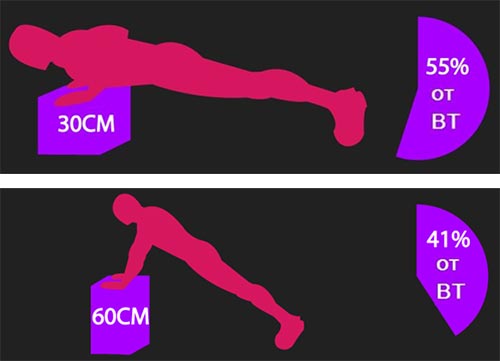 Which Push-Ups to Do to Learn How to Do Push-UpsOne of the main principles of training is progressive overload. If you gradually increase the load, you will progress: become stronger, more enduring, and so on. And if you keep making push-ups more challenging for yourself, then over time you will learn how to do push-ups. So, here is the order of push-up variations to learn how to do floor push-ups: Push-ups on an elevated surface about 60 cm high (load: 41% of body weight); Knee push-ups (load: 49% of body weight); Push-ups on an elevated surface about 30 cm high (load: 55% of body weight); Push-ups from one knee (one leg rests on the floor with the knee, the other is straightened). Once you learn to do 15–20 reps from one knee, you can move on to classic push-ups. If you already know how to do push-ups but want to improve your results, then: first, try push-ups with your feet elevated 30 cm (load: 70%); then increase the platform height to 60 cm (74%). In addition, there are many more difficult push-up variations. Or variations with the emphasis not on the chest muscles but on the triceps. Advanced options include archer push-ups, diamond push-ups, and others. In my article “Top 14 Unusual Push-Up Variations” you will find all these variations. And for a full training program, visit our website DOBROMILFIT.RU. Also, use quality sports nutrition, not cheap mass-market stuff. SIMILAR ARTICLES
COMMENTS |