|
» »
How to pump glutes if they're naturally absent?
Author: Olha Frolova - fitness enthusiast. All articles by the author ➤
To build the perfect glutes, sometimes just squats will suffice. Especially for men. But if that’s not your case, here’s the action plan:
Who has "bad luck" with their glutes? 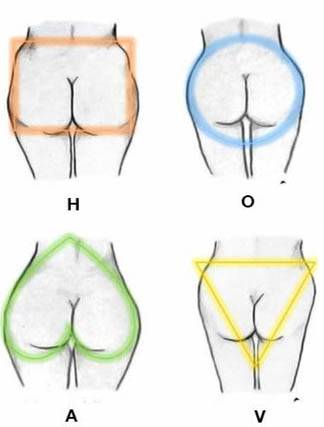
Glutes with shapes "O" and "A" respond well to training and look good even without it. These are the types we most often see in fitness models and bikini champions. What about the others? Three main female body types can be identified when the glutes are naturally not round but rather angular (like "H" and "V" in the illustration) and grow poorly despite training. a) The body is slender, struggles to gain weight (any weight), with bust, waist, and hip measurements being almost the same, creating a silhouette that slightly resembles a ruler. Grandmothers may complain about a poor appetite. The thyroid gland is active, but sex hormones are often below normal. This type may excel in sports requiring more skill than strength (tennis, etc.). b) Fat accumulates mainly around the waist, but if one manages to reveal the abs, the legs at that moment look like two thin sticks. The lumbar curve is poorly expressed, which makes the glutes appear even smaller. Hyperactivity of the adrenal glands or corticosteroid treatment in childhood may occur. The pancreas tends to overwork but inappropriately, often leading to overeating (and overeating only further drives the pancreas into hysteria). This type may run well over long distances but struggles more with sprints and jumps. c) A boyish figure with narrow hips and broad shoulders. Even in adulthood, this type may be troubled by acne. They bench press and pull up as well as the guys but often stall on deadlifts and squats near the end of the movement. The bad news is that the genetically predetermined shape of the glutes cannot be changed. No exercises in the world can turn a rectangle into a circle. All we can do is enlarge a small rectangle. Now for the good news. With proper training, you can become a world bikini star even with extremely unflattering starting conditions. Natalia Melo is proof of how this can be achieved. 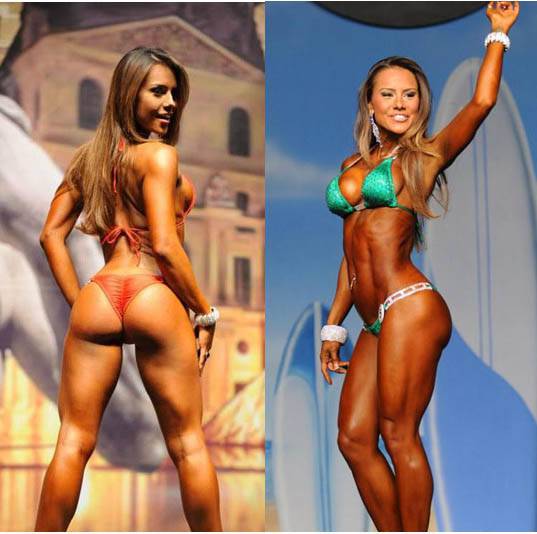
A naturally massive torso is not overtrained and finely sculpted, developed lateral back muscles add curvature to the waist, and the legs and glutes (which are by no means round, as you can see) are pumped to the limit to compensate for the volume lost with an already disproportionately thin layer of fat. In short, while you need to be born with a butt like Kim Kardashian's, you can actually achieve a butt like Natalia Melo's on your own. Let's think about how. Principles of Glute TrainingWhen people say that a muscle should be worked from different angles, it doesn't mean you need to do: From a biomechanics perspective, it’s almost the same. The glute muscles (without even highlighting individual parts) have three main functions: hip extension, hip abduction, and pelvic tilt backward (if the last one is new to you, it’s purely the "twerk" dance). It’s important that all these movements are incorporated into your training. Hip extensions are straightforward—squats, deadlifts, lunges, and extensions—these all pertain to them. We’re also spoiled for choice in terms of hip abduction: you can use a machine or a crossover. However, no exercises immediately come to mind for pelvic tilting at first. But they do exist, and their potential is enormous. The exercise "Barbell Hip Thrust" (or "Glute Bridge" with a bench) is the only basic exercise that places more than 50% of the overall load on the glutes. In deadlifts and squats, it’s only 30%-40%. See the video below. Many are initially embarrassed by how the bridge looks from the outside. This will pass as soon as you learn to lift weights 2-3 times more than your own weight. An interesting feature of this exercise is the incredibly fast progress in weights. If you squat about 50 kg, in a month's time, you could easily be doing the hip thrust with 100 kg or more for 8-10 repetitions. That’s a weight that most gym-goers have never handled. And the fact that it feels almost effortless for you can remain our little secret. For a while, you might also be bothered by pain and bruises from the bar. The pain will go away, just like with front squats, when the nerve endings get accommodated. A yoga mat (or a couple) under the bar can help with bruises. The barbell hip thrust is not a very popular exercise, and it is absolutely underserved. It is safe with the correct technique, has been proven to promote glute hypertrophy (there was an experiment where subjects only did one exercise for a month: squats, hip thrusts, and deadlifts; the hip thrust won), and is recommended for weightlifters, sprinters, and jumpers to improve performance. Additionally, the bridge with a barbell does not cause as much muscle microtrauma as: Hence, it can be practiced much more frequently. When you squat or deadlift, it’s beneficial to statically tense the glutes in the lockout (the top point of movement)—when you have straightened up. This also causes the necessary backward tilt of the pelvis and increases the amplitude of the exercise. With isolation work, it’s not so straightforward. Machines such as are always designed for some average person and are often quite worn out. Old crossovers jerk the cable. A good machine for hip abduction can be quite expensive and not available in every gym. And if you have never felt your glutes properly using the aforementioned equipment, the problem is likely in the equipment, not in you. Rare and Effective Glute ExercisesFortunately, machines offer nothing that cannot be done with body weight and a band around the knees. The exercises listed below are best performed frequently, at a brisk pace with high repetitions and supersets without rest, until you feel a burning sensation in your muscles. If possible, do 2-4 repetitions in one inhalation-exhalation to allow oxygen-rich blood to reduce the extraction of necessary chemicals from the tissues, speeding up the onset of the burn. 1. Glute Bridge with a Band Supported on a Bench (the heavy version is suitable to start the workout, while the "light" version can be performed at the end as an isolation exercise). 2. Single-Leg Glute Bridge with Bench Support (the video shows it without a bench). 3. Glute Bridge Lying on the Floor (suitable for beginners, but has a smaller range of motion than the bench version). 4. Glute Bridge with Feet Together ("frog pumps," if you will search for the video). 5. Leg Abductions with a Band Around the Knees. This can be done in a trisets format while sitting on chairs of different heights. 6. Lateral Band Walks with a Band Around the Knees. 7. Knee-Bent Leg Abduction Lying on Your Side ("side lying clam"). 8. Knee-Bent Leg Abduction Lying on Your Side with Hip Lift and Support on One Arm ("side lying clam raise"). 9. Knee Abduction on Hands ("fire hydrant"). 10. Knee Abduction Back on Elbows ("quadruped hip extension from elbows"). 11. Straight Leg Abduction Back and to the Side on Hands ("quadruped leg swing"). There’s no need to perform all of these unless absolutely necessary; it’s enough to choose a couple that "click" for you. Errors and Individual Features of Glute TrainingIf you are reading this, you've probably already spent some time training that didn’t yield the desired results. Why could this happen? 1) You tried to gain muscle in the glutes and lose weight at the same time. Recomposition is indeed possible, especially noticeable in beginners with excess weight. However, this process is so slow that 1-2 classic cycles of bulking and cutting will get you where you need to be much faster. For muscles, especially lagging ones, a stable anabolic environment needs to be created, which is only possible with a caloric surplus (you consume more calories than you expend). 2) You trained too infrequently. Beginners can easily progress by training one body part just once a week. However, over time the body learns to recover faster, and the effects of supercompensation wear off throughout the week. You revert to where you started. Typically, the lower body tolerates a higher volume and frequency of training much better. If you have been training your glutes once a week, try doing a cycle of 2 targeted glute workouts and 1 general leg workout every 7-9 days. For example: Day 1Day 2Day 3The same as Day 1. 3) You trained too much and too often. Muscles do not grow during training; rather, they break down. They grow when you rest. Squats, deadlifts, and deep lunges should almost never be done more than 2 times a week, as they cause a significant amount of micro-damage. This isn’t bad, but it requires extra recovery time. Avoid heavy exercises to failure, at least not every week. Typically, you can progress normally while leaving 1-2 repetitions "in the tank." Never train with soreness: delayed muscle pain is a signal that the tissues are still inflamed and their "repair" process is not complete. Adequate sleep is crucial. If that's a problem, find at least 2 consecutive days a week to get plenty of rest. It's good to schedule all "injurious" exercises (deadlifts, lunges, extensions) in one workout right before the weekend, using maximum weight and minimum repetitions. All other leg exercises can be done in a second workout 3-4 days later. 4) Too low intensity. The optimal number of repetitions for basic exercises is 6-8. The last repetitions should be difficult to achieve. Legs and glutes are adapted to work all the time when you aren’t sleeping, so to create an unusual mechanical stress for them, you need to lift heavy weights, focusing on progressive overload. When you reach 8 repetitions, it’s time to add weight and try it at 6 repetitions. This is a general guideline and may not apply to isolation exercises. 5) High intensity and low volume. This can happen with powerlifters or those training with a strength protocol. The weights are high, but the overall training tonnage is low—too few repetitions and sets. Women, especially in the lower body, tend to have a lot of slow-twitch muscle fibers that do not engage in heavy lifting but respond well to metabolic stress. This stress is felt as a burning sensation in the muscle when performing exercises in a high-repetition mode. To achieve this, you can complement a strength program with high-repetition glute bridges with a band for resistance, high-rep single-leg bridges, extensions with a rounded back, and leg abductions on a machine or with a band around the knees. However, training volume is a complex topic, and it’s advisable to have it calculated by an experienced trainer. You can allocate a separate day for hypertrophy or perform these exercises right after deadlifts and squats. 6) Age over 40. As the well-known Olympic coach Mark Rippetoe said, "Training volume is artificial age." After forty, protein synthesis is suppressed, a large portion of consumed proteins is used for energy, and sleep and recovery worsen. Due to hormonal changes, women may experience a disruption in healthy fat deposition patterns (instead of the hips, fat concentrates around the abdomen). You become sensitive to high-volume training in a negative way. It might be time to try a purely strength program with moderate training frequency and minimal isolation for the glutes. A nice bonus is that high intensity will provoke adaptations in the bones and connective tissue, which will help prevent injuries in older age. 7) Unstructured training. The difference between bodybuilding and physical exercise is that you can do physical exercise haphazardly and feel good. But in bodybuilding, the process itself brings little pleasure. You expose your body to progressively increasing stress in the hope of obtaining adaptations in the form of increased strength and muscle size. It is virtually impossible to develop adaptations to random loads. The stress needs to be consistently predictable, and the permissible variables are the weight of the load and the number of repetitions. These conditions are nearly impossible to achieve if you frequently try and abandon new training programs or engage exclusively in CrossFit. 8) You've been training for years; everything was working, but recently there has been no progress. In 90% of cases, when a plateau hits, it’s enough to increase the training volume. You can do more repetitions, more sets, train more frequently (since the body adjusts the overall "balance" not in one workout but over about a week), or combine all of these. It's hard to recommend anything without knowing exactly how you’ve been training up until now, but, for example, if you had two "leg" days a week with 15 sets each, you could try training them 3 times a week. Once focusing on the glutes, once on quads + glutes, and once on hamstrings + glutes. Something like this: Day 1Day 2Day 3At the end of each workout, you can add 3-6 isolation sets for the calves. After the second and third workouts, you may initially experience significant soreness—then it's better to temporarily stretch the whole cycle to 9 days. Suppose your training volume is already quite high; what then, should you train every day? Believe me, experienced athletes can manage that and much more. We do not know Natalia Melo's exact protocol, but we do know that she trains her glutes 7(!) times a week. Obviously, she doesn’t have a split program but full-body workouts, starting with 6-10 sets for legs and glutes. Contrary to popular belief, full-body training is not just physical therapy for beginners and the elderly; it is a necessity when you need to dramatically increase the total number of repetitions/sets. It can also be assumed that she doesn't perform heavy compound exercises more than 2-3 times a week and that her program is based on various variations of the glute bridge, from heavy weights with a minimum number of repetitions to exercises with a band and body weight for 20 repetitions or more, as well as a lot of isolation work—to ensure metabolic stress. This information should be enough to present a real challenge for poorly growing glutes. Lastly, it’s worth noting that many women with this issue attempt to resort to steroids, but this is precisely a case where the potential harm of pharmaceutical drugs outweighs the potential benefits. No, there will be no lectures on side effects this time. The thing is, androgen receptors—both synthetic and natural—respond in tissues that naturally have a lot of corresponding receptors from birth. Flat glutes indicate that there are few of the necessary receptors in them, and you’re more likely to gain width in the shoulders, which only exacerbates the body’s disproportion. Now for the final question: what is the difference between training lagging glutes and normal ones? The answer: nothing. Those who are luckier can achieve 80% of their results with just 20% of the effort based on the Pareto principle. The rest of nature requires detailed attention and a full 100% effort. SIMILAR ARTICLES
COMMENTS |