|
» »
High and Low Fiber: Foods with Low and High Dietary Fiber Content
Author: Mikhail Ziborov - author of the site makefitness.pro. All articles by the author ➤
If you think that making yourself a salad from the usual cucumbers and tomatoes, adding a bit of greens, and drizzling it all with olive oil (Extra Virgin, of course), makes for a mega-healthy meal that satisfies your fiber needs, I hasten to disappoint you. Tomatoes and cucumbers don't actually contain that much dietary fiber. Below are products with a truly high volume of fiber. And, by the way, all of this is available in our telegram channel. You receive all the information below for free. I only ask you to subscribe to our telegram. It’s a couple of clicks, it's not difficult. 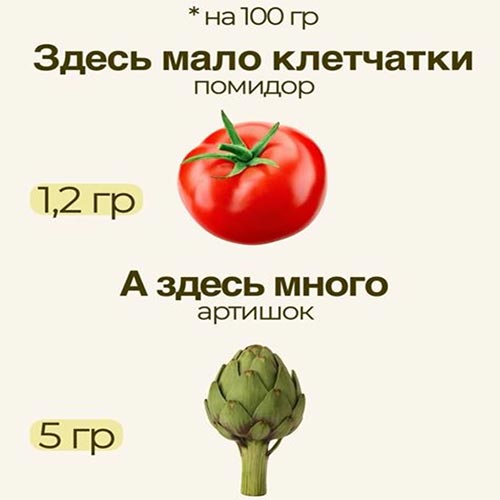
What is Fiber (Dietary Fiber)Fiber and dietary fiber are synonyms. They mean the same thing. Fiber itself is, so to speak, a nutrient along with proteins, fats, and carbohydrates (PFC). Unlike PFC, this nutrient either has no caloric value (carries no energy) or has a very low caloric value. Often it has none, which is why this nutrient is essential for weight loss (and we know firsthand how to lose weight and never worry about it again). Fiber is divided into two types: soluble (it feeds beneficial gut bacteria and turns into a "gel" that lines the outside of the intestines, protecting them); insoluble (due to its coarse consistency, it is not digested and removes "waste and toxins" from the body, as people like to say). And fiber is extremely beneficial both for health (significantly reduces the risk of colon cancer, supports gut microflora, and therefore immunity) and for weight loss (blood sugar control, satiety, zero calories). In short, it’s a worthy nutrient, but most often people don’t get enough of it, even though they think they eat a normal amount. Please note: if you consumed little dietary fiber before this article, you should increase its share in your diet gradually, not abruptly. Tomato and ArtichokePer 100g of tomatoes, you get only 1.2g of fiber because tomatoes contain a lot of liquid. However, if you look at an artichoke, you will get 5g of dietary fiber from 100g. That is 4 times more than from tomatoes. Cucumber and Brussels SproutsThere is very little fiber in 100g of cucumber—only 0.5g. This is because this vegetable is very watery. In contrast, Brussels sprouts contain 7 times more dietary fiber per 100g—3.8g. In principle, any type of cabbage will have either a lot or a sufficient amount of fiber. This is what makes the cruciferous family special. Zucchini and BroccoliAgain, based on 100g of product. Zucchini has 1g of fiber. Not bad, but there is a much better alternative. That is broccoli—3g of dietary fiber. As mentioned, any type of cabbage is guaranteed to have a high volume of fiber. Broccoli is exactly that kind of cabbage. Iceberg Lettuce (Head Lettuce) and KaleBoth are leafy greens. But lettuce has only 0.9g of fiber, while Kale has as much as 4.5g. The difference is significant. Green Beans and Red/White BeansIt would seem both products are beans, but the difference in fiber is simply huge. Green beans have 2g per 100g of product. Not bad, but... red and white beans have 10-15g. Want a truly fiber-charged salad? Then add beans to it. Brown Rice and Quinoa/BuckwheatThese are standard grains recommended for weight loss. For example, it is advised to replace white rice with brown rice, which is correct. It contains 1.8g of fiber. But if your goal is specifically the volume of dietary fiber, then quinoa or buckwheat are much better suited for this role. They contain 7-10g of dietary fiber. Potato and LentilsAccording to one scientific study, potatoes are one of the most satiating foods. But there isn't actually that much fiber in them (2g per 100g of product). It’s okay in principle, but compared to lentils, it’s really little. Lentils themselves contain 8-12g of fiber. FigsHere we will compare fresh figs and dried ones. Fresh figs have a decent amount of dietary fiber—2.9g. But dried ones have 9-12g. However, you must understand: in 100g of dried fruit, there is simply more dry mass, while fresh fruit contains a certain amount of liquid. Additionally, dried fruits are always more caloric (significantly so!) than their fresh counterparts. So keep that in mind. Bell Pepper and Sweet PotatoBell pepper has 1.2g of fiber. Meanwhile, sweet potato pulls in 3g. The choice is yours. Grapes and RaspberriesThese are seasonal berries. But if the choice is based on the amount of dietary fiber, raspberries beat grapes hands down: 6.5g for raspberries versus 0.9g for grapes. Watermelon and AvocadoWatermelon has extremely little of this essential nutrient—only 0.4g per 100g of product. Avocado, on the other hand, has a whopping 7g. But also keep in mind that avocado is high in fats and quite caloric. Oatmeal and Chickpeas/Mung BeansOatmeal porridge has a large supply of fiber—6g. But it is surpassed by legumes such as chickpeas (8-11g of fiber) and mung beans (16g). Products with an Average of 3g of FiberHere is a small list of other products where you can find fiber: carrots and beets – 2-3g; apple and pear – 2.4-3.1g; orange and kiwi – 2.4-3g; pomegranate and persimmon – 3.6-4g. SIMILAR ARTICLES
COMMENTS |