|
»
Schmorl's hernia: causes, symptoms, treatment
Author: Sergey Yezhov - sports medicine physician. All articles by the author ➤
Recently, more and more patients have been coming to me with complaints about "Schmorl's hernia." Yes, that is exactly how they phrase their problem. The thing is that this pathology is often just an incidental finding on an MRI scan and rarely the cause of pain. However, the very word "hernia" terrifies patients, and those particularly impressionable come in thinking about an inevitable surgery. In this article, I will try to explain the essence of the pathology, how dangerous it is, and how to train in the gym correctly to avoid exacerbating the condition. 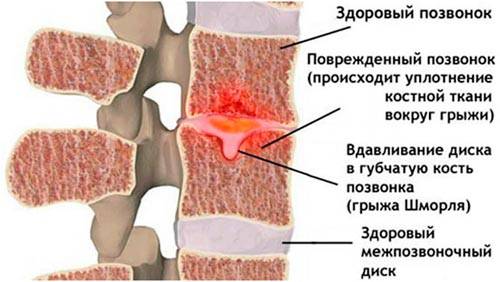
Hernia or Schmorl's nodes is a type of intervertebral hernia where the nucleus pulposus of the intervertebral disk penetrates into the body of the adjacent vertebra without exceeding the fibrous ring. The nucleus pulposus of the disk presses against the superficial cortical layer of the vertebra and fills the cavities within it with cancellous bone tissue. As I mentioned, in most cases, Schmorl's hernia passes asymptomatically and is an incidental finding during spinal examinations. Typically, no treatment is required. However, for athletes, Schmorl's hernia may be a contraindication for specific types of loads. The main cause of Schmorl's hernia is the thinning of the hyaline plates that cover the body of the vertebra, as well as osteoporosis (reduced mineralization) of the bone tissue. Provoking factors include increased axial loads on the spine, which places athletes in the risk group for this pathology. This is particularly relevant for strength sports (weightlifting, powerlifting), gymnastics, jumps, and figure skating. In athletes, hernias are typically localized in the lumbar region, which is the most loaded during these activities. Symptoms Schmorl's hernias can remain asymptomatic for a long time because they do not compress the nerve roots of the spinal cord. With large hernias, the following symptoms may appear:
The main danger is the destruction of the vertebral body with large hernias, which can lead to a compression fracture. There is no specific treatment for this pathology. In cases of severe pain, anti-inflammatory medications (Ksefokam, Voltaren, Nimesil, Movalis) are prescribed both orally and in the form of ointments, as well as muscle relaxants (Mydocalm) and neurovitamins (Milgamma). Once the acute process subsides, massage, physiotherapy, and therapeutic exercises (LFC) are recommended. Training in the Gym Final approval for training is given only by a doctor (neurologist, traumatologist, or sports physician). In the gym, it’s prohibited to perform axial load exercises on the back. For example: You should also be extremely careful with
Any kind of jumping is also not recommended. Every workout should end with stretching the back muscles (you can do a hang on the pull-up bar, but never jump down from it). Regular check-ups (at least once a year) with a specialist, including X-rays or MRI scans to assess the dynamics of the condition, are essential. SIMILAR ARTICLES
COMMENTS |