|
»
Exercise for double chinVIDEO
LOAD ON MUSCLES
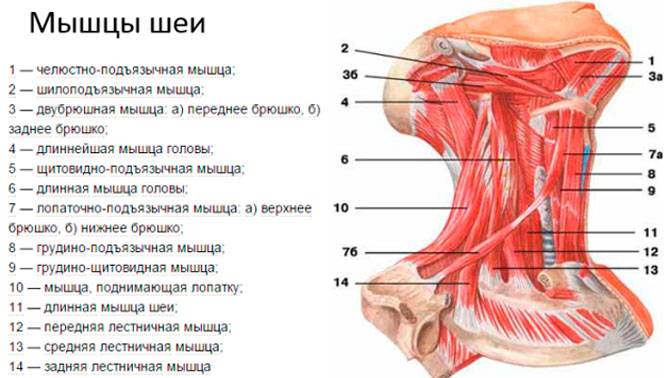
Zone: chin and neck Effectiveness. This exercise helps strengthen the suprahyoid muscle group. It is used for correcting a "double" chin. Main muscles. The suprahyoid muscles connect the hyoid bone to the mandible, the base of the skull, the tongue, and the pharynx. 1. The digastric muscle (m. digastricus) has two bellies. The posterior belly (venter posterior) originates from the mastoid notch of the temporal bone, and the anterior (venter anterior) from the digastric fossa of the mandible. The intermediate tendon passes above the hyoid bone and attaches to its body with a strong fibrous plate. Function: when the hyoid bone is fixed, the anterior belly lowers the mandible; when the mandible is fixed, the posterior belly pulls the hyoid bone upward and backward. 2. The mylohyoid muscle (m. mylohyoideus) is located between the body of the mandible and the hyoid bone, forming the diaphragm of the mouth. 3. The geniohyoid muscle (m. geniohyoideus) lies above the mylohyoid muscle. 4. The stylohyoid muscle (m. stylohyoideus) originates from the styloid process of the temporal bone; it attaches to the body of the hyoid bone. Function: it raises the hyoid bone and pulls it backward. The infrahyoid muscles approach the hyoid bone from below, starting from the scapula, sternum, and the cartilages of the larynx. 1. The omohyoid muscle (m. omohyoideus) consists of two bellies connected by an intermediate tendon. The superior belly (venter superior) originates from the body of the hyoid bone, while the inferior belly (venter inferior) begins from the upper edge of the scapula. Function: when contracted, it tightens the cervical fascia and lowers the hyoid bone. 2. The sternohyoid muscle (m. sternohyoideus) originates from the inner surface of the manubrium of the sternum and the sternal end of the clavicle, goes upward; it attaches to the lower edge of the body of the hyoid bone. Function: it lowers the hyoid bone. 3. The sternothyroid muscle (m. sternothyroideus) starts from the inner surface of the manubrium of the sternum and the cartilage of the first rib; it attaches to the lamina of the thyroid cartilage. Function: it pulls the thyroid cartilage, and thereby the entire larynx, downward. 4. The thyrohyoid muscle (m. thyrohyoideus) originates from the lamina of the thyroid cartilage; it attaches to the hyoid bone. Function: it lowers the hyoid bone and, when the hyoid bone is fixed, raises the larynx. Number of repetitions. The exercise is performed at a calm, comfortable pace; start with a small number of repetitions, gradually increasing to 30 times, holding statically for a few seconds on the last count. DESCRIPTION

Author: Kristina Bondareva - facebuilding coach All articles by the author ➤
Press the tongue against the upper palate with effort. The double chin should be pulled up by the tongue, and the neck should tense. ANALOGUES
COMMENTS |