|
» »
Principles of adjusting the weights of equipment during gym training
Author: Timko Ilya - master of the whole project and fitness trainer. All articles by the author ➤
A bit of theory Training load is the total volume of work done during a workout, which consists of the total number of sets, lifts, and the average weight of the equipment (barbell or something else). Thus, the weight of the equipment is one component of the training load. So, if during a workout you performed 30 sets, averaging 10 lifts each, with an average weight of 50 kg, then the volume of work = 15,000 kg (30 x 10 x 50). As you can see, the load is measured in kg. This means that by changing the number of sets and/or the number of lifts and/or the weight of the equipment, we change the training load. It’s not hard to guess that the heavier the equipment, the fewer lifts you will do. Thus, the overall load for the workout decreases. By the way, you can calculate energy expenditure for the workout here. Practice Varying the weights of the equipment is particularly relevant for those who want to increase strength or muscle volume. This is a decisive factor for these outcomes. If your goal is to lose excess fat, then changing weights is also necessary. However, the main focus will be on the overall volume of work done. I think you don’t need to have an in-depth knowledge of human physiology to understand that increasing the weights of the equipment at every workout for several months is simply unrealistic. Such "linear" weight growth will lead you to a dead end, known as overtraining (read more here). All trainers say: "To get bigger and stronger, you need to lift heavier weights." And they are right. But it's important not to take this too literally. There’s an old saying: “To jump, you need to squat.” To handle a heavier barbell, you need to rest well first. And how can you rest if you plan to increase weights at every workout? That’s why the approach used by many successful athletes is “Two steps forward – one step back.” Let me explain what this means. Take a set where you give it your all – 100%. If you can max out at 100 kg for 1 rep, that set is 100% (while 95 kg for 1 rep is 95%). If you can max out at 80 kg for 10 reps, that set is also 100% (and 80 kg for 9 reps or 72.5 kg for 10 reps is 90%). I hope the essence is clear. So, working at 100% (regardless of the weight) at every workout does not allow your body to rest, and sooner or later, you will overtrain and hit a wall. It doesn’t matter whether you want to get bigger, stronger, or lose weight – the laws of physiology work independently of your desires. This scheme for changing weights can be roughly depicted as follows: 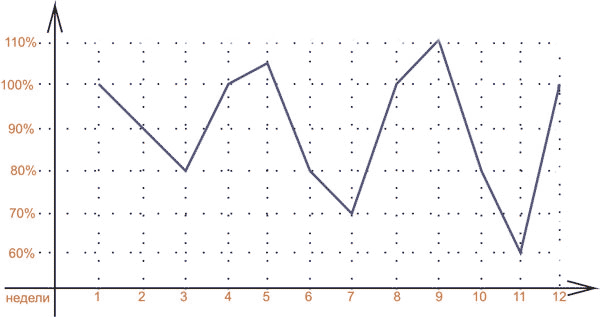
This example assumes that you perform the same exercise once a week. As you can see, after working to the max, there are about 3 weeks of reduced load. Moreover, the higher you “climb,” the lower you need to “descend” (relative to the height). I want to emphasize that this is a rough template designed merely to illustrate this method. However, I believe the principle is clear. Each individual can build their own schemes based on it. It is also important to change not only the weight of the equipment but also the number of repetitions. Choose a maximum and minimum number of working repetitions and vary within these limits. If the goal is strength, then (typically) it's 1 to 6 reps. If it's mass – 6 to 12 reps. If it's reducing subcutaneous fat – 12 to 25 reps. Do you understand what I mean? In other words, you need to change the weights of the equipment in two dimensions simultaneously: alter both the number of repetitions and the percentage of your maximum capabilities. Let me give you an example from my experience. In one workout, I did deadlifts with 240 kg for 2 repetitions (100%). A week later, I set 200 kg. And although I could lift it for about 8 reps, I only lifted 6 (75%). Another week later, I set 220 kg and did only 2 reps but could have done 4 (50%). A week later, I set 260 kg for 1 rep (100%). I hope this article has been useful to you. If so, please share it with your friends and subscribe for new articles. Good luck! SIMILAR ARTICLES
COMMENTS |