|
» »
8 main factors that determine muscle strength
Author: Timko Ilya - master of the whole project and fitness trainer. All articles by the author ➤
I believe that most of you have noticed that muscle volume is not the only factor that determines strength. For example, it often happens that a slightly muscular guy can lift heavier weights than some huge bodybuilder. I’m sure many of you have seen such a picture in gyms. From this, we can conclude that many factors affect muscle strength. But what are these factors, and can they be influenced? You'll find out everything right now. 1. Muscle VolumeThis one is straightforward. The larger the organ, and the more hypertrophied it is (with cirrhosis of the liver being the exception)), the better it performs its function. Muscles have two types of hypertrophy:
To be precise, the increase in muscle volume refers to sarcoplasmic hypertrophy. That is, muscles increase due to a greater amount of sarcoplasm. In pure sarcoplasmic hypertrophy, muscle strength does not significantly increase. However, pure forms of such hypertrophy do not exist (just like myofibrillar hypertrophy). Thus, during sarcoplasmic hypertrophy, some degree of myofibrillar hypertrophy is also observed. And that is what increases muscle strength. So, we can say that muscle strength correlates to some extent with muscle volume. Therefore, if you train exclusively for volume and not for strength, strength will still increase along with volume. 2. Muscle Innervation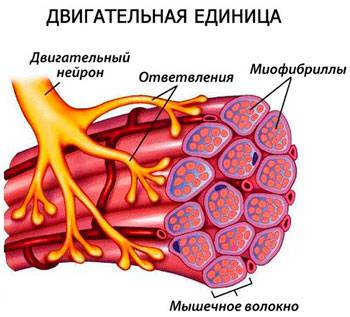
This refers to how many motor neurons are connected to a given muscle. Everyone knows that muscles contract in response to signals from the brain. These signals travel through motor nerves (motor neurons) to the muscle fibers, causing them to contract. The more motor neurons that connect to a muscle, the more motor units can be activated. For instance, beginners recruit only 70% to 80% of muscle fibers, while seasoned athletes may approach 100%. Can you influence innervation somehow? Yes, you can. Just keep training. Over time, with the impact of loads, innervation of the muscles will improve. This means motor neurons will form a denser network around your muscles. 3. Tendon ThicknessThis is a very important factor. The organism, when faced with weak links during the growth of certain parameters, halts the growth of those parameters. In our case, this means that muscle strength cannot exceed what the tendon can withstand. If enough force can be applied through some psychotropic substances, it could lead to a tendon tearing from the bone. Thus, the organism unconsciously limits the growth of muscle strength when that strength approaches the durability of the tendons. Can this factor be influenced? Partially. Much of tendon thickness is genetically predetermined and established during childhood. When you are already an adult, you can strengthen tendons through training, but only to a limited extent. 4. Ratio of Fast and Slow Fibers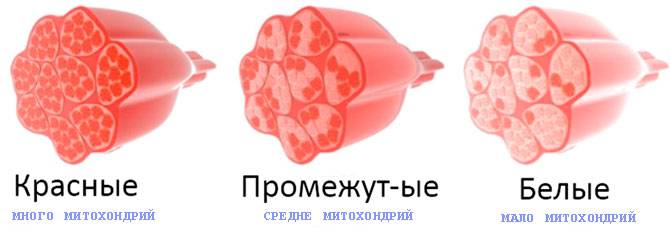
Many people know that we have so-called fast (white) and slow (red) muscle fibers. This should not be taken literally, as the differences between them are quite conditional. It’s just that the red fibers, due to having more mitochondria and better blood supply, are more suited for endurance work rather than strength. Fast fibers (white), on the other hand, are better suited for explosive, short bursts of work. The ratio of these fibers varies among different muscle groups. Thus, some muscles (e.g., the calf muscles) are renowned for their endurance, while others (like the chest) are known for their strength. Additionally, with age, the number of fast fibers decreases while slow fibers increase. This is simply a transformation of one type of fiber into another. Can this factor be influenced? No, it cannot. The ratio of specific fibers is genetically predetermined. This is why some people are naturally better suited for strength sports, while others are better suited for aerobic activities. You can specifically train one type of fiber through targeted workouts, but it remains only somewhat conditional. 5. Muscle Elasticity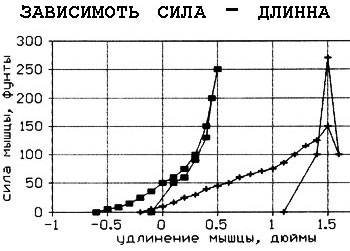
Everyone knows that muscles work by contracting and stretching. The greater the difference between stretching and contraction, the more force the muscles can generate. This follows the principle of a rubber band: the more you stretch it, the stronger it will snap back. It’s logical to assume that the greater the elasticity of the muscles, the more they can stretch, which means they can contract more forcefully. This moves from the realm of physiology into biomechanics. The image shows two graphs. The left graph represents the calf muscle, and the right represents its tendon. As you can see, with greater stretching, the muscle demonstrates greater force. Can this factor be influenced? Yes, you can. Regularly stretch and use stretching exercises. 6. Tendon Insertion Point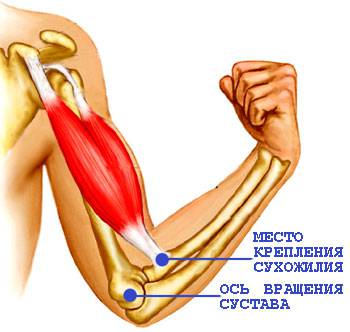
It’s easiest to explain this using the example of the biceps. As seen in the illustration, from the biceps’ attachment to the elbow joint, there’s a specific distance. Now, recall your school physics and the law of the lever. The closer the point of application (the muscle attachment) is to the axis of rotation (the joint), the more force will need to be applied to perform any action. This means that if we detach the tendon from the bone and sew it back just a couple of millimeters further from the elbow joint, the strength of the biceps will significantly increase. As you can understand, this lever law applies to all muscles, as all our muscles operate according to this principle. Can this be influenced? No, it cannot. People are born with different muscle attachment points. These differences are minor and typically do not exceed 1-2 millimeters. However, they can be significant in terms of strength, as even fractions of a millimeter can make a difference. 7. Number of Muscle FibersWithin the same muscle volume, there can be a different number of muscle fibers. The number of these fibers is established while still in the womb and does not change throughout life (there are studies suggesting that under the influence of growth hormone, fibers can divide, but we are not discussing pharmacology in this article). Yes, it is roughly the same for everyone. But that “roughly” matters. Those born with a greater number of fibers can display greater strength under equal conditions, as a higher number of fibers automatically leads to better innervation and more contractile elements. 8. Psycho-emotional ExcitementI think this one is clear. Let’s take a person and ask them to lift the maximum weight they can. Then we take the same person, put a gun to their temple, and say that if they don’t lift 10 kg more than they just did, we will shoot them. And, lo and behold! Their strength increases! )) This is quite simple. Muscles contract with a force directly proportional to the strength of the signal from the brain that comes to them via motor neurons. The stronger the signal, the stronger the contraction. The more excited you are, the stronger the signal the brain can send. This is why athletes (especially lifters) slap themselves and shout before stepping onto the platform. Personally, I did the same in the early days of my sports career. But then I realized that the ultimate mastery is to step onto the platform completely calm and still achieve maximum results. I suppose this comes with years of experience. ConclusionsLet’s take two guys whose body compositions look roughly the same. But the first guy has more muscle fibers, a higher percentage of fast-twitch fibers, a more favorable tendon attachment point, better innervation, thicker tendons, and greater muscle elasticity. Visually, you wouldn’t notice these differences, but in terms of strength, this first guy would likely outperform the second by not just 10-20%, but by 100-200%! Of course, I’ve taken extreme cases, but all these factors combined greatly influence muscle strength. Moreover, there are 3 out of 8 factors that you cannot influence at all, and for one, you can only have minimal influence. What’s the point of all this? Not everyone is genetically predisposed to outstanding strength attributes. I, for one, fall into that category. Yes, I managed to achieve decent strength levels that many only dream of, but it came at the cost of torn menisci, hernias, and arthrosis. I hope now you understand why two seemingly identical people with the same training experience can demonstrate entirely different strength levels. Therefore, remember that all people are different and were born with varying physical capabilities. One person may be better suited for weightlifting, another for marathon running, and a third for chess. Good luck! SIMILAR ARTICLES
COMMENTS |