|
» »
Is endurance an innate factor or a result of training?
Author: Knysh Vladlen - fitness trainer. All articles by the author ➤
Fatigue during prolonged physical exertion is something we often associate with being untrained. Is that really the case? Let's find out. The muscle fascia (muscle) consists of muscle bundles formed by myofibrils. Myofibrils can be compared to the strands in a high-voltage cable—the larger the cross-section and the greater the number of strands, the greater the load it can carry (though there are other criteria that impact conductivity). The same happens with muscles. An increase in the number of contractile fibers contributes to the growth of muscle mass, volume, and strength indicators. The world is designed such that any production volume is directly related to the prior availability of fuel, in one form or another, to the producing structures. A car engine runs on fuel; your laptop operates on previously stored electrical energy through an electrochemical reaction; and so on. Our body is no less interesting a machine, where specific biochemical processes take place. 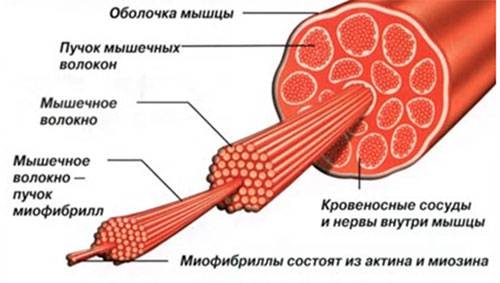
Why Does a Beginner Get Tired So Quickly in the Gym?Mitochondria. It is precisely the lack of these organelles that leads us to fatigue so quickly. Mitochondria are the energy stations of cells. They facilitate the biochemical processes that provide the necessary fuel for production. In our case, this refers to muscle function, specifically its endurance. 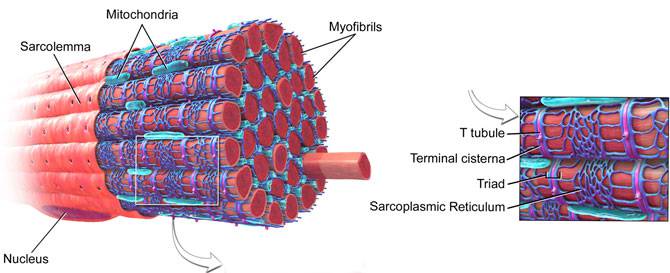
Mitochondria surround myofibrils, and the denser they envelop each muscle filament, the more enduring the muscle becomes overall, allowing you to sustain the required physical load longer. Ultimately, it all comes down to energy production factors, namely, its intake in the form of fats, glucose, etc., for further transformation into energy. The Most Important Thing - TrainingMitochondria cannot surround myofibrils in two layers due to the limited space inside the fiber. The quantity of their formation is physiologically limited. You can achieve a peak after a month of daily training, significantly improving your personal endurance metrics. But there is one CATCH—muscle fibers are divided into several types, each having its training specifics aimed at development. Types of Muscle Fibers (MF):
An in-depth analysis of each type of fiber deserves a separate article, and to avoid confusion, we won't cover them here. However, you should be aware of the differences between muscle fiber types and consider this division for correctly structuring your training process. Muscles perform many variants of movement, which explains the division based on functional and structural differences. How to Develop Endurance?In general, to develop mitochondria (your endurance), you need to perform a large number of sets (from 10) with a time under load of 20-30 seconds, with the main goal being to avoid global muscle acidification (that familiar burning sensation we know and dislike). Under strong hypoxia, muscle fibers die. So, if we wish to develop endurance, our training should occur within the so-called "aerobic threshold." To put it simply—once you feel the burn, do another 2 or 3 repetitions at most and stop the exercise. You may have to reduce your working weight. However, our goal is not to lift submaximal kg but to develop endurance. By the way, this type of training will positively affect your muscle volume growth, but only if you're training naturally. Revealing the SecretsHere, we arrive at the revelation of the most important secret, which turns out to be quite obvious—through this type of training, for a certain period, we kill two birds with one stone: we develop aerobic endurance and grow simultaneously. But that's not even the most important part; what's crucial is that we continue to create factors for the growth of new myofibrils. What does this mean? Correct! —new mitochondria will be formed, enveloping the newly formed muscle structures. And this will lead us to further development of endurance. Theoretically, this is an endless process. Practically, its maximum will be reached once the growth of myofibrils stops. AttentionIf you stop training and return to the gym after some time, don't be surprised by the decrease in endurance. Without training, mitochondria age and are destroyed by the body. The decay period lasts from 10 days to 3 weeks. Contact information for Vladlen (the author of the article): Facebook, VK, Instagram. SIMILAR ARTICLES
COMMENTS |