|
» »
Phases of recovery after workouts
Author: Timko Ilya - master of the whole project and fitness trainer. All articles by the author ➤
Anyone who participates in sports (not necessarily strength training) often wonders: "How often should I train to achieve maximum effect?" This question is frequently posed to me. Many believe that the more frequently they train, the better. However, practice shows that the optimal number of workouts for non-professional athletes is three times a week. Where did this number come from? Why is once a week too little, while every day is too much? Let me explain. First, remember the following: 1. Muscles grow when you rest. This applies not only to muscles but also to any physical qualities you are training, whether it be strength, endurance, or another quality. 2. Muscle growth only begins after the body has fully recovered from the latest physical exertion. These are the laws of physiology, and no one can change them. It is easy to exhaust all muscles to failure during a workout. But the real art of training lies in how quickly and effectively you can help your body recover. Now, let’s visualize this more clearly. In the first graph, you see the recovery curve after a physical exertion. 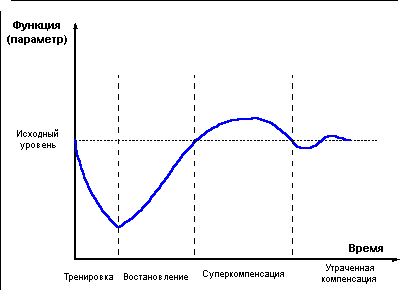
During training, your performance and muscle strength decrease as fatigue increases. This is understandable. Then the workout ends, and your body begins to recover to its baseline level. How long this will take is something no one can determine. It can take anywhere from one day to 10 days or more. From my own experience, I can say that after very intense workouts, some muscle groups may take up to two weeks to recover. After your body has fully recovered, the so-called supercompensation phase begins. This is when the body, after another stress, starts to increase its physical qualities beyond the normal level. This phase lasts from 1 to 4 days. If the next workout does not occur after this phase, the supercompensation gradually declines back to baseline levels. Thus, the art of recovery boils down to two tasks:
How will you feel this? You have to rely on your subjective feelings. During the supercompensation phase, you feel a surge of energy, eager to hit the gym for new records, and all that follows. The next graph clearly illustrates what happens if you train too often or too rarely. 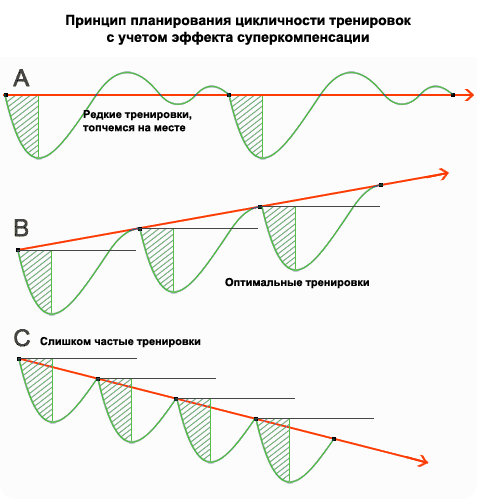
With frequent training (C), the body does not have enough time to recover fully. Each successive workout occurs against the backdrop of decreased functional capacity, leading to overtraining. With infrequent workouts (A), the supercompensation phase passes, and you find yourself treading water, starting each workout essentially from scratch. You might feel disappointed—since everything I’ve said above is mere theory, and I still haven't answered the question of how long you should rest between workouts. I’m afraid no one can give you a concrete answer. Too many factors influence this (sleep, diet, health condition, lifestyle rhythm, weather, intensity of the latest workout, work, etc.). All of these will drain your energy. In global practice, the standard is set at three times a week. If you feel you don’t have enough time to recover, switch to twice a week. Conversely, if you feel capable, increase the physical load during workouts. SIMILAR ARTICLES
COMMENTS |