|
» »
Creating a training plan. Part 1: Setting goals
Author: Novikova Diana - triathlon coach. All articles by the author ➤
Creating a training plan is something that drives athletes crazy as they plan their results and competitions. At the first stage, no one thinks about it. The initial goal is simply to start training, and if that happens, it already brings pride and a noticeable increase in results (as well as photos for social media). This cycle of articles will be dedicated to proper planning of preparation for both beginner and experienced athletes, depending on the duration of training and types of sports. The material is taken from primary sources: the scientific work of L.P. Matveev "Theory and Methodology of Physical Culture," several scientific articles, as well as sporting and coaching experience. Before creating a plan, we first set goals. Many know about the wheel of balance, where we designate areas of life, set satisfaction levels in each area, and think about how to make things better. The numbers in each wheel represent the level of satisfaction. Accordingly, the bright piece of each segment represents the degree of fullness in accordance with the level of satisfaction. 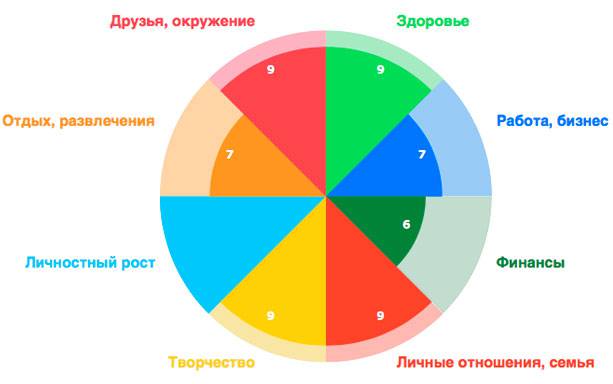
And here, almost everyone includes sports. If you're reading this article, it will definitely appear in your wheel somewhere.
In general, it's all positive. As you can see, sports influence all your life segments. Let's move on to goals in sports. We'll highlight sports goals at three levels, depending on their scale. Long-term GoalFirst of all, let's set a long-term goal – on the scale of life. If you realize this, the premise for injuries disappears, which sounds something like “Complete an Ironman in 3 months.” You may even complete it, but in the context of a long, healthy, and active life, it would be a step backward. Life does not end in summer, which requires urgent weight loss, or at competitions, which require a larger volume and stronger intervals. As much as we want to be optimistic, reaching peak athletic form takes time: 8 years in running, 12 in tennis, and this timeline cannot be rushed. A life goal sounds, for example, like “Waking up refreshed until deep old age, being active, healthy, and trying new sports.” In this format, it’s clear that for this goal, you need both to lift weights and to maintain a regimen, adjust your nutrition, and toughen up. As we age, bone circulation decreases, and to stop deterioration, a more active lifestyle and longer training sessions (though with lighter weights and intensity) are needed. If you are lazy to go to the gym now, why would you go when you're 60? Habits are formed over the years. Mid-term GoalAt this stage, it’s important to identify the main direction of physical activity and additional ones. Examples of the benefits of incorporating other sports: 1. Functional training develops the heart and musculoskeletal system, so it is recommended for athletes of all disciplines as a supplement. 2. Learning a fundamentally new activity develops learnability, makes thinking more flexible, and studies show that understanding the nuances of the main sport is easier after switching. 3. Stretching increases muscle strength, joint mobility, and circulation. 4. Swimming helps to recover faster. 5. Pilates strengthens the muscle corset, which helps prevent injuries and eliminates unnecessary movements when working on speed or accuracy. 6. For those who find Pilates boring, climbing is a suitable alternative – it also strengthens the core, stabilizing muscles, and teaches focus. 7. A trampoline is beneficial. Jumping reduces muscle soreness and teaches you to feel and control your body better. I hope you are convinced that strengthening muscles, stretching, and variety are important for any sport? The other extreme is attempts to excel in two or more fundamentally different sports. I myself tried to prepare for a long triathlon while attending acrobatics classes. As a result, progress was snail-paced in both directions. There are many such examples, and this is always a path to overtraining, decreased concentration, and low results. Conclusion: It’s important to focus on the main sport + add supplements to improve results in that sport. Having determined the main direction of movement, we identify our strengths. If it's triathlon, in which distances are we stronger, in long or short? We will focus on our winning qualities. This can be played out successfully, for example, cyclist Lance Armstrong lost almost all of his muscle mass after an illness. After returning to training, he shifted to lighter gears and pedaled faster, which, considering the weight loss, became an advantage. A series of tests helps determine predisposition to sports and distances. Finding out at 30 that you're a great tennis player is pretty useless and even sad. However, such information as the ratio of fast and slow muscle fibers, which affects speed and endurance, can save hours of preparation for inappropriate distances. And the final step at this stage is to choose competitions for the year. One or two most important ones where we will aim to show maximum results and prepare specifically. There can also be additional ones, which can be many, and we can perform well, but we will not specifically reduce the load, taper off, or prepare. Right now, it’s important to outline these goals for ourselves; I will tell you what to do with them later. If you do not plan to compete, the goal can simply be about weight/definition/running duration; these are excellent goals. It is also useful to apply the methodology of preparation, but adjust it to fit yourself. Short-term GoalThis is a goal for a month. This format is convenient for all types of sports. In cyclical disciplines, a 4-week plan has already become classic. In strength sports, a 1-2 month format is also a common way to alternate mass-cutting and change plans. With this type of planning, the supercompensation effect is taken into account. Examples of monthly goals:
Here, it’s important to know your point A and point B and at the end of the month compare them by measuring results. Often the reason for a drop in motivation is that an athlete without a coach does not measure results and feels like they're not making progress. As you may have guessed, the monthly goal does not contradict the mid-term, and the mid-term goals do not contradict life goals. Aside from facts and figures, we have emotional motivation. Why do all this? There are common reasons for everyone – to have a beautiful body, good posture, and feel energetic. But there are also personal goals. People achieve incredible results in sports in the battle against illness or in memory of loved ones. For ordinary mortals, it often looks less romantic: signing up for a marathon out of emotions, promising a girlfriend, or making a bet with a friend. And that’s great, such actions make our lives bright. It is very important not to try to prove anything to anyone. Victory is valuable personally for the winner, not for society. Ask yourself – would I do this knowing that no one would ever find out about my achievements? If the answer is no, that’s not bad, but it’s a reason to dig into yourself; there may be a lack of parental love, resentment towards an ex-boyfriend, or a lack of attention. Perhaps after a couple of talks with a psychologist, the goal will change. Or maybe it will acquire new meanings and become more conscious and truly desirable. In any case, you can’t run solely on emotions, so after the goal appears, it's important to create the right plan for achieving it and follow it. This will be covered in the next articles. SIMILAR ARTICLES
COMMENTS |