|
» »
Pelvic tilt during barbell squats: what causes it and how to fix it
Author: Mikhail Ziborov - author of the site makefitness.pro. All articles by the author ➤
The example described below is a common problem-mistake made by beginners. Our goal is to ensure that you don’t make the same mistakes we did in our time. So, just visit our Telegram public group, where we address similar nuances and show solutions to problems. Don’t step on our rakes! Why is Pelvic Tipping Dangerous?Pelvic tipping (also known as hip tilt, butt tuck, pelvic tuck, etc.) is one of the problems encountered during squats. Interestingly, it can occur even during bodyweight squats: while lowering the pelvis and thighs to parallel with the floor, the lower back rounds, and the glute muscles seem to "tip" or "nod." It’s difficult to explain in words; it's better to see it once: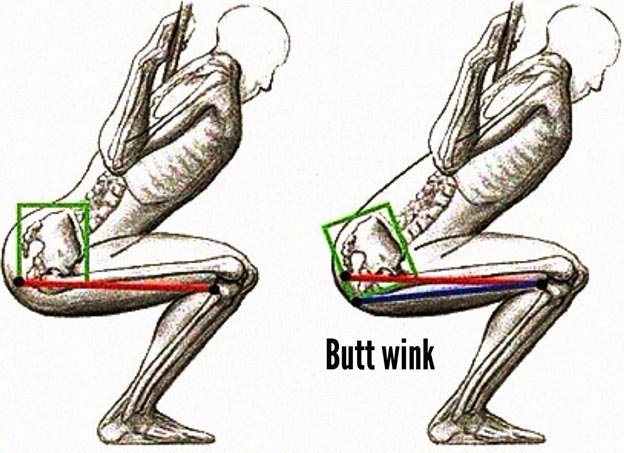
Pelvic tipping causes two immediate problems: 1. This phenomenon prevents deep squats, making it harder for men to achieve greater results in barbell squats, and for women to develop their glutes (during deep squats, the glute muscles stretch more, leading to better and faster growth). This issue is even more relevant for women than for men, as if a man doesn’t plan to compete, he can afford to squat a bit less deeply. However, women who wish to enlarge their glutes won’t be able to do so adequately (their legs will grow, but not their buttocks). Look, in order for the glutes to grow, you need to squat deeply to stretch them. If you don’t squat deeply because of pelvic tipping = the glute muscles don't receive the load they need and therefore do not grow. Meanwhile, the legs, on the other hand, receive ample work and grow. Clearly, you can work on your glutes or increase the working weight in barbell squats through other exercises. For example, the glutes grow without stretching (in glute bridges, for instance), but they get the best growth results from a combined effect – stretching and contraction. The working weight on the bar can also be increased through shallow squats (to parallel with the thighs) or in leg presses. But still, if you want to squat a lot and correctly, it’s better to correct this phenomenon. 2. You may experience problems with your spine. The rounding of the back during pelvic tipping positions the spine (in the lumbar region) in an unstable position, leading to an unjustifiably large load on the intervertebral discs. The heavier the weight on the barbell, the greater the load on this area of the back. Multiply all of this by frequent squats with a barbell on the shoulders (generally 1-2 times a week), and you risk injuring your lower back. I think no one wants such a "gift." This video clearly shows how spinal injuries occur. Although different exercises are presented, the injurious movements are similar: What Causes Pelvic Tipping in SquatsThe problem lies in the muscles of the posterior thigh. Specifically, it is due to their insufficient stretching. During squats, the muscles of the back of the legs (more specifically, the hamstrings) are stretched. They stretch up to the point where the pelvic tipping occurs. When the tipping happens, the hamstrings can no longer stretch further; otherwise, they risk tearing and sustaining a serious injury. To avoid this injury, the body self-regulates movements during the squat: the lower back rounds, and the pelvis tucks under. It is precisely due to the inability of the muscles to stretch that pelvic tipping occurs! How to Eliminate Pelvic Tipping in SquatsThis problem can be resolved by stretching the muscles of the posterior thigh (in reality, it is the tendon part that is stretched). It is also advisable to work on stretching the hip joints if you find it difficult to squat deeply for this reason as well. I want to caution you. You should not try to stretch the necessary muscles through squatting alone. It's not a good idea to think that if I squat deeply, the muscles will stretch sooner or later, and the tipping will disappear. In the time you spend trying to stretch through squatting, you can seriously injure your back. Or you may not be able to eliminate the problem at all; the tipping will still occur during a deep squat. Therefore, always stretch after (definitely after!) strength training. Stretch every time you work out, even if leg exercises weren’t included in that workout. It’s clear that you shouldn't stretch cold legs: finish, for example, your back and biceps workout, do some squats, lunges, conduct joint warm-ups for the legs, and only afterward proceed to do stretching. By the way, another common problem with squats is knees moving past the toes. The link provides answers regarding the what, how, if it can be done, and the nuances. Training programs for girls, guys (and other genders) can be found here. Animated techniques for each exercise (no need to read and visualize; everything is illustrated) can be found on our website makefitness.pro. Additional information for those looking to lose weight/gain mass (for example, which foods are better to add and which to exclude) is also available on our site. SIMILAR ARTICLES
COMMENTS |