|
» »
What are stimulating repetitions, why are they needed, and how should they be used?
Author: Mikhail Ziborov - author of the site makefitness.pro. All articles by the author ➤
Stimulating repetitions are repetitions in a strength exercise (within a set) that lead to increases in strength, endurance, and muscle mass. In other words, they stimulate the body to develop. But not all repetitions are stimulating. Here’s an example to make it easier to understand. You take a barbell with a weight that you can lift for 15 reps. Out of those 15 repetitions, you perform, say, 5. Tell me, will those first 5 repetitions lead to improvements in physical qualities and muscle growth? No, they will not. Because the muscles lifted the weight спокойно, did not strain, did not receive stress, and therefore have no reason to get stronger and grow: no stimulus for development occurred. In other words, the first 5 repetitions were not stimulating. 
It’s a different story with the last 5–6 repetitions at the end of the set. Those repetitions will be stimulating. That is why those who do not complete a set all the way to the end (to failure or near failure) deprive themselves of the factor that leads to muscle growth and strength gains. And those who do not follow us on Max or Telegram deprive themselves of similar daily information about everything related to training. And it’s free information, too. But another question arises. What if you work with a weight that you can lift only 5 times? Which of those repetitions will be stimulating? This is where it gets more interesting. The involvement of muscle fibers in the work and what stimulating repetitions have to do with itLet’s say you are working with a barbell that you can lift 15 times (the example above). This is a medium weight, roughly speaking. At the beginning of the set, only part of the muscle fibers in the muscles lifting the barbell are involved in the work. As these muscle fibers become fatigued, new fibers that were not previously involved begin to engage (so that you can continue lifting the barbell). And closer to the end of the set, all or almost all muscle fibers are involved in the work. After all the fibers become fatigued, failure occurs: you can no longer lift the barbell on your own. And it is precisely the last repetitions in the set that lead to the fatigue of ALL muscle fibers. And it is exactly because of this fatigue (the stress received) that the muscles trigger adaptation mechanisms. Simply put, strength, endurance, and muscle tissue increase. And it is the last repetitions, that is, the stimulating ones, that are important for your progress! That is why it is so important to reach failure or a near-failure state (1–3 reps in reserve). Because incomplete sets lead to the fact that: you either do not get enough growth stimulus (the muscles grow only halfway instead of to the maximum); or you do not get a stimulus at all. For inexperienced gym-goers, it looks like this: the trainer on duty said to do 3 sets of 8 reps, so I did. And it does not matter that I could have performed all 12 repetitions in each set. In short, I did not finish the work, but I hope to get jacked in 2 months before summer. So what happens if you work with a heavy barbell that you can lift only 5–6 times? A much larger number of fibers will start to engage right from the first repetition. For simplicity, let’s say it is 80% of the fibers. And as you perform the exercise, more and more of them will be engaged. By the end of the set, 100% of the motor units will be involved. That is, when working with a heavy weight, stimulating repetitions are ALL repetitions in the set (all 5–6 repetitions). And now, here is a visual representation of how muscle fibers are recruited as the set progresses: 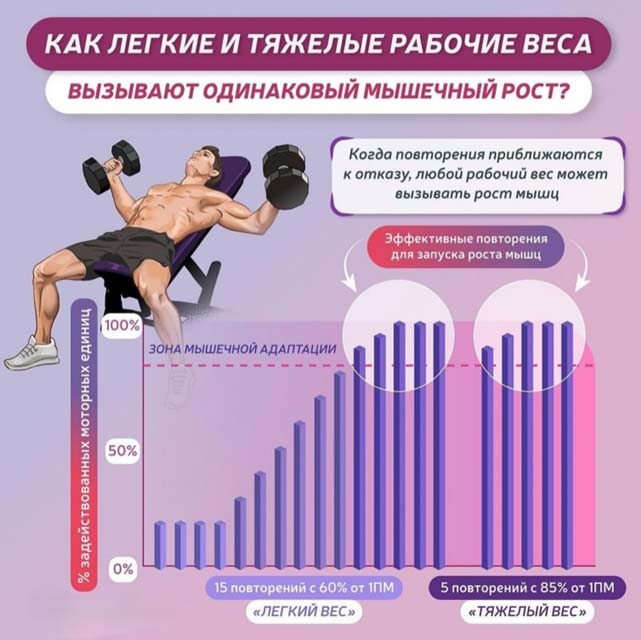
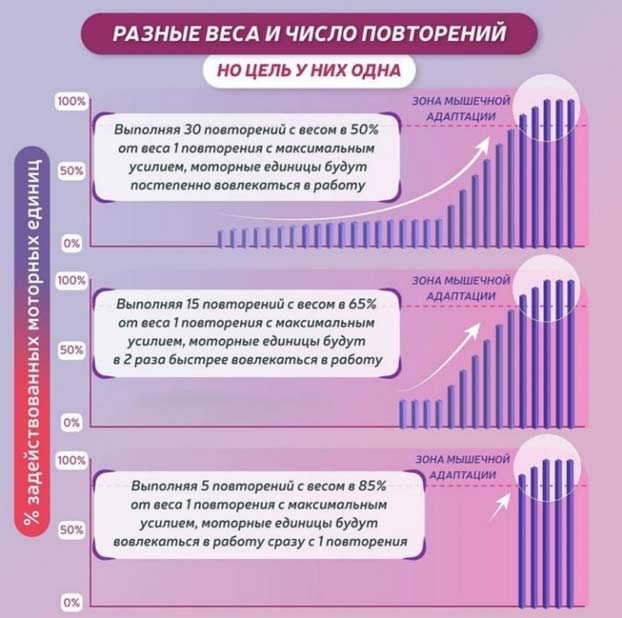
Which repetitions are stimulating?Roughly speaking, stimulating repetitions are the last 5 repetitions before failure occurs. If you can lift the weight for 15+ repetitions (this is a light or medium resistance), the last 5 repetitions will be stimulating. If you can lift the weight for 10 repetitions (a medium resistance or slightly harder), repetitions 6 through 10 will be stimulating. If you can lift it only 5 times (this is a heavy weight), all 5 repetitions will be stimulating, since they engage almost all muscle fibers right from the very first repetition. And if you are working for 1–3 repetitions with a very heavy weight, then all 1–3 repetitions will also be stimulating. And, of course, our training programs and meal plans take into account not only the principle of stimulating repetitions but also a whole bunch of other training nuances. Proper muscle gain requires specific actions from the athlete: appropriate loads, the right number of calories, and the correct ratio of nutrients. We offer all of this.
SIMILAR ARTICLES
COMMENTS |