|
» »
What happens if you train and don't get enough protein
Author: Mikhail Ziborov - author of the site makefitness.pro. 2023-01-05 All articles by the author ➤
You knew that it's not necessary to consume protein throughout the day for muscle growth, and you can actually eat your daily requirement all at once? The body, for the most part, doesn't care when you eat this protein. The main thing is to get the necessary volume within a day (before sleep). Of course, it would be better to eat throughout the day, but it's not a strict requirement. You will find even more facts, techniques, and nuances for building muscle mass in our Telegram channel yourfit. We update our content daily. 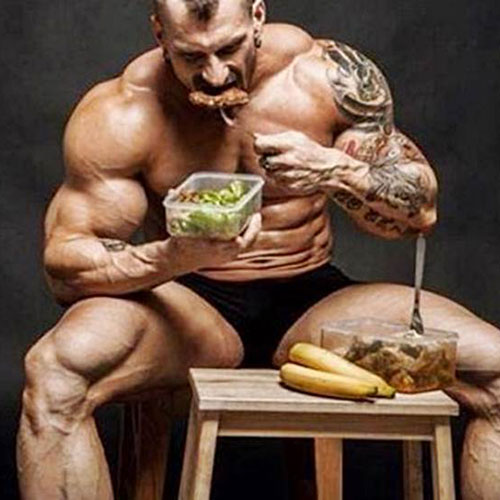
Do Muscles Grow Without Protein?A protein molecule is a large molecule that cannot be absorbed in this form. The body breaks down proteins into their constituent parts – amino acids. Amino acids undergo a check (transamination), and then the body creates its own protein structures from these building materials. Simplifying it, the body operates on the following principle: - First, amino acids are used to renew vital organs; - Then they are used for organs that do not play a critical role in survival; - Only if there’s anything left, are amino acids spent on recovery and growth of muscle tissue. This is precisely why athletes strive to consume protein in higher volumes: to ensure there’s enough for internal organs, muscles, and even a little extra just in case. I also want to mention that the body has a small reserve of amino acids. It constantly circulates in the blood. If any organ suddenly needs “amino acids,” they are readily available. By the way, recovery doesn’t begin at night, as many think, but immediately after training. Sleep merely accelerates this process significantly. Therefore, the reserve of amino acids in the blood starts to gradually deplete during the day. Now, imagine that you eat enough, you are well-fed, and you have no issues with nutrition. But with protein, there’s a critical shortfall: you’re not getting enough, yet you are training in pursuit of muscle mass. Ask yourself: will your body be able to build muscle if it lacks the materials to do so? And the materials that do come in are used up by the internal organs, which are far more crucial for the survival of the body. This means that without a sufficient amount of protein, you cannot build muscle mass! No way. Some might argue, "Look at some vegan athletes who have incredible musculature but don't eat meat, dairy, etc." Guys, those athletes are simply obtaining amino acids from plant-based protein sources – legumes, soy, etc. They are essentially consuming protein, just not from animal sources, but from plant sources. What Protein Do You Need for Muscle GrowthIt’s clear that it is much easier and, most importantly, cheaper to obtain the necessary amino acids from sources like cottage cheese, fish, eggs, meat, cheese, and milk rather than from plant sources. This is explained by the fact that plant proteins may lack certain essential amino acids. For example, if you choose to eat peas instead of meat and eggs, while peas or beans also contain a lot of protein, they do not provide specific amino acids in quantities sufficient compared to meat or dairy products. If even just one amino acid is missing during the construction of muscle protein in the body, the muscle structures will not be formed. Yes, you can combine different sources of plant proteins together. For instance, protein-rich cereals, nuts, legumes, and seeds all together provide the necessary quantity and volume of amino acids. In that case, you will be able to grow and gain muscle mass. I discussed this in more detail in the article "Can You Progress on Plant Protein." But! First, you need to know which specific plant product is lacking which component, so you can compensate for it with another product. In simpler terms, you must combine different types of plant proteins. This is the principle behind how plant protein powders are made, typically based on 2-3 plant sources (rice, sunflower protein, hemp protein, pea protein, etc.). In short, combining plant proteins is a bit more "troublesome" than just eating cottage cheese or a steak, although it is quite feasible. Therefore, for muscles, animal-derived protein is needed (and it's simpler and cheaper when you calculate the costs). How Much Protein Is Needed for Muscle GrowthScientists today agree that for those who train, an average of 1.8g of protein per kilogram of body weight is needed per day. But let’s be honest: are you going to calculate how much and what kind of protein you consume? Very few people do that. Therefore, it's better to use a ready-made meal plan, where it has already been calculated what and how much you need to eat to gain muscle mass specifically for you. If you find it difficult to extract the necessary amount of protein from your diet for muscle mass gain, I recommend using the well-known protein powder – a protein supplement made from a by-product of cheese, i.e., whey (typically). It’s simple to prepare and consume: just put it in a shaker, add milk, mix, and drink. ConclusionIn response to the question, "What will happen if you train and eat but do not get enough protein?" I can say that you will simply progress very slowly. Muscle mass will not grow as it could with proper nutrition. Strength and endurance will also suffer. Therefore, do not expect to see any results from training if you have a protein deficiency in your diet. SIMILAR ARTICLES
COMMENTS |