|
»
Real weight loss story from Dmitry (120 - 90 kg)
Author: Dmitry Tolkachev. 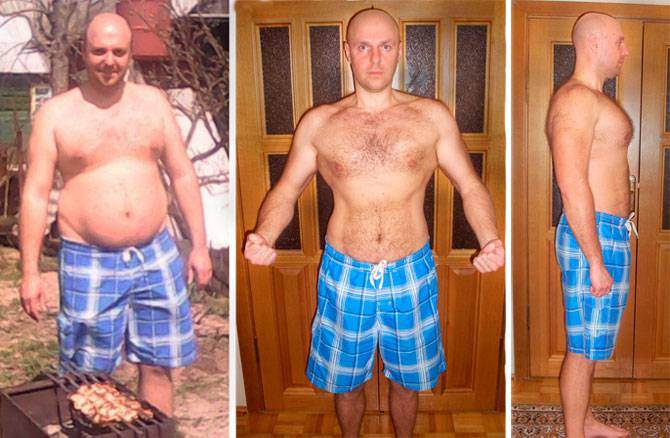
1. A Bit of LyricDmitry Tolkachev, 36 years old, height 190 cm. Belarus, Gomel. As far back as I can remember, I was always not a skinny boy. I can't say I was fat, but I had some extra weight (my parents overfed me). At that time, children started school at the age of 6. In 1986, I went to the first grade. As the doctors later explained to me, it was precisely because of my early age that I developed scoliosis (spinal curvature) at school. A problem for all modern schoolchildren. In childhood, I attended various sports sections: sambo, judo, hand-to-hand combat, basketball, swimming pool. I also went to the gym. I didn’t achieve any ranks or titles. I practiced, as my parents told me then, for myself. I was an ordinary child, like many others. 2. Back PainI graduated from a technical school, university, got married, started a family, and had children. Just like everyone else. I lived an ordinary life, like everyone: home - work, work - home. I didn't worry until my back started to hurt. Once it hurt, twice it hurt, it passed and was fine. By the time the back pain appeared, I weighed 110 kg. I should mention that the back pain was seasonal, like heating in the apartment. When the heating was turned on - my back hurt, when the heating was turned off, i.e., when it got warm outside - the back pain went away. This lasted for several years. In the winter of 2012, my back was twisted so much that I couldn't walk. Then came the hospital, drips, injections, and all the pleasures. Lumbar osteochondrosis (sciatica). Treated it - it passed. A month later, the same thing happened again. I started to understand how osteochondrosis is treated, the causes of exacerbation, in short, what to do about it. The causes of the disease are the wear of intervertebral discs (in short, the cartilage in the back wore out). My childhood spinal curvature made itself known. They cannot be restored, i.e., “only the grave can fix the hunchback.” But I needed to live somehow. The physics I studied in technical school came in handy. So, to reduce pressure on the vertebrae, one must reduce body mass and firmly stabilize the position of the spine. In other words - lose weight, or as they say now - dry out and strengthen the muscles of the lower back and abdomen (core muscles, as I later learned it’s called). I learned a lot when I faced this problem. 3. GymSo I went to the gym, where else would I go? Not having any training plan, or nutrition plan, knowing nothing, I went to lift weights. At that time, I weighed 120 kg and it was certainly not muscle. After a year of training, I reduced my weight to 115 kg and got stronger. I became stronger. But this did not yield the expected results. I started to delve into the intricacies of bodybuilding with the help of the internet. Once I found the site “Your Trainer,” and my third eye opened, I gained insight. And then things took off. I'll say right away, I didn't use sports supplements, and I never even thought about using chemicals. As they say - everything was natural. I started training at home. From the equipment:
I used the circuit training program. Although the program states to start with 4 circuits and not rest during the circuit, I didn't follow the recommendations. I trained every day, not every other day. I did not do 4-5 circuits, but 2-3. The training took about 40 minutes. I took breaks during the circuit when I was totally exhausted. I trained so that my heart rate was always high, that’s when the fat burns. I could move on to the next circuit without a break. In short, the main thing is the heart rate. In addition, I started walking to and from work. It’s about 3 km each way. I stopped using the elevator (I live on the 6th floor). I started going to the pool - I swam for 30-40 minutes. On pool days, I didn’t train. I bought a bicycle. I rode it to my summer house and back. The summer house is 30 km from home (not all at once, of course, gradually). When it was warm, I ran at the stadium and at the summer house for 30 minutes. The main indicator of correct training is a stream of sweat. 4. NutritionNutrition was all natural (no sports supplements, and I won't even mention pharmaceuticals). In short – more protein, less fat, slower carbohydrates, and earlier (before 16:00). My daily diet now: 1 breakfast 1. Porridge: 200 g of milk 1-2% fat, 4 tablespoons of flakes (I made a mix: 2 oat, 1 wheat, 1 barley), a teaspoon of honey. 2. Curd mass: cottage cheese with up to 2% fat - 200 g, kefir 150-200 g, a teaspoon of honey, a handful of cornflakes (dietary, sugar-free). You can cut dried fruits instead of honey or a banana instead of the flakes and honey. Instead of curd mass - 2 soft-boiled eggs. 3. Coffee with milk and a sugar substitute. Milk with up to 2% fat in the microwave for 1.5 minutes. 2 breakfast 1. Meat – the base (any dietary, fat-free, any cooking method except frying). I don’t know the exact weight, just a decent-sized piece. 2. Side dish – any porridge (buckwheat, brown rice, pearl barley, millet, or barley), pasta made from durum wheat. Take as much as you want. 3. Dessert - curd mass (I really love cottage cheese) (see the recipe above). 4. Coffee with milk (recipe above). Lunch is similar to the 2nd breakfast. Snack 1. Dessert - curd mass or pancake (2 whole eggs, 3 tablespoons of oatmeal, 100 g of cottage cheese, sugar substitute to taste. Mix and microwave for 3-5 minutes depending on the microwave power). 2. Coffee with milk. Then usually comes the workout. Dinner 1. Curd mass without carbohydrates already. 2 dinner 1. 2 soft-boiled eggs and kefir with fiber. Or steamed fish. Or cottage cheese with kefir. I have never counted calories. I have never tracked the ratio of proteins, fats, and carbohydrates, but I did not eat porridge and cereals in kilograms, so there were fewer carbohydrates than proteins. Everything was done by eye. What I ate a lot of was cottage cheese (I really love it). In the first breakfast, I added a tablespoon of flaxseed oil to the curd mass. The diet during drying is fundamentally not different. Less porridge. We replace them with a salad of fresh vegetables (cabbage, tomato, cucumber, a little olive oil, and you can add French mustard). So it’s better to dry out at the end of spring when vegetables are cheap, or when you have your own. 5. ResultBy training and eating this way, I achieved my goals – weight loss and strengthening my core muscles. Appearance is not a goal - it’s a pleasant bonus. I had no goal of building a beautiful body, and I still don’t. As a result, I lost weight from 120 to 90 kg (currently 94). I continue to train according to the program Homemade workouts for men for definition. I replace bench presses with push-ups and rows with pull-ups. I dedicate more time to the lower back (hyperextensions on the piano, ab roller, dumbbell front raises, dumbbell deadlifts - by the way, I bought collapsible dumbbells weighing 15 kg - highly recommend). That's how it is. My back doesn’t hurt, knock on wood. There’s plenty of testosterone (you know what I mean). And life is wonderful. Currently, I weigh 94 kg. I tried to gain mass and build muscle. I gained 4 kg. My shoulders rounded out, biceps became more pronounced, and my chest sticks out. But I didn't like it. At 94 kg, I don’t feel very comfortable. Mass gain and cutting are not for me. Although I can gain, cut, and maintain weight without problems. My normal weight, according to how I feel, is 90 kg. At this weight, I meet Soviet GTO standards for gold (for my weight). Those 4 kg personally bother me. When I think that to have an athletic physique you need to gain 20-25 kg and then cut down 15-20 to achieve lean mass, I start to feel uneasy. It’s not for me. To each their own. If you are an athlete and your goal is muscle growth for competition, then sure. But if you’re an average person like me, I see no point in having huge muscles. To me, it's the same as driving a truck around the city to and from work. Plus, large muscles come at a cost (sports supplements, pharmaceuticals, gym fees, etc.). I am satisfied with my muscles. Reasonable minimalism, I would say. I am waiting for summer when my cucumbers, tomatoes, and cabbage will grow, or at least when they become cheaper in stores, and the biking season begins. I’ll shed those extra 4 kg and be good. Note from Ilya Timko. If you have your own personal story of body transformation, then message me privately. I publish interesting stories on the website. SIMILAR ARTICLES
COMMENTS |