|
»
Bad morning habits that are making you worse
Author: Mikhail Ziborov - author of the site makefitness.pro. All articles by the author ➤
“We are what we eat.” I would add that we are also what we are accustomed to. And if you have many bad habits that start your morning, I recommend beginning to fix that. So, here’s a top list of bad morning habits that hinder you from being healthy and productive. The points are arranged according to the order after waking up. 1. Waking up at different times every day. This negatively affects your body’s circadian rhythm and the quality of sleep. The body simply has no routine, and waking up at different times is a stressor for it. For example, if you wake up at 8:30 today, your brain remembers that, meaning it knows when to produce waking hormones. Tomorrow, if you wake up at 7:00, your body won’t be prepared for that, as it was relying on yesterday’s 8:30. Of course, I’m exaggerating, but I think the principle is clear. How to fix this? Try to wake up at the same time every day: choose the earliest time that you wake up. On Wednesday, for example, if you need to be somewhere by 7:30, you should wake up at 6:00 to prepare and do all the necessary morning routines. Therefore, for the entire week, get up at 6:00: this way, you will establish a routine. 2. Waking up at different times on weekends. This point stems from the previous one, and the logic here is simple: don’t schedule long sleep hours on weekends—this will only disrupt your routine without providing any benefits. It’s better to get up at the same time you usually do. And if you want to sleep better, just go to bed earlier than usual (thus extending your sleep without disrupting your wake time). 3. Picking up your phone. By checking who messaged you overnight or what photos were posted on Instagram, you’re looking at your phone in these positions: 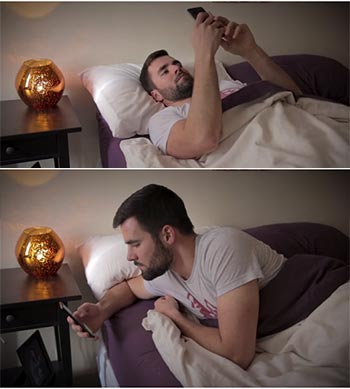
These body positions lead to postural instability, meaning weakened muscles that are responsible for balance in everyday life. I want to say right away that there is no “safe” position for using your phone in bed. Instead, it’s better to do some exercises and perform basic home exercises: for legs, for abs, for upper body, and some compound exercises. 4. Checking your email and browsing social media. This simply takes away 15-30 minutes of your life for a pointless activity. You could spend that brief time on self-education, work, or even training. In short, do something useful. For instance, reading or learning a new profession (Photoshop, copywriting, programming, etc.). If you dedicate just 15 minutes each morning for six months to reading a book or learning another skill, that will total 2730 minutes (182 days multiplied by 15 minutes = 2730 minutes in six months). That equates to 45.5 hours. With such a significant amount of time, you can learn or master a lot. 5. Watching the news. By watching the news in the morning, you can absorb negativity that may spoil your mood and hinder you throughout the day, suppressing your inspiration to work (of course, unless you’re a savvy businessman who needs to keep a finger on the pulse of events). By not checking the news feed on your phone or TV, you don't overload your reticular activating system and don't train your brain to receive negative information daily, meaning you don't focus on the bad and remain open to something positive. 6. Getting dressed/getting ready in the dark. 7. Drinking coffee on an empty stomach. Drinking coffee, especially regularly, can increase stomach acidity (https://www.ncbi.nlm.nih.gov/pubmed/10499460), leading to heartburn and GERD, or lowering it (https://www.ncbi.nlm.nih.gov/pubmed/16894406), causing other digestive problems. The issue here is specifically with coffee, not caffeine, as caffeine alone does not increase stomach acidity. 8. Leaving the bed unmade. This habit may not impact you physiologically, but by not making your bed immediately, you lose a very simple and short exercise in willpower and discipline. Want to be successful? Start small. 9. Cleaning in the morning. Let’s say you woke up. If you didn't wash the dishes or clean the kitchen table after dinner last night, you have nowhere to prepare your breakfast. Instead of focusing on yourself or quickly preparing something to eat, you have to waste time cleaning the kitchen. This doesn’t just apply to the kitchen space but the entire living area. Therefore, I recommend using the concept of "cleaning to neutral," where you don’t conduct a perfect cleanup of the messy place the night before but rather clean it to a neutral state (not perfectly tidy but not a disaster either). This will save you energy, time, and motivation in the morning. 10. Skipping breakfast. This is a very important meal because your body has been fasting all night and needs building materials and energy to create new cells (not just muscle but also internal organs). Where do you think it will get them? Proteins and energy will come from the muscles, and the missing microelements will come from bones, teeth, and joints, etc. The fat layer will be burned last, that is, only during severe starvation. If you’re an athlete striving to build or maintain muscle mass, skipping breakfast is not a good idea (even worse than missing any other meal). Not to mention the risk of kidney disease (https://www.ncbi.nlm.nih.gov/pubmed/32012653), development of stomach ulcers (https://www.ncbi.nlm.nih.gov/pubmed/10633828), the onset of type 2 diabetes (https://www.ncbi.nlm.nih.gov/pubmed/25686619), and other health problems. 11. Eating fast-digesting foods for breakfast. Many people are used to having oatmeal, sandwiches, and even sweet pastries in the morning. This can lead not only to the potential development of type 2 diabetes but also directly impacts your well-being and mood. Simple carbohydrates, while energizing, do not sustain that energy for long. It would be much more sensible to replace a significant part of them (not all) with protein and fatty foods, which will fill you better for a longer time and also be beneficial for your health and well-being (https://www.ncbi.nlm.nih.gov/pubmed/27184288). SIMILAR ARTICLES
COMMENTS |