|
» »
How to choose magnesium and which form is better
Author: Mikhail Ziborov - author of the site makefitness.pro. All articles by the author ➤
Magnesium (magnesium or Mg) is a microelement (mineral) that regulates more than 300 processes in our body. Metabolism, among other things, is tied to magnesium. The question of magnesium for sports purposes has already been raised by us. For those losing weight, it is interesting from the perspective of energy metabolism; for those gaining muscle mass – its role in protein synthesis; for those monitoring their health – prevention of hypertension and heart diseases. The daily dosage for an adult is 400 mg/day. However, considering its increased expenditure during workouts – the dosage can be raised without health concerns (personally, I reach 500-600 mg/day). With a magnesium deficiency, standard symptoms can include increased fatigue (it affects the mitochondria, i.e., endurance), night cramps or other sleep disturbances, irritability, and mild anxiety (study). With significant magnesium deficiency – decreased libido, erectile function issues, rapid ejaculation, and in women – lack of orgasm, hair loss, and brittle nails. Main criteria for choosing magnesium are bioavailability and side effects. These are the criteria you should rely on when selecting a supplement. Bioavailability refers to how much is available for the body to use, i.e., the amount that has been absorbed (entered the bloodstream). Moreover, magnesium is necessary for successful recovery after strength training. For other recovery supplements – follow this link. Forms of Magnesium: Pros and Cons1. Magnesium sulfate (magnesium sulfate or E518) is an inorganic form of magnesium (magnesium combined with sulfuric acid). It can be found in the form of tablets/capsules, powders, and also in the form of injections. Pros: low cost, available in various forms (tablets, etc.). Cons: in case of increased sensitivity to this form of magnesium, it may have a laxative effect; not recommended for people with cardiovascular and kidney failure; low bioavailability – about 34%. This also applies to magnesium sulfate heptahydrate (water molecules are added). 2. Magnesium oxide (or magnesium oxide or E530) – is an inorganic form (magnesium is combined with oxygen). It is available in the form of tablets/capsules and powder. Pros: low cost, the highest volume of magnesium in this form. Cons: may increase stomach acidity (acid rebound); can lead to dependence after 6-12 months of use; may cause diarrhea (in large doses and not always); low bioavailability – 40%. 3. Magnesium chloride (or magnesium chloride or E511) – is an inorganic form (chlorine is added). It has the widest range of formulations: tablets/capsules, powder, liquid (for injections and others). Pros: the highest bioavailability among inorganic magnesium forms (and even among some organic forms). Cons: rarely found on the supplement market; very high cost; low magnesium content in the supplement – about 8%. 4. Magnesium lactate (or magnesium lactate or E329) – is an organic form of magnesium (mineral combined with lactic acid). It is more commonly found in tablet form, less often in capsules, and even less so in powder. Pros: low cost compared to other organic forms of magnesium, medium bioavailability. Cons: contraindicated for breastfeeding and pregnant women (can enter breast milk and affect the fetus; studies were conducted on animals); used with caution in cases of kidney dysfunction. 5. Magnesium citrate (or magnesium citrate or E345) – is an organic form (citric acid is added). The main forms of release are equally distributed among tablets, capsules, powdered, and even liquid forms (drink solution). Pros: medium bioavailability; also offers other beneficial effects (calming, choleretic, anti-stress, analgesic). Cons: may have a laxative effect; low magnesium content in the supplement – 11%; animal studies have shown negative impacts on fetal development; breastfeeding is not recommended while taking magnesium citrate; should be taken cautiously by people with cardiovascular diseases and kidney problems. 6. Magnesium orotate (or magnesium orotate) – is an organic form of magnesium (the microelement is combined with orotic acid – a vitamin-like substance B13). Available in tablet and capsule forms. Pros: high absorption; can be used by people with cardiovascular diseases as well as those with carbohydrate and lipid metabolism issues. Cons: increased cost. A special advantage for athletes is orotic acid or B13 – a factor in anabolic processes and metabolism (muscle tissue growth and endurance). 7. Magnesium pidolate (or magnesium pidolate) – is an organic form (the microelement is combined with pyroglutamic acid). Standard forms of release are tablets/capsules and powder. Pros: high bioavailability. Cons: very low magnesium content in the supplement – about 8% (i.e., from 1000 mg of magnesium pidolate, a maximum of 80 mg of magnesium is absorbed, and in reality, even less); rarely found on the supplement market; high cost. 8. Magnesium aspartate (or magnesium aspartate or asporotate) – is an organic form (aspartic acid is added). The form of magnesium aspartate is divided into three isomers: L-, D-, and their mixture - DL-aspartate. Keep in mind that L-aspartate is the most bioavailable of these three isomers (so pay attention to the composition of the supplements). You can find it in tablets, capsules, and liquid form (for injections). Pros: extremely high bioavailability. Cons: to reduce production costs, less bioavailable isomers of aspartate are added; rarely found in pure form (often with added potassium), high cost. 9. Magnesium gluconate (magnesium gluconate or E580) is an organic form of magnesium (gluconic acid is added). It is available in the form of tablets/capsules and in liquid form (for internal use). Pros: extremely high absorption rate, average price (close to low). Cons: not available as a stand-alone supplement (i.e., it will contain impurities from other supplements); poorly studied. 10. Magnesium taurate (magnesium taurate) is an organic form of magnesium (taurine sulfonic acid is added). Standard forms of release are capsules/tablets, less often powder. Pros: high absorption rate; additional taurine contributes to cataract prevention. Cons: low magnesium content – 8.9% in magnesium taurate (from 1000 mg, you’ll get 89 mg); extremely high cost. 11. Magnesium glycinate (magnesium glycinate) is an organic form (glycine amino acid is added). There is also bisglycinate and diglycinate, which are essentially the same. Available in the form of tablets/capsules, much less frequently as powder. Pros: high bioavailability, single-component supplement, relatively safe for pregnant women (study). Cons: low magnesium content – 14% (from 1000 mg of magnesium glycinate, you can get a maximum of 140 mg of magnesium); may have a mild sedative effect; very high cost. 12. Magnesium malate (magnesium malate) is an organic form of magnesium (malic acid is added). Most commonly found in tablets, less often in capsules. Pros: high absorption rate; may positively influence performance (malic acid). Cons: high cost; poorly studied; low magnesium volume in the supplement – about 13%. 13. Chelated magnesium (magnesium chelated) is not a specific form of magnesium. Chelation refers to the combination of magnesium with an organic substance (acids, amino acids). For example, gluconate, citrate, malate, taurate, glycinate, orotate, pidolate, asparaginate, lactate – all these are chelated forms. Chelated forms have varying degrees of absorption: some are absorbed better, some worse. However, chelated (organic) forms are often better absorbed than non-chelated. Therefore, when purchasing chelated magnesium, pay attention to which specific chelated form is included. There are also forms of magnesium such as carbonate, silicate. But these forms are not classified as mineral supplements, instead belonging only to medicinal products (unlike the described forms). There is also magnesium phosphate (hydrogen phosphate, dihydrogen phosphate, etc.), magnesium levulinate, and magnesium threonate. These are rarely found on the market, although they can be used as supplements. Which Forms of Magnesium are BetterIt is difficult to say exactly how much magnesium will be absorbed from a particular form and which form is definitively better. This is because studies are conducted on humans (but the number of subjects is small) and also on rats. The results of these studies are ambiguous (older studies contradict more modern ones). Currently, we have more precise figures for magnesium absorption, but they are still approximate. Based on the data received, the best forms are considered to be organic (i.e., chelated) forms. Personally, my favorites are citrate and aspartate (due to good absorption and optimal price). Other more bioavailable forms like glycinate and taurate, I consider an unnecessary waste of money (they cost several times more). And for sporting results and health, they generally do not provide any serious bonuses. Effectiveness of Different Forms of Calcium: 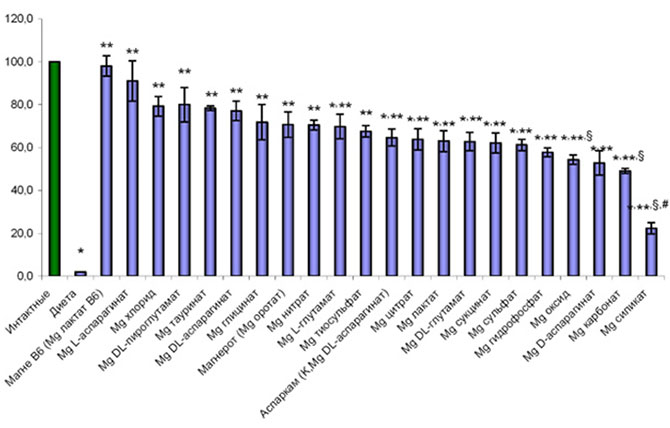
In the figure: The influence of magnesium salts (50 mg elemental Mg per kg body weight of the animal) on the extent of magnesium deficiency compensation (X) in the erythrocytes of animals under alimentary hypomagnesemia, %. Denominations: on the ordinate axis – change in the percentage of magnesium deficiency compensation (X) in the erythrocytes of animals (%); on the abscissa axis — studied animal groups. Vertical lines – standard error of the mean. — difference from the intact animal group; * — difference from the group of animals receiving a magnesium-deficient diet; § — difference from the group of animals receiving Mg L-asparaginate; # — difference from the group of animals receiving magnesium chloride. The use of any form of magnesium along with vitamin B6 (pyridoxine) increases magnesium absorption! Proteins, resistant starches, inulin, and oligosaccharides also enhance magnesium absorption. Taking several small doses throughout the day is better than one large dose (small portions are absorbed better). SIMILAR ARTICLES
COMMENTS |