|
»
Tendonitis of the patellar tendon (jumper's knee): symptoms and treatment
Author: Sergey Yezhov - sports medicine physician. All articles by the author ➤
Inflammation of the patellar tendon, which runs between the kneecap and the prominence of the tibia, is called patellar tendonopathy or, more commonly, "jumper's knee." The primary cause of the condition is acute or chronic overload of the knee joint. This is particularly common among athletes who frequently perform jumps in their professional activities (such as tennis players, track and field athletes, soccer players, basketball players, and volleyball players). The load during such movement involves a sharp and powerful, "explosive" contraction of the quadriceps muscle of the thigh, which is the key muscle for performing jumps. Experiencing constant tension, the quadriceps tendon becomes overloaded, leading to micro-tears of the fibers that do not heal well. This results in nutritional impairment, inflammation, and degenerative changes in the tendon tissue. 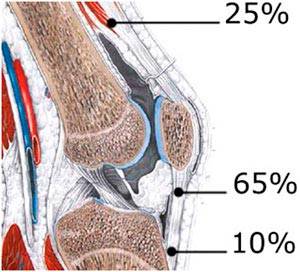
(The percentage of load distribution during the contraction of the quadriceps.) Main symptoms of patellar tendonitis:
Treatment. The principal rule for treating "jumper's knee" is to begin therapy as early as possible. The tendons in our body receive relatively poor blood supply. Therefore, the longer you prolong the process, the more pronounced pathological changes will occur in the tissue, which worsen the prognosis for recovery. Conservative treatment includes the following:
Surgical methods are resorted to when there is no positive result from conservative therapy carried out for 1.5 – 3 months. During the operation, there is a release of the patellar tendon, damaged tissues are carefully excised, and the tendon is fixed to the tibia with a special screw. SIMILAR ARTICLES
COMMENTS |