|
»
Rotator cuff: pain, exercises, treatment
Author: Mikhail Ziborov - author of the site makefitness.pro. All articles by the author ➤
Rotator cuff of the shoulder is a collective term for four muscles and their tendons responsible for shoulder rotation (from the shoulder joint to the elbow). Weakness in these muscles often causes athletes to injure both the muscles and tendons themselves, as well as the shoulder joints. These muscles include the infraspinatus, supraspinatus, teres minor, and subscapularis (essentially, the muscles of the scapula – both in the front and back). The infraspinatus takes on the most load during shoulder rotations! And it is most often the one to suffer. All other muscles simply assist it during rotation (depending on the planes in which the shoulder is rotated). Incidentally, depending on the situation, even different bundles of the deltoid muscles can assist. 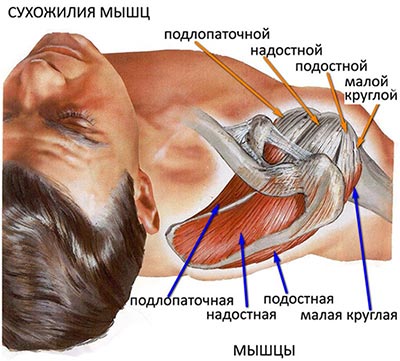
You can learn how and in what situations the muscles of the rotator cuff work from the video: https://www.instagram.com/p/Byx1x2MBv53/?igshid=aihj6bwx5ycc Pain in the rotator cuff of the shoulderPain in the shoulder can occur due to injury to individual cuff muscles or even several at once (depending on the severity of the injury). But most often, it is the infraspinatus muscle that suffers because it takes on the greatest load during any rotary movement. Pain may appear when you raise your straight arm forward and upward (shoulder impingement syndrome). Rehabilitation exercises for such pain can be seen here: https://www.instagram.com/p/B14ME8WBuUz/?igshid=1lngz4r7484hb https://www.instagram.com/p/B3XkuYHB6s-/?igshid=1u4li201xmhac Pain in the shoulder or shoulders can also occur when you press weight overhead (military press or Arnold press) or when bench pressing with a barbell or dumbbells. In fact, it can even happen during home workouts: https://makefitness.pro/upragnenia-v-domashnih-usloviah/. Remarkably, such pain, if not too severe, may disappear literally by the second or third set of these exercises. This is because the deltoid muscles get pumped with blood during these few sets, expand, and the weight no longer presses as much on the painful area. However, this condition does not mean the rotator cuff is healed: every time during the initial sets of exercises, the pain will remind you of itself! Here is another set of rehabilitation exercises for the rotator cuff: https://www.instagram.com/p/B_IOm6lBmNf/?igshid=5fr3btpnnhdk https://www.instagram.com/p/CANbi0fJJZW/ In general, pain can appear in different planes and even radiate to the back of the shoulder (near the insertion of the triceps tendon). But the cause is always the same – weakness of the rotator cuff muscles. Therefore, strengthening is the main goal when facing this problem. During acute pain, it is important to give the shoulders rest (avoid performing any shoulder-related exercises). After the pain sensations decrease, you can move on to simple shoulder rehabilitation exercises (as listed above and below). One way to stay in shape while dealing with an injury to one of the shoulder joints can be unilateral training, where you perform exercises using only one hand (overhead presses, bench presses, arm curls, extensions, lateral raises, etc.): https://makefitness.pro/upragnenia-na-plechi-s-ganteliami/. These can be exercises in a gym or at home, with dumbbells or with resistance bands. Even with TRX or in a cable machine. During unilateral training, the body always strives for balance, so the musculature of the injured limb will also strengthen in a peculiar way (even though it isn’t working). Naturally, though, the musculature of the working arm will still be somewhat stronger. Exercises for rotator cuff rehabilitationWhen I faced this problem, just one exercise helped me – the “scarecrow” or Cuban rotations with dumbbells. Here’s how to perform it: A modified (and more challenging) exercise is the Cuban press, where you perform an overhead press after the rotation. Performance: With just these two exercises, I managed to strengthen and relieve pain from my rotator cuff. However, pain occasionally returns to the same shoulder (the weights in the main exercises that injure the shoulder have increased significantly), so now I also use a whole set of other therapeutic exercises. For example, lateral Cuban rotations. Or here’s another selection: https://www.instagram.com/p/B0-DBtlAraR/?igshid=yc5qhdti466r ConclusionUnfortunately, treatment for such issues is the domain of doctors. All we can do is strengthen these small muscles. It is advisable to focus on the above-mentioned exercises once every two weeks to prevent injuries to the rotator cuff. Here’s a study that describes various degrees of injury to the rotator cuff: https://www.ncbi.nlm.nih.gov/pmc/articles/PMC5730646/ And here (scroll down to the conclusions) is information on what accelerates and what slows down tendon recovery in the rotator cuff: https://www.ncbi.nlm.nih.gov/pmc/articles/PMC4363803/ SIMILAR ARTICLES
COMMENTS |