|
»
Simple yoga practices for healing the spine (part 1)
Author: Sofya Pushkaryova - yoga instructor and psychologist. All articles by the author ➤
Currently, an increasingly common disease is osteochondrosis. This disease has significantly "younger". Now even 20-year-olds complain about back pain, the causes of which are scoliosis, osteochondrosis, hernias of the spine. Therefore, in this article, I want to talk about simple yoga practices that are, firstly, beneficial for any beginner in yoga and, secondly, aimed at the prevention and treatment of back pain. As I have noted before, a comprehensive approach is required for healing: physical exercises, proper nutrition, and realistic thinking. Now we will focus on physical exercises. So, for someone starting yoga for the first time, it is important to begin correctly. The practice should not be too complex, dangerous, and it should bring visible results. The foundation of our body is our supports, the legs. The legs bear the entire load of the body. And it's no coincidence that we also call the legs "supports." This is the energetic foundation of the body, a connection to the earth. Everyone is familiar with the phrase "stands well on their feet," which signifies stability, rootedness in the material aspect. A good foundation provides a sense of security, stability, and confidence. Thus, by starting to strengthen our legs, we create the foundation of our health, well-being, and stability. Well-developed supports provide energy, a boost of vitality, high life tone, and proper load distribution on the spinal column. It often happens that back problems begin with such a common foot condition as flat feet. A weak foot does not fully perform its function, leading to issues with the spine. Asanas for Spinal TreatmentAny yoga sequence should start with warm-up exercises. For a warm-up, you can incorporate joint gymnastics and breathing practices. Joint gymnastics gently activates the whole body, preparing the joints and ligaments for subsequent work. If you practice in the first half of the day and have no chronic diseases, you can perform the breathing "Bhastrika", which warms up and cleanses the body and strengthens the respiratory system. Standing asanas are suitable for strengthening and developing our supports. They are the simplest to perform, easily mastered, and lay the foundation for subsequent practice. 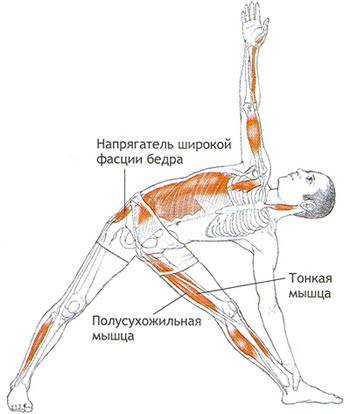
Utthita Trikonasana (Triangle) In addition to strengthening the legs, when performed correctly, this asana also strengthens the back muscles, corrects spinal curvature in scoliosis, restoring the body's natural symmetry. It eliminates stooping in the thoracic region, opens the pelvis. The asana is performed to the right and to the left. After completing, relax, take a few deep breaths, and observe your breathing. 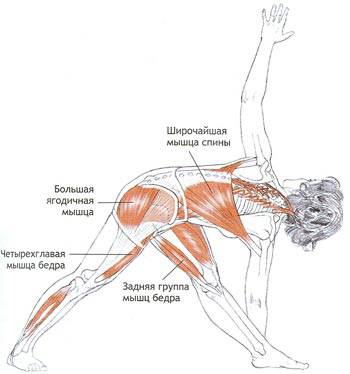
Parivritta Trikonasana (Revolved Triangle) This asana effectively stretches the leg muscles, restores mobility to the pelvis, relieving muscle blocks. It improves spinal mobility and opens the thoracic region. It is performed on both sides, just like the previous asana. Perhaps in the very beginning, your body will not look like in the picture. This is not a problem. Find a comfortable position and try to relax those muscles not involved in the asana's frame. After completing, relax and shift your focus to your breathing. Virabhadrasana II or Warrior Pose 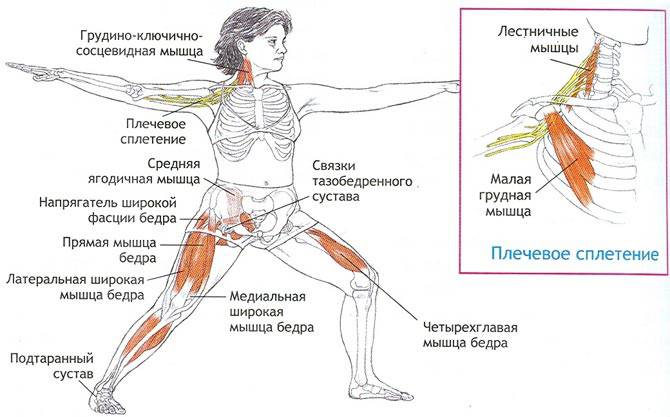
Well tones, stretches, and strengthens the leg muscles. When performing, pay attention to the work of your thighs and feet. There should be no discomfort in the knees. Feel how your thighs and feet work. Perform to the right and to the left. Do not lift or tense your shoulders. Then relax and rest. Virabhadrasana I 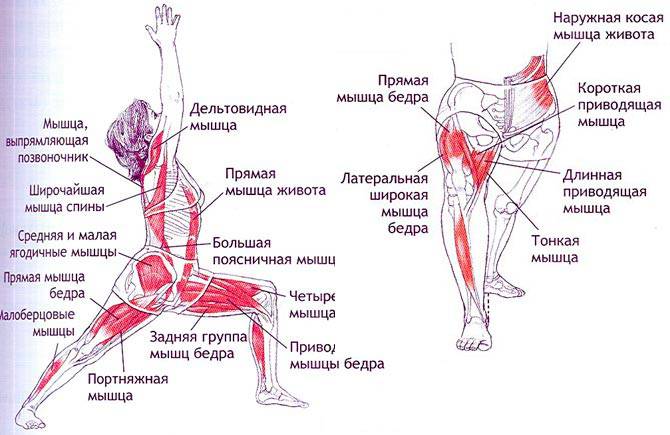
In this asana, the spinal column is well stretched, and the neck muscles are strengthened and elongated; it also restores pelvis mobility. Perform it on both sides and rest, observing your breathing. During the practice of standing asanas, concentrate your attention on the legs and feet. Observe how the muscles work. If you notice that your feet are not fully engaged in performing the asana, try to make them stronger and more stable next time. Gradually, your sensations will change, and you will feel more stability and strength in the asanas. Your supports will become more stable. You will feel a surge of energy and vitality after the session. Shavasana 
And be sure to finish your sequence with Shavasana. Shavasana – the corpse pose. Each class ends with Shavasana, lasting at least 10 minutes. In Shavasana, it is desirable to completely relax the muscles. If you manage to relax so deeply that you balance between sleep and wakefulness, that is the best outcome. During Shavasana, your brain unloads, your psyche clears, and you recover. Wishing you a harmonious and beneficial practice! Also read Simple yoga practices for healing the spine (Part 2). To sign up for your first trial yoga session with a 50% discount in Moscow, call 8 926 596 87 15. I would also be happy to develop a personalized yoga program for you via email at info@yoga-klub.ru, and I can conduct Skype consultations with sonya_pushkareva. Your personal yoga trainer Sofia Pushkareva Let's practice together with the trainer – a home yoga practice program for women (video below). SIMILAR ARTICLES
COMMENTS |