|
» »
How often should oral and injectable steroids be taken?
Author: Nikita Shilkin - Candidate for Master of Sports in Powerlifting and gym trainer. All articles by the author ➤
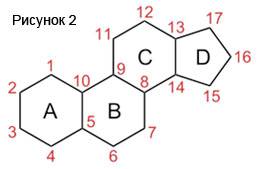
Important! We do not advocate for the use of steroids and other potent substances. All information is provided so that those who still decide to take them can do so with minimal health risks. At the core of the testosterone molecule (Figure 1), like that of any other steroid, lies the steroid skeleton (Figure 2), consisting of four benzene rings. Each position of each carbon atom is numbered by scientists for ease of reference. 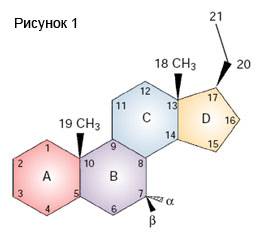
Half-Life PeriodThe liver continuously breaks down steroid hormones present in the blood into simpler metabolites that are excreted in urine. Therefore, if new doses are not introduced, their concentration will decrease. Different substances are metabolized (broken down) at different rates. The term "half-life" is used to measure this. Half-life is the time it takes for the concentration of a substance in the blood to decrease by half. For instance, after administering 100 mg of a substance (with a half-life of 24 hours), 50 mg will remain in the blood after 24 hours. After 48 hours, 25 mg will remain. After 3 days, there will be 12.5 mg. Thus, to maintain a stable concentration, it is necessary to administer the substance once every half-life or more frequently. Pure testosterone has a half-life of only about 10 minutes. This makes pure testosterone inconvenient for use, as it would need to be injected very frequently. Moreover, in the first few minutes after administration, the concentration would be excessively high. To modify certain properties of a hormone (for example, testosterone), some alterations are made to its molecule by adding and/or removing various molecules without changing the steroid skeleton itself. The primary goal of these modifications is to increase the drug's lifespan in the body or enhance its anabolic properties. Half-Life of Injectable SteroidsTo address this issue and create longer-lasting preparations, esterification is employed. This involves converting the steroid into the ester (salt) of an organic acid. The ester dissolves in oil and is administered intramuscularly. Upon entering the bloodstream, the ester passes through the liver, which detaches the base of the organic acid, releasing the active substance into the blood. This process occurs rather slowly, allowing the administered dose to be distributed over a significant period. Thus, esterification significantly increases the half-life and makes the preparation more convenient for use. However, the action of the drug itself does not change. That is, testosterone propionate and testosterone decanoate have exactly the same properties and effects, differing only in their half-life. Table of Half-Lives of Various Esters 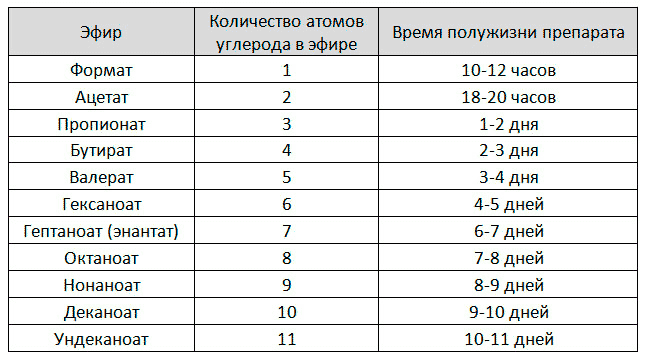
All products made this way are intended only for injection. Half-Life of Oral SteroidsTo create preparations suitable for consumption in tablet form, a different method is used. The difficulty arises from the fact that steroids in their pure form cannot pass through the gastrointestinal tract, as enzymes there instantly break them down. To prevent their destruction, a CH4 molecule is attached to the steroid molecule at position 17-alpha. This process is called alkylation, and the steroids obtained in this manner are referred to as 17-alpha alkylated. Alkylation at 17-alpha enhances the anabolic properties of the preparations. All tablet preparations, except for Parabolan, are 17-alpha alkylated. Alkylated preparations are actively broken down by the liver, resulting in a short half-life. It ranges from 3-4 to 11-12 hours. The half-life can vary significantly depending on how actively your liver functions. Consequently, oral preparations require more frequent administration. Typically, this involves 2-4 doses per day. Table of Half-Lives of Oral Anabolic Steroids
Despite the suitability of all 17-alpha alkylated drugs for oral administration, some are produced in both tablet and suspension forms (crystal suspensions in water). For example, injectable methandienone or injectable stanozolol. Such suspensions typically act stronger than the oral form and have a local effect, meaning they can stimulate more robust muscle tissue growth at the injection site due to a higher concentration of the active substance being created there. Summary1. Anabolic steroids are sex hormones modified to enhance their anabolic properties and prolong their effects. 2. Steroids should be taken at least once per half-life period. 3. To extend the action of steroids, esterification or alkylation is used. Esterification is the conversion of a steroid into a salt or ester of an organic acid. It does not change the hormone's action on the body; it merely prolongs the release of the drug into the blood over a longer period. Alkylation refers to the addition of a CH4 molecule to the hormone's molecule, making the drug suitable for oral administration. Alkylation at the 17-alpha position enhances the anabolic action of the preparation. 4. Steroid esters are oil-based solutions for injections and usually act longer than the tablet forms of anabolic steroids. SIMILAR ARTICLES
COMMENTS |