|
»
Facebuilding: 3 ways to relax facial muscles
Author: Kristina Bondareva - facebuilding coach. All articles by the author ➤
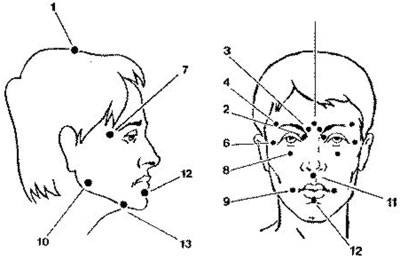
Face-building is not only about training the facial muscles but also about relaxing tense and spasmed muscles. In this article, I will discuss existing methods for relieving tension in the facial muscles, how to "wake up" your face in the morning, and how to relieve stress in the evening. 1. Acupressure MassageThis massage is best performed in the evening, as well as after training the facial muscles! The principle of working with the facial muscles is the same as with the muscles of the body: after applying a load to the muscle, be sure to relax it. Contraindications:
How to find biologically active points (BAP) BAPs are usually found in small depressions on joints and bones, on arteries, where the pulse can be felt. When pressed, BAPs are slightly painful. Stimulating each point is sufficient for about 3 to 10 seconds. Sequence:
2. Japanese Facial Massage Zogan / Asahi / TsoganHave you noticed that Japanese women look very good even at an advanced age? Of course, this is related to a specific type of aging in this nation. But there is another secret—the Japanese facial massage, Zogan. This massage effectively relaxes spasmed facial muscles, tones them, sculpts the face, lifts the skin, and also helps reduce facial fat. The Japanese massage is best performed in the morning! This massage is suitable for:
Facial Zogan massage is contraindicated:
How to do it correctly? The main rule of the massage is that all movements should follow the direction of lymphatic pathways; the movements should be gliding, and do not press hard! (carefully study the video below!) Sequence:
3. Post-Isometric Relaxation of Muscles (Stretching)This is a very effective method for relieving muscle spasms in the face. To use this method, it is better to consult a specialist, as it is not easy for beginners to identify tense muscles independently. A doctor will assess the condition of your face and will relieve muscle tension using simple, painless techniques. Usually, a few sessions are sufficient, after which you can use the muscle stretching techniques at home. The key is to understand the correct way to position the muscle and the amount of force needed for stretching. Conclusions1. In the morning - Zogan facial massage to invigorate and reduce facial swelling. 2. In the evening - acupressure massage for relaxation. 3. Post-isometric relaxation for deep work with a specialist! Stay beautiful! P.S. I develop individual programs for face-building training and conduct classes via Skype. If you are interested – contact me. Kristina Bondareva – face-building coach. SIMILAR ARTICLES
COMMENTS |