|
» »
How to train with breast implants?
Author: Timko Ilya - master of the whole project and fitness trainer. All articles by the author ➤
This topic is very ambiguous and quite complicated. Doctors cannot fully answer this question—they are not trainers. And trainers cannot answer—it’s not their expertise. :) So, I do not claim to be the ultimate authority. Comments from silicone breast owners are welcome. So, let’s try to figure this out. The specifics of training depend on the following factors: 1. How long ago was the surgery? If it has been more than 4 months, then this factor is no longer impactful. 2. Where were the implants placed (under the breast muscle or under the gland)? 3. How were they installed (where the incision was made and how large it is). 4. Size of the implants. These are the main factors. And depending on how everything went for you specifically, the recommendations can vary greatly. I will try to systematize the recommendations based on my experience training women with implants, knowledge of physiology, and accounts from other women about the specifics of their training. Main Recommendations1. Regardless of any factors, it is advisable to train in supportive lingerie. Gym workouts often include running, jumping, and other exercises where the breasts may move significantly. This is especially important for those with larger implants. 2. Regarding cardio, it is better to avoid the treadmill and jump rope for the first month of training (for the reasons mentioned above). The safest cardio equipment would be the stationary bike and stepper. The elliptical is generally safe as well since the impact load on it is minimal. If a month has passed and you try running without any unpleasant sensations, you may proceed to running. But do so only in supportive lingerie. 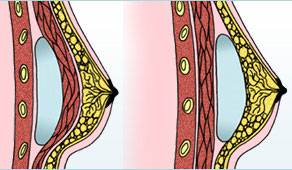
3. If the implant was placed under the breast muscle, there is a high probability that you will never be able to train your chest normally again. I don't know how it looks aesthetically, but in terms of workouts—having an implant under the chest muscle is undesirable. Just think: with the stretching and contracting of the chest muscles, they will push against the implant, causing discomfort and potentially leading to its deformation and displacement. After all, there is theoretically no free space between the chest muscle and the ribs. And then there's an implant in there as well. 4. Now, regarding the incisions and stitches. It is clear that after the installation of breast implants, there are stitches left. Either under the arm, or on the breast itself, or in the navel. Any stitch needs time to heal completely. In reality, the timeframes doctors provide (up to six months) are greatly exaggerated. Usually, a month is enough for a small stitch to heal completely. Therefore, you can start training in the gym just a month after the implants are installed. As for how to train—let's discuss that further. Chest Exercises with ImplantsSo, if we do not consider various jumps and running, the limitations in strength exercises may only affect those exercises where the chest is actively engaged. If a month has passed and you've returned to the gym, for starters, you can try the following exercises for the chest: In the initial workouts, try doing them in partial amplitude. These exercises engage the chest but are quite safe, as there is no significant stretching of the chest muscles and little stress on them. After a month of such training, you can try the following exercises: They provide a slightly greater load, but the risks are also minimal. Some might find these exercises sufficient for training the chest. The fact is that the higher the load on the chest and the more it stretches, the greater the likelihood of discomfort. In the next group of more risky exercises, I would include: These involve a significant load on the chest. Usually, women with implants rarely perform these exercises. However, some may want to give them a try. But only after you have attempted the previously mentioned exercises. The following exercises are best completely avoided if you have implants: Also, similar fly movements and closures that entail strong chest stretching and isolated load on it should be avoided. Conclusions1. In most cases, it's possible to train the chest with implants. The question is how and with which exercises. 2. You can start training as early as a month after the surgery. 3. Limitations in exercises may only relate to those involving the chest muscles and those with impact loads: jumps, running, and everything that causes the chest to bounce significantly. I want to emphasize that there might not be any limitations. It’s very individual. In rare cases, it may be uncomfortable to perform exercises where the chest does not work but stretches, such as pull-ups and lat pulldowns. 4. It is advisable to always train in supportive lingerie. 5. Keep in mind that placing implants under the chest muscle may impose more significant restrictions on chest exercises than placing them under the gland, potentially leading to a complete exclusion of load on the chest muscles. Once again, I’d like to emphasize that everything I have written in this article is my personal opinion. Please share your experiences in the comments. It will help others. Good luck to you and to beautiful breasts! SIMILAR ARTICLES
COMMENTS |