|
» »
How to adjust the number of repetitions throughout a training program
Author: Timko Ilya - master of the whole project and fitness trainer. All articles by the author ➤
Before answering this question, let's consider why we should change them at all? You have set a goal for yourself: to gain mass (or any other). You are somewhat aware of the optimal number of repetitions for this. 10 to 12 repetitions. Logically, all you need to do is to keep doing that number of repetitions month after month. And you will gain mass! But, unfortunately, it’s not that simple. The effect achieved through training (strength, mass, or fat burning) is called training adaptation. Training adaptation is nothing more than the body’s adaptation to physical stress. In other words, you train your muscles, and as the body gradually adapts to external factors (physical stress), it increases their mass. Or you perform aerobics, and the body gradually burns its fat reserves. It doesn't matter. Both are results of the body’s adaptation. Moving on. Like any adaptation, training adaptation only occurs in response to an unfamiliar stimulus. That is, if the stressors become familiar to the body, then adaptation will not occur. Familiar stressors are those that the body has experienced many times before. Why does this happen? Because our body has already adapted to the familiar stress in the past. These changes are sufficient to cope with the external stimulus, such as training stress. Now let's see what happens if you perform exercises with the same number of repetitions. For example, today you bench press 100 kg for 6 reps. And a week later, you bench press 100 kg for 6 reps again. You do this for several months. The body quickly adapts to this weight and repetition count, and training adaptation stops. Mass, strength, and fat loss will also stop. Someone might say, "Let's increase the weight of the barbell!" Sure! But you won’t manage it for more than a month. If you keep increasing the weight while trying to lift the same number of times, you will simply overtrain since the body won’t recover in time. More details about increasing weights can be found here. In the end, we come to the conclusion that changing the number of repetitions is necessary to continually encourage the body to adapt to new physical stress. Now let me explain how to do this. First, you need to determine your minimum and maximum repetitions. If your goal is strength, let it be 1 to 10 reps. If it's mass, then it's better to do 4 to 15 reps. If it's fat burning, then 12 to 25 reps. And from week to week, you should vary the number of repetitions within these limits, forcing your body to experience unfamiliar stress over and over. An approximate variant for changing repetitions (for strength) can be seen in the graph below. 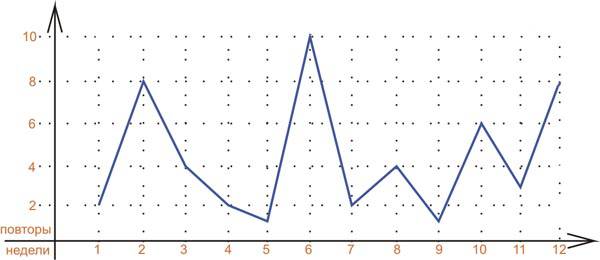
As you can see, the number of repetitions constantly oscillates between the upper and lower limits. I do not advise performing the same number of lifts for more than two weeks in a row. You should also remember that the weight of the weights should change accordingly to the number of repetitions. And it doesn’t matter whether you are losing weight or gaining mass. This principle applies equally to everyone, as it merely reflects the laws of human physiology. And those do not depend on your desires. I hope this article was helpful to you. If so, please share it with your friends and subscribe for new articles. Good luck! SIMILAR ARTICLES
COMMENTS |