|
» »
Athletic heart: what it is, its types, is it dangerous?
Author: Mikhail Ziborov - author of the site makefitness.pro. All articles by the author ➤
Did you know that the most common cause of death among young athletes is precisely heart-related issues? A study notes that 36% of athletes out of 1866 deceased individuals died specifically due to hypertrophic cardiomyopathy—the so-called "athletic heart." The term initially seems positive, but in reality, the athletic heart can be both "bad" and "good." To avoid encountering negative aspects of training, I suggest you subscribe to our public channel on Telegram: there we discuss common and not-so-common mistakes that you can avoid to maintain your health. What is an Athletic Heart and Its Types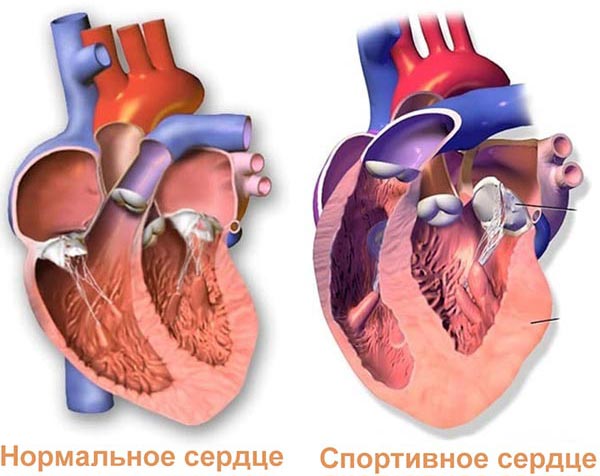
Athletic heart (athletic heart syndrome) refers to changes in heart muscle. These changes can occur in different ways: - Strength athletes experience an increase in muscle tissue in the left ventricle (to pump out blood more forcefully); - Those primarily engaged in aerobic activities have a stretched opposite side (to accept and deliver more blood). These changes occur due to training, aiming to deliver more oxygen and nutrients to the muscles, meaning to develop endurance and use the heart's resources more efficiently. However, scientists still don't fully understand the exact reasons behind this development of heart muscle. Hence, the term "athletic heart" remains a hypothesis. Thanks to hypertrophy (increase) of the heart muscle, individuals can withstand higher loads, and at rest, their heart rate is much lower than that of an average person (about 40-50 beats per minute compared to 65-70). The heart becomes stronger, beats less frequently, but pumps the same or larger volumes of blood. This is called a physiological (good) athletic heart. So, what could possibly go wrong? The problem arises when, under continuous heavy training (at their peak capabilities), our motor doesn't develop new muscle cells quickly enough, leading it to replace them with rapidly growing connective tissue cells. As we understand, connective tissue cannot adequately substitute muscle tissue: while the heart grows in mass, it does not aid in blood pumping. Thus, a pathological (bad) or pathophysiological athletic heart develops (also referred to as sports myocardopathy). There are two types of athletic hearts: physiological and pathological. And as the hypothesis suggests, the heart becomes "good" due to adequate training loads, while it becomes "bad" due to excessive and constant loads. Of course, a bad athletic heart does not develop if you overload yourself just once. But if this is done regularly... This is to say that you do not need to exhaust yourself to the point of exhaustion and break records every week. For your reference, a physiological athletic heart has strict parameters: the wall thickness must not exceed 13 mm for men and 11 mm for women. Anything above this is considered pathological. Causes of Pathological Athletic Heart DevelopmentOne reason is excessively high training loads, as I mentioned earlier. But our hearts begin to beat faster not only during physical activity but also when we are stressed or anxious. In a word—excess stress. And if this stress is chronic... The combination of acute, chronic, psycho-emotional, and physical stressors is the primary reason for developing a bad athletic heart (excluding genetic predispositions or cardiovascular diseases). You can find a professional training program (for free) on our website. Workout loads (sets, repetitions, weights) are also available here. Signs of an Athletic Heart1. Bradycardia. This is a reduced heart rate at rest (occurs in 80% of athletes). 2. Hypertrophy – thickening of the heart muscle walls. 3. Cardiomegaly – enlargement of the heart size (due to hypertrophy). 4. Hypotension – lowered blood pressure by about 20 mmHg (most often observed in highly trained athletes, i.e., in 10-19% of cases). Interestingly, the heart may show none of these signs but still have a high functional state. You can monitor your pulse and blood pressure to at least get a general idea of any changes in your heart health. Other indicators can only be checked at a clinic. Also, pay attention to any discomfort in the heart area: tingling, aching, sharp stabbing pain, and pressure sensations, etc. If these symptoms occur frequently, even if you are training, I recommend seeing a doctor. The conclusion is clear: a physiological athlete's heart poses no danger to a person; on the contrary, it offers certain advantages. A pathological athlete's heart can lead to (and has been shown to lead to, as indicated by the study mentioned at the beginning) death. By the way, you can find a list of supplements and extracts for strengthening and supporting the heart via the link. SIMILAR ARTICLES
COMMENTS |