|
» »
How to build calves: 5 effective methods
Author: Timko Ilya - master of the whole project and fitness trainer. All articles by the author ➤
It's no secret that building your calves is arguably much more challenging than developing any other muscle group in the body. Anyone who has ever tried to do it knows this. What is this related to? The main difficulty lies in the fact that the calf muscles are primarily made up of fibers that are very endurance-oriented but do not respond well to growth. This is inherent in their nature. Otherwise, we would not be able to walk for long periods; our calves would simply tire out. In other words, we effectively train our calves day in and day out for several hours when we walk or even just stand still. Therefore, through the process of evolution, the calf muscles have become extremely resilient but, at the same time, are very difficult to hypertrophy due to the predominance of slow (endurance) muscle fibers. I think it’s now clear why the calves are so hard to develop. Now let's move on to the techniques that will help you achieve this. 1. Do More Repetitions and SetsSince the calf muscles are very endurance-based, it’s quite hard to stimulate their growth if you do the standard number of repetitions for mass gain (10-12). To ensure that the load on the calves is stressful, you need to perform AT LEAST 15 repetitions. This means aiming for about 20-25 reps per set, and by the last repetition, your muscles should be burning. And how do you manage to do many sets? It’s advisable to perform 4-6 sets for the calves. But let's be honest, doing that many sets can be quite tedious, especially since calf raises are inherently a monotonous exercise. To make it less boring, you could, for example, do one set (to failure) after each exercise during your workout. This way, you’ll train your calves "in between" the other exercises. 2. Train Both the Gastrocnemius and Soleus Muscles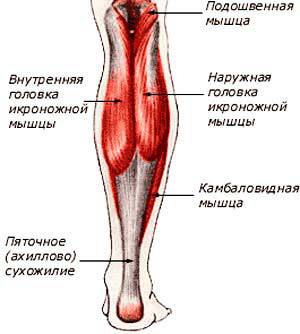
Take a look at the anatomy picture of the ankle. In addition to the gastrocnemius muscle, there is also the soleus muscle. The soleus is located directly beneath the gastrocnemius. Thus, it also influences the overall size of the calf. The larger the soleus, the more pronounced the calves appear. But how do you train it? It’s quite simple. When you perform seated calf raises, the soleus muscle primarily works. For example: If you stand and perform calf raises, the gastrocnemius (the two-headed calf muscle) primarily engages. For instance: This indicates that you need to perform calf raises both seated and standing, and do so in roughly equal proportions. For example, alternate: one day standing, the next day seated. 3. Train Your Calves Several Times a WeekSince this muscle is very enduring, it recovers quite quickly. Therefore, for good results, I recommend training the calves 2 to 4 times a week while alternating between seated and standing calf raises. 4. Do Special ExercisesThe most common "special" exercise for the calves is jumping. Look at basketball players; they all have very well-developed calf muscles. This is because they jump a lot during every training session. You can also do jumps. However, in a gym setting, it's better to: No need to squat deeply. In fact, it's sufficient to bend your knees slightly—just enough to push off. This is done so that your calves tire much more quickly than your thighs. In the video below, the guy seems to be squatting too deeply. Make sure to jump as high and as quickly as possible. There’s no need to lift heavy weights. In most cases, a barbell weight comprising 40% - 50% of your body weight is sufficient. However, you should aim for no fewer than 10 repetitions. One downside of this exercise is that it may not be suitable for beginners, as they need to know how to absorb the impact from the barbell when landing. Otherwise, it can lead to back problems. Another clever exercise is: Or the so-called "donkey calf raises". Many may have heard of this exercise. At first glance, it doesn’t seem to differ from a standard standing calf raise. Well, the person bent over, so what? What difference does it make for the calves? The difference is that this position stretches the calves more. In other words, it extends their fascia. Muscles with more elastic fascia are more likely to grow in volume under equivalent conditions. 5. Emphasize Different HeadsMany know that the calf muscle is bi-headed; it is also referred to as the gastrocnemius. Consequently, by using certain techniques, you can shift the load to different heads of this muscle. If you turn your toes outward and keep your heels close together, the load will primarily engage the outer head of the calf. You should primarily rest on the outer part of your foot. Conversely, if you turn your toes slightly inward (tipping your feet slightly inwards), the load will be more on the inner head of the calf. In this case, you should rest on the big toe—i.e., on the inner side of your foot. In general, at the initial stage, I wouldn’t recommend stressing too much about different heads if your goal is to increase the overall size of the calves. Once you achieve the desired size, then you can start emphasizing certain parts. ConclusionsConsidering everything mentioned above, I can present you with a sample calf workout plan. This is a rough plan and should not be taken literally. I provide it so you have something to work from.
Lastly, I would recommend lowering your heels as much as possible (in all exercises) and raising them as high as possible. In other words, work through the full range of motion. You can also add a brief pause at the top. That’s all I wanted to share about training your calves. Check out Denis Semenikhin's video on this topic below. Good luck! SIMILAR ARTICLES
COMMENTS |