|
» »
How to build calves if they are naturally underdeveloped?
Author: Frolova Olga - fitness enthusiast. All articles by the author ➤
The calf muscles of homo sapiens are rightly considered the most genetically predetermined part of the body. In nature, there are absolutely stunning calves that have never seen a weight, as well as quite modest specimens even among competing bodybuilders. Why do we so often encounter "stubborn" calves, and how can we combat this? 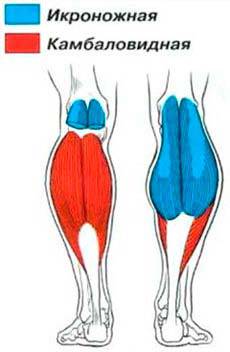
By the time you first enter the gym, the triceps surae muscle is already incredibly trained. It consists of the soleus and gastrocnemius muscles, which have been actively working since the moment you learned to walk. Even in a stationary position, they are tense and protect you from tipping forward. If any lateral back muscles need to be developed almost from scratch, the calves are already pumped to about half of their genetic potential. At this stage, any muscle will progress quite sluggishly. Moreover, the number of slow muscle fibers (which are adapted for low-intensity work and grow twice as poorly as fast fibers) in the soleus muscle can reach 90%. You can roughly determine how big you can potentially grow your calves by this: if the circumference of your ankle exceeds the circumference of your wrist by at least 20% (which is quite rare), then the maximum possible volume of your calves will be no less than the maximum volume of the upper arm. This means that genetics is too weak an excuse for giving up without a fight. The main task is to create a stress for your legs that they have never encountered before. Best Exercises for the CalvesElectromyography shows that squats activate the gastrocnemius muscle more than any variations of calf raises. However, this exercise alone is insufficient for optimal development of the calf muscles. In terms of isolation, a regular standing calf raise machine can be the best option if used correctly, and the worst if used like everyone else: with straight legs. The thing is, the ankle joint is designed like a hinge, just like the elbow. It is meant to move the bone along a circular trajectory. In contrast, machines are designed for movement strictly up and down. This is almost the same as lifting a barbell for biceps on a Smith machine! If you perform the exercise with straight legs, the resistance curve sharply increases toward the end of the lift, causing few to complete the movement through the full range of motion. The solution is simple: instead of the usual calf raises, do jumps. The weight should be calculated so that during the set, your toes never lose contact with the floor, and your shoulders remain in contact with the machine. From the side, it should look like a regular lift, only with springy knees. During the exercise, it is important to tense your entire torso and hold your breath during the jump, as the weight often exceeds what you lift in basic exercises and spinal compression is very high. If your gym does not have such a machine, you can replace it with a Smith machine and a stable platform from which you can dangle your heels for greater range of motion. Exercises for the calves with a fixed bent knee (such as seated calf raises) are less traumatic for muscle fibers and can be practiced more frequently with lighter weights and a higher number of repetitions. It's also very convenient to push the platform with your toes in the leg press machine (where the movements are also jumping, with "soft" knees). We often forget about the function of the calf muscles in bending the leg at the knee joint. Although the main load goes to the hamstring, you are surely familiar with the burning sensation in your calves when performing leg curls on a machine. A more intense version of this exercise for the calf muscles is with body weight and a fixed ankle. Unfortunately, a special machine for this, resembling a very low donkey for extensions, is extremely rare. You can get help from a friend to hold your bent feet at the ankle or hook them onto some heavy furniture. It’s advisable to place something soft under your knees. For the best effect, using all available equipment for calf training is essential, as well as trying all possible foot placements (toes in, parallel, and toes out). Since calves recover remarkably quickly, they should be trained frequently (three times a week or even more) and with varying intensity (weight). This might sound counterintuitive, but consider placing calf exercises on upper body training days, and do them at the very beginning. Tired calves (consider this a warm-up) won’t hinder you from performing bench presses and everything else normally. However, doing calves before heavy compound lifts on "leg day" is simply foolish, as by the end of the workout, metabolic waste will have built up in your blood, leading to less-than-optimal results. And the main rule for training lagging calves is to give them at least as much attention as the muscles you see in the mirror. Now, specifically about how to complement your training program with calf exercises. Each set is performed with different foot placements (toes in, parallel, and toes out). It’s good to perform each pair of exercises in a superset. The rest interval between calf workouts is 1-3 days. Concurrently, at least once a week, you should perform squats and/or deadlifts in a schedule that suits you. Day 1Day 2Day 3At the end of the entire workout (including exercises for other body parts), you can add 3 sets of leg curls with a torso lift while keeping the ankle fixed. But if you already have a lot of load on the hamstrings, it’s better to avoid curls. A great addition would be 10 minutes of jumping rope (or as long as you can manage). It all looks like a hell of a lot of work. But to date, no other proven method has been devised to break the "calf genetic curse." SIMILAR ARTICLES
COMMENTS |