|
» »
TOP 4 life hacks for workouts: how to improve training
Author: Mikhail Ziborov - author of the site makefitness.pro. All articles by the author ➤
If someone had suggested, helped, nudged, or directed me to the things I know today, I would have spent less time mastering them or avoided certain mistakes. But you have me, friends, and our resource MakeFitness.Por (here's our Telegram), where you'll receive guidance on how to do things better, cheaper, and more enjoyably. Feel free to count on us. 1. Pressing the tip of the tongue to the palateIt turns out that the position of the tongue in the mouth directly affects strength performance during exercise (to be precise, it affects the torque). Torque is the force applied that allows us to lift dumbbells, barbells, and other weights (up to our own body weight). Torque is also known as the moment of force. This study indicates that if you press the tip of your tongue to your palate during strength exercises, your strength performance can increase by up to 30% (the study showed increases in leg flexion). What does all this mean? It means that with this simple technique, you can enhance your strength performance, lift heavier weights, or perform more repetitions at your usual load (and, consequently, progress faster). Press your tongue to the palate – lift more kg. 2. Focus on increasing strength from the start, not massThe thing is, when guys enter the gym, they often follow the standard training scheme they found on the internet: 4 sets of 8-12 repetitions per exercise. But I advise you, if you are just starting your journey as an athlete, to lift heavier weights and train with them by doing 4 sets of 1-3 repetitions. And my advice is substantiated by this study. It compared two groups that performed only 2 exercises – barbell squats and leg presses: - The first group trained for all 8 weeks, doing 4 sets of 8-12 repetitions (the weights were around 70%). - The second group trained for 3 weeks, doing 4 sets of 1-3 repetitions (the weights were 90-100%), and in the remaining 5 weeks, they switched to 4 sets of 8-12 repetitions (weights around 70%). In short, the second group initially used heavier weights and then moved to slightly lighter ones. The result of all these manipulations was higher strength indicators in squats and leg presses. Interestingly, the second group gained more muscle mass than the first, even though the first group was initially focused on mass gain (generally, 8-12 repetitions are considered for hypertrophy, while 1-3 repetitions are for strength growth). Therefore, I advise beginners: when you come to the gym, choose weights that you can lift for 1-3 repetitions, no more (of course, with a spotter). But it's clear that this applies not to all exercises, but to basic ones like (you can see the proper technique for each exercise at this link: everything is animated and visual, you don't need to read): Pull-ups, dips on bars, French presses, and bicep curls typically imply 8-12 repetitions initially. 3. Replace exercises with more effective onesFew people know, but some common exercises aren't always the most effective. Understand me correctly: no one is downplaying their effectiveness, but there are better options. So why not use the most effective exercises? Nordic hamstring curls 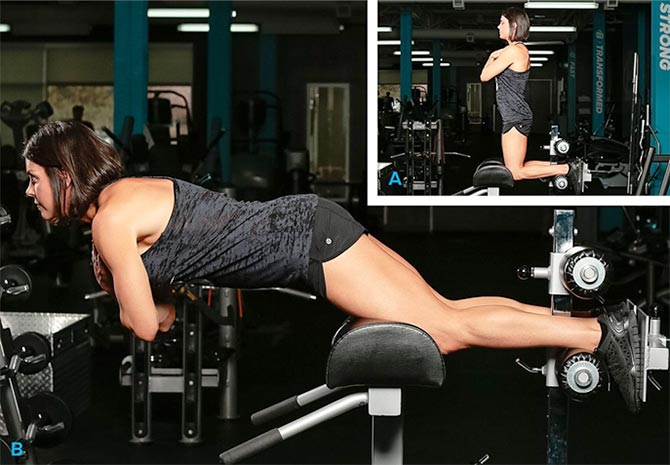
These are more effective than Romanian deadlifts for training the hamstring group. Nordic curls show greater activation of the three hamstring muscles: semitendinosus, semimembranosus, and biceps femoris (study to confirm my point). However, to be fair, the Romanian deadlift is much more effective than good mornings (forward bending with a barbell on your shoulders). In the article “Romanian Deadlift or Good Mornings,” I thoroughly analyzed these 2 exercises. Nordic curls are more effective than leg curls performed while lying face down. The movement is practically the same: only the body's position changes. But in this study, it was found that after 12 weeks of training, leg curls done seated resulted in greater gains in leg muscle mass (hamstring area). Interestingly, participants trained one leg seated and the other lying down. The seated leg developed more. This is because when seated, the hip joints are flexed, and the hamstring muscles are stretched more, experiencing greater load during the lowering phase. In short, if you have to choose between seated and lying leg curls – now you know which is more effective. Seated leg curls are also more effective than barbell curls for biceps because pull-ups are a compound exercise that involves multiple joints (shoulders and elbows). In contrast, bicep curls target only the elbow joints. Have we all agreed that compound exercises promote muscle growth and strength better? So, the ever-popular biceps will get a solid workout from pull-ups, but that doesn’t mean barbell curls are ineffective. No, they're just slightly less effective. Standing barbell curls are more effective than seated curls. There are several reasons for this: - While seated, you deactivate core muscles (for instance, those that help cheat and lift weights using body sway), meaning the entire load is directed at the target muscle group. - With seated incline curls, your arms are already in a slightly stretched position at the start, which increases the load on them. You can find a training program tailored to yourself through the link (it includes the most effective exercises for your growth). 4. Use proven effective supplementsFor example, creatine is one of the cheapest supplements but extremely effective: after just 1.5-2 weeks of use, strength increases by about 20%. Can you lift 100 kg for 10 reps? In two weeks, you'll be able to lift 12 reps. Click the link for detailed information on creatine (how much to take, how to take it, which brand is best, studies on creatine effectiveness) and other training supplements. SIMILAR ARTICLES
COMMENTS |