|
» »
How to train the neck: exercises, features, nuances
Author: Nikolai Borisov - coach, champion of Russia in powerlifting. All articles by the author ➤
Part 1. PhilosophicalWhy is it so rare to see someone training their neck in the gym? Why do 99% of fitness enthusiasts diligently care for the appearance of their biceps, which are only visible part of the summer and in the gym, while neglecting their necks, which are visible almost all the time, even in a tie, only hidden by a scarf? Perhaps it's the fashion – a desire to be like everyone else. Maybe it started with bodybuilding rules, which assess the biceps in several poses while forgetting about the neck. Many prefer simpler exercises since bending the arm is significantly easier than training the neck. To justify their laziness, myths about the dangers of neck training are maintained, more frightening and persistent than myths about the harm of squats. The lack of demand leads to a lack of supply. I have not seen a single neck training machine. Straps from reputable manufacturers rub against ears, press down on the head with buckles, wear out quickly, and tear – they are not suited for serious work. Most certified instructors won’t give you worthwhile advice regarding neck training. They aren’t taught this – there’s no demand for it. There are many video tips online, with plenty of useful information. However, they show exercises with a 10 kg plate or a dumbbell around 16 kg. These weights do not correlate with the large volumes of neck work demanded. Athletes often say that the neck works in many exercises and doesn’t need separate training. They mislead. It doesn't work; it just tenses. These are different concepts. The abs tense in many exercises, but almost everyone trains them separately. The neck of a modern person, unlike the arms and legs, does nothing in daily life. The muscles of the neck degrade from inactivity. As a result, various diseases arise, including herniated intervertebral discs, simply from pathological weakness of the muscles. Regular neck warm-ups also train the vestibular apparatus, which, in turn, helps prevent "motion sickness" intransport, and allows a person to maintain coordination when looking back on a bike. In the case of falling from a bike, when your helmet meets a heavier object, a strong neck can save you from becoming a vegetable. Simultaneously with the muscles, the vascular system develops, reducing the symptoms of vegetative-vascular dystonia and easing headaches from various illnesses. It is not uncommon to see a double chin on bodybuilders. It looks unpleasant, yet they do not notice. Apparently, when looking in the mirror, all attention is focused on the biceps. The main reason for the double chin is the pathological weakness of the subcutaneous neck muscle, which the bodybuilder is unwilling to train. Part 2. Wrestling ExercisesAn undeniable advantage of wrestling exercises for the neck is that they do not require special equipment. Just lie down on a mat, tatami, or travel mat and get to work. Indeed, if you get into a "bridge" position and shuffle your legs around your head, your neck will definitely be worked out. At the same time, hair will be removed from the back of your neck. But losing hair isn’t the worst thing. Extending the head too far back contributes to hyperlordosis of the cervical spine, which is as dangerous as hyperlordosis (maximum arching) in the lumbar spine. Wrestlers need to train their necks in conditions close to a grapple, but we can slightly modernize the bridge. 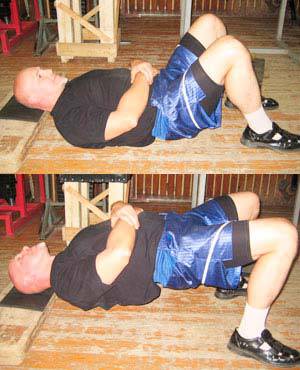
It is enough to place a board 5-8 cm thick under your head, put a travel mat on it, and start from a shoulder position on the floor (side view), rising into a bridge position. The board will increase the range of motion, which will positively impact the development of the posterior neck muscles. It is preferable not to assist your neck with your legs; try to resist. Focus on moving your chin away from your chest, do not think about lifting your torso. If you incorporate this exercise into your training plan and perform it with added weight on your chest, your lower back will receive additional load. The back and hamstrings will not recover in time, leading to decreased results in deadlifts and squats and an increased risk of injury. For fitness enthusiasts, this exercise is quite suitable, but those whose backs are heavily loaded in basic exercises should turn to isolated neck exercises. Part 3. Isolated ExercisesWarm-up This also serves as training for the vestibular apparatus. It is therapeutic exercise for those whose necks are extremely weak or unwell. 1. Press the chin to the chest - tilt the head back as far as possible. Tense the muscles at the extreme positions. 2. Turn the head to the right - left. Try to pull the chin back as much as possible without moving the shoulders. 3. Tilt the head to the right - left. Try to touch the ear to the shoulder without raising the shoulders. 4. Raise the shoulders as high as possible - then lower them. Tense the trapezius muscles at the top position and the latissimus dorsi at the bottom. Pump blood into the neck. Perform everything smoothly, gradually increasing the speed as the neck warms up. Do each exercise 30 times. Repeat for 3 rounds. Aim to achieve a feeling of warmth in the neck. 5. Circular head movements with a full range of motion. At least 50 times in each direction. 6. Lying on your back/stomach, let your head hang over the edge of the bench. Raise and lower the head. Always lower it smoothly! 7. Lying on your back/stomach, with your head hanging over the edge of the bench, raise your head. Rotate to the right and left, maximizing the pull of the chin. Now, when each of the 14 pairs of neck muscles is warmed up, it is ready to work. Raising Weights with the Forehead Part 3. Isolated ExercisesWarm-up This serves as training for the vestibular apparatus. It is also therapeutic exercise for those whose necks are extremely weak or unhealthy. 1. Press the chin to the chest - tilt the head back as far as possible. Tense the muscles at the extreme positions. 2. Turn the head to the right - left. Try to pull the chin back as much as possible without moving the shoulders. 3. Tilt the head to the right - left. Try to touch the ear to the shoulder without raising the shoulders. 4. Raise the shoulders as high as possible - then lower them. Tense the trapezius muscles at the top position and the latissimus dorsi at the bottom. Pump blood into the neck. Perform everything smoothly, gradually increasing the speed as the neck warms up. Do each exercise 30 times. Repeat for 3 rounds. Aim to achieve a feeling of warmth in the neck. 5. Circular head movements with a full range of motion. Do this at least 50 times in each direction. 6. Lying on your back/stomach, let your head hang over the edge of the bench. Raise and lower your head. Always lower it smoothly! 7. Lying on your back/stomach, with your head hanging over the edge of the bench and raised. Rotate to the right and left, maximizing the pull of the chin. Now, when each of the 14 pairs of neck muscles is warmed up, it is ready to work. Raising Weights with the Forehead Sit on a bench. Place a weight plate in front of you. On it, put a piece of porous rubber. Grip the plate by the edges, securing the rubber with your thumbs. Lie on your back, with your head hanging off the edge of the bench. Raise your head. Place your forehead on the plate, with the edge of the rubber level with your eyebrows, allowing more space for your nose. Remove your thumbs from the bottom surface of the plate. When all your fingers are positioned on top of the plate, you won't be able to assist with your hands, and your neck will do all the work. Don't rush for weight. The increase will be gradual. Perform flexion and extension of the neck. Don’t help yourself by raising your chest; aim to bring your chin towards your chest and then away. When you start working with two plates, and then with a 50 kg plate, you can position your thumbs not on top but on the sides of the plates for safety. Always be ready to catch the plates with your hands. Pulling with the Head I think a description isn’t necessary; it’s enough to watch the video. I only want to remind you to lower the weight slowly to avoid injury. Instead of weights, you can use the low pulley. It's safer, but it doesn’t target the muscles as effectively. You can train your neck with a partner. The partner should be taught to apply pressure to the forehead and back of the head strictly perpendicularly. This isn't simple, as the angle of the head changes continuously during the exercise. The partner must apply pressure smoothly. They should "push" the head down while ensuring they don’t injure your neck. They must ease the pressure on the head at the top; otherwise, you won’t be able to lift your head maximally and will lose range of motion, meaning you won’t achieve peak contraction. In my opinion, it’s easier to work alone than to teach someone else. Head Turns with Forehead Support This is a super effective exercise, but only for prepared athletes. Place a step about a meter away from the Swedish wall. Put a piece of porous rubber on the edge of the step closest to the wall. Stand with your back to the wall and your face toward the step. Support yourself with your hands in front of the step. Place your forehead on the porous rubber so that your eyebrows are at the edge, and your nose is below the level of the step. Place your feet on one of the rungs of the wall's ladder at a distance of at least one meter (for stability). Choose a height at which your knees are semi-bent and your lower back does not receive harmful "over-bending" loads. Instead of the Swedish wall, you can use a barbell resting on STABLE stands or a power rack. Lift your hands off the floor. Continue to keep them 10 cm off the ground for self-insurance. If you feel discomfort in your neck, immediately press your hands to the floor. Turn your head to the left and right. Your head should roll from your forehead to your temples alternately. If it feels easy, ensure that you are pressing with your forehead and not the top of your head. When the load is insufficient, take a weight plate that you already placed in front of the step. Part 4. DetailsI train my neck every 7-8 days. If you are younger, you can train more frequently. Beginners, while working with light weights, can train their neck every 3 days. I tried separating the front and back training, doing the front with presses and the back with rowing. That didn't work. The sternocleidomastoid muscles (some of the most powerful and important in the neck) contract, pulling the neck forward and back, meaning they work in all exercises and do not have enough time to recover with frequent training. Now, I do front and back neck exercises after pressing. With warmed-up hands, it is easier to place a 50 kg plate on the forehead. I perform the plate raise and head pull with approximately equal weights. I alternate three workouts to avoid getting used to the load:
I do warm-ups after each training session. Naturally, before the neck training - it's a given. Warming up between strength training speeds up the recovery process. I wish you success! Site "Personal Trainer" - our services SIMILAR ARTICLES
COMMENTS |