|
» »
How to build neck muscles: exercises and training principles
Author: Timko Ilya - master of the whole project and fitness trainer. All articles by the author ➤
To be honest, I'm not a fan of training the neck. Probably because in powerlifting and weightlifting, it doesn't seem to have much benefit. Nevertheless, this body part enjoys decent popularity among men. After all, a strong neck can save you in fights. Besides, a person with a "bull neck" has a more intimidating appearance. However, training the neck requires not only a specific set of exercises but also great caution, as the cervical vertebrae are quite mobile. Whatever neck exercises you perform, all movements should be smooth and without jerks. And traditionally, let's start our "flight analysis" with anatomy. A Bit of Anatomy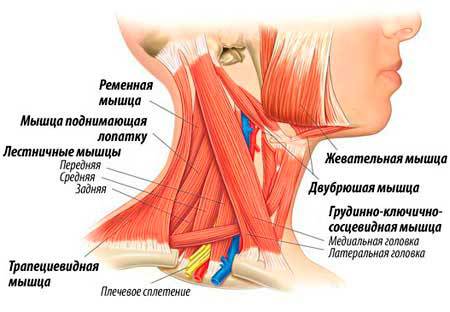
As you can see, the largest and most noticeable muscle of the neck is the sternocleidomastoid. It tilts the head forward and sideways. The scalene muscles also support lateral head tilts. The backward head tilt (neck extension) is provided by the trapezius and splenius muscles. Speaking of trapezius muscles, if you want to build a thick neck, you shouldn't forget about them. This article provides detailed guidance on how to achieve that. Thus, it is clear that for a comprehensive neck workout, you need to perform three movements:
Neck Exercises1. Neck Flexion and Extension, Lying on a Bench These are the two simplest and most common exercises that do not require any special equipment or skills. If you've never trained your neck before, I recommend starting with a 2.5 kg weight plate. Trust me, that will be enough for beginners. I want to emphasize again that the cervical vertebrae are quite mobile, and the neck muscles are very delicate. Therefore, start with a lighter weight and execute all movements smoothly and preferably to the full range of motion. That is, flex and extend your neck as much as possible. It's best to alternate these two exercises using supersets. Beginners can do 2 sets (for each exercise) of 10-15 repetitions. By the way, instead of a weight plate, you can ask a partner for help, who will apply pressure to the back of your head or forehead. 2. Neck Flexion and Extension on a Crossover The principle is the same as the previous exercise; there isn’t any significant difference. Only instead of a weight plate or a partner, a cable with weights is used. How to do this is shown in the video below (watch from 4:00). 3. Neck Flexion and Extension, Standing or Sitting For this, you will need to create or buy a small device that fits onto your head. The essence of this exercise is the same as the previous two. There is absolutely no change for the neck muscles; only your position varies. Which of the three aforementioned exercises you choose to do is up to you. It doesn’t make a significant difference. However, while extending the neck while sitting is quite convenient, flexing it in this manner may not be comfortable. This means you would have to wear the apparatus upside down so that the weight is behind you. Personally, I have never seen anyone do it this way. 4. Side neck bends while lying down It is done similarly to flexion and extension while lying down, but only while lying on your side. As a weight, both a barbell plate and a strong partner's hand can work. Some even manage to press against their own hand or through a towel. The video below shows this exercise (watch from 3:50). If you are a beginner, perform this exercise for 2 sets on each side with 10 - 15 repetitions using a small weight. 5. Neck training on a wrestler's bridge This is perhaps the most powerful exercise for the neck muscles. But it is also the heaviest and most dangerous. I do not recommend it for beginners. This exercise has many different variations, both dynamic and static. You can see all of them in the video below. I recommend starting the wrestler's bridge only after you have strengthened your neck with the lighter exercises described above. This will take about 2 - 3 months. Basic Principles for Neck Training1. Always do neck exercises at the end of your workout. This way your body is maximally warmed up. Thus, the risk of injury is lower. 2. Always warm up your neck with circular movements before exercises for it. 3. All exercises should be performed smoothly and without jerks. Remember that cervical vertebrae can be easily displaced, leading to nerve compression. 4. When training your neck, don't forget about trapezius training. The trapezius muscles are the foundation for the neck. With larger trapezius muscles, the neck looks much bigger. If you plan to work on your neck today, it makes sense to work on your trapezius first. 5. The neck muscles are relatively weak and not very resilient. Therefore, beginners should start with 2 sets of 10 - 15 repetitions. 6. If you want to train your neck from all sides, you need to do flexions, extensions, and side bends of the neck. Here is an example of a neck training routine for beginners:
7. Do not do more than 2 neck workouts per week. Even if you manage to recover, there’s no point in training it more often. That's all I wanted to say. I don't consider myself a cool expert on neck training, but I hope you learned something new. Good luck! SIMILAR ARTICLES
COMMENTS |