|
» »
Why do the stomach vacuum exercise
Author unknown. One of the decisive factors that finally motivates people to engage in fitness is a tightly fitting belt and a protruding belly. The reasons for the weakening of the abdominal muscles vary – pregnancy in women, a fondness for beer in men, improper nutrition, and a sedentary lifestyle for everyone. When it comes to improving body shape, the phrase "tone the abs" is often mentioned. This once-popular exercise – raising and lowering the torso with feet fixed – has long been removed from fitness programs as it did not strengthen the muscles much but overloaded the spine and increased intra-abdominal pressure. The most common modern exercises for the abs are crunches and various exercises that create load for the rectus and oblique abdominal muscles. These exercises place stress on the rectus and oblique abdominal muscles. At the same time, many rightfully believe that strength exercises, despite their proven effectiveness for burning fat and strengthening muscles, often do not lead to the desired results – a reduced waist size and a pulled-in abdominal wall. Fat rolls are replaced with strong, protruding muscles, which, undoubtedly, is much better than a sagging belly, but it still does not eliminate the visual effect of a massive figure. This occurs because fat deposits are divided into two types. The first type is associated with a high amount of fat tissue in the body. These are soft folds on the sides and belly that can be effectively reduced with fat-burning exercises. The second type is visceral fat, which surrounds the internal organs and can be covered quite well by strong muscles on the outside. In this case, a protruding belly is observed even in skinny individuals, with the sagging being linked to the weakening of the transverse abdominal muscle located beneath the rectus muscles and responsible for pulling in the abdominal wall. The best exercises for strengthening the transverse muscle and reducing the visceral fat layer come from yoga practice: uddiyana bandha and nauli, which are performed as follows: on a strong exhale, press your palms against your thighs, bend your knees, lower your head, and pull your relaxed abdomen toward your spine and under your ribs. Then you should tuck your chin to your chest, tighten your pelvic floor, and hold your breath for as long as possible. For additional work on the abdominal wall in this position, you also perform nauli – alternating tension of the abdominal muscles in a transverse direction. The Vacuum Exercise on Knees, on All Fours, and Sitting (Arnold Schwarzenegger) 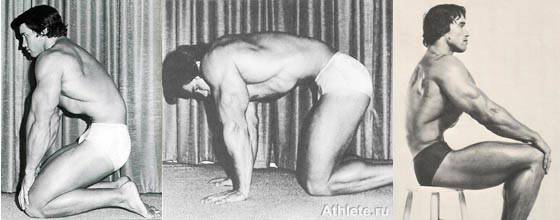
This technique forms the basis of exercises collectively known as "the vacuum." They can be performed lying down, on all fours, sitting, or standing. The effectiveness of the "vacuum" relies on proper breathing technique. The bodyflex breathing technique is often recommended – after a complete exhale, take a rapid and deep inhale through the nose, followed by a sharp and loud exhale through the mouth. At this moment, the abdominal wall and all internal organs are supposed to shift under the ribs. After holding your breath, the abdominal wall returns to its original state, and breathing is restored. The simplest version of the "abdominal vacuum" exercise is lying on your back, with your legs bent at the knees and arms extended along your body. Once you feel the internal muscles working, you move on to performing the "vacuum" with extended legs. The next step in strengthening the muscles is pulling in the abdomen while on all fours – this is a very effective exercise for women, just as pulling in the abdomen while lying on your stomach is. Bodybuilders prefer to perform the "vacuum" either standing or bent over, using a support. Pulling in the abdomen while sitting is considered one of the most challenging variations, but it is invaluable for office workers and, furthermore, is practically unnoticed by others. SIMILAR ARTICLES
COMMENTS |