|
» »
What is the glycemic index?
Author: Timko Ilya - master of the whole project and fitness trainer. All articles by the author ➤
Hello. Now you will learn what the glycemic index (GI) is and why it is important to consider when planning your diet. So, let's start from the complex and move to the simple. First, let's provide a scientific definition. The glycemic index is an indicator of how foods affect blood sugar (glucose) levels after consumption. This means that the higher the GI, the faster blood sugar rises after consuming certain foods. Glucose is used as the reference, with a glycemic index of 100. The glycemic index of buckwheat porridge is 50. This means that the blood sugar level rises twice as slowly (and is also twice as low) after eating buckwheat compared to glucose. Let's move on. What determines the speed at which blood sugar levels rise? It mainly depends on the speed of digestion (breakdown) of the particular food. Of course, there are other factors that influence this, but the speed of digestion is the key one. Therefore, it can be said that: The glycemic index is an indicator of how quickly foods are absorbed (digested) in your body. The higher the index, the faster they are digested. The lower the index, the slower they are. I will reiterate that this definition is somewhat coarse and exaggerated, but simpler to grasp the essence. It's better for you to understand the core idea without the nuances than to understand nothing at all. By the way, as many have probably guessed, the glycemic index only applies to foods that contain carbohydrates. Since glucose comes only from carbohydrate breakdown. Therefore, if you consume a product that is completely devoid of carbohydrates, your blood sugar level will remain the same. How Does Glycemic Index Affect Weight Loss?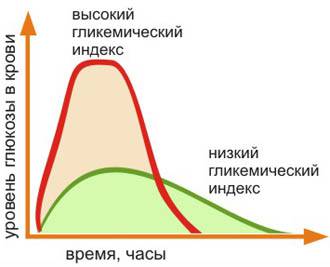
Imagine you consumed something with a high GI. For example, a cake (around 100). Within 30–60 minutes, your blood sugar level rises sharply. However, the body does not need that much energy at the moment. It will take as much as it needs (let's say 50%), and the rest will be neatly stored as fat "for later." Now, suppose you ate apples (GI 30). The sugar level rises slowly. Over several hours. Because glucose enters the bloodstream much more slowly, the body can utilize it all for its needs, and there is no time for storing it as fat. This is why those trying to lose weight are advised to eat foods with a low glycemic index. Because in this case, the risk of fat storage is much lower. However, if you have any common sense, you probably understand that it’s not just about the index but also the amount of food consumed at once. If you eat only 50 grams of cake, your blood sugar level will be much lower (even though it will rise faster) than if you eat 500 grams of buckwheat porridge. When Is It Best to Eat High GI Foods?The answer is quite logical. It is advisable to consume such foods when the body has the greatest need for carbohydrates:
During both of these time frames, glycogen stores in the muscles are depleted, and the body will use all the sugar to replenish these stores. However, again, this doesn't mean that you can eat 1 kg of cake in one sitting and think there will be no consequences. Therefore, completely excluding high GI foods is also unnecessary. Sometimes, in moderate amounts, such food can be beneficial. After all, the faster the muscles replenish glycogen stores, the quicker you will recover after a workout. What Foods Have a High GI?Foods with a high glycemic index are primarily almost all baked goods and confections. That is, anything made from flour or anything sweet. Fruits and dried fruits are an exception, as fructose has a very low GI (only 20). Below is a table with the GI of most common products.
SIMILAR ARTICLES
COMMENTS
| |