|
» »
Causes of appetite loss and ways to increase it
Author: Nikita Shilkin - Candidate for Master of Sports in Powerlifting and gym trainer. All articles by the author ➤
Increased appetite is a pressing issue for many people. This is not only for bodybuilders who strive to eat as much as possible to gain muscle but also for regular individuals suffering from underweight and anemia. Additionally, poor appetite, or more precisely, undernourishment, leads to weak health, deteriorating overall health indicators, and lower quality of life. In this article, we will discuss the main ways to enhance appetite in various disorders. Causes of Poor AppetiteTo start, we will define poor appetite as a condition where you cannot eat as much as your body requires. The reasons for this unpleasant and harmful condition can be conditionally divided into three main groups:
Psychosomatic – stresses, a habit of eating little, clinical anorexia. In this case, there was typically a time in your life when you ate a lot and with pleasure. Treatment is complex and always individual, but it generally comes down to relieving stress (rest, psychotherapy, medications) and implementing a diet that includes fractional meals scheduled at specific times. We will discuss the diet closer to the end of this article. Gastrointestinal tract (GIT) disorders often include ulcers, dyskinesia of one or more sections of the intestines, dysbiosis, insufficient enzyme production by the pancreas or gallbladder. These issues are treated with medications, diet, and/or special procedures. In this case, it’s possible to have never had a good appetite in your life or to have experienced a sharp decrease in appetite after illness, poisoning, or taking certain medications. Athletes on high-calorie diets also often experience a rapid decline in appetite without any obvious reasons. Metabolic disorders can be triggered by intoxication, infectious diseases, inflammations in the body, or overtraining (mainly in athletes). Anemia, vitamin deficiencies, and endocrine system problems also contribute to this. All metabolic disorders that reduce appetite are, in essence, an excess of catabolism over anabolism. These psychosomatic issues and GIT dysfunction often occur simultaneously and, in some cases, are directly related. Increasing Appetite in Psychosomatic DisordersFull rest and recovery are quite effective if the cause of low appetite is stress, chronic overload of the GIT, or overtraining. Rest implies complete cessation of workouts and work, plenty of sleep (preferably including daytime naps), and eating healthy food in an amount that is comfortable. Light physical activities and walks in the fresh air are beneficial. The duration of rest should be 1-2 weeks; sometimes, it may be necessary to extend this to a month if the stress was severe and/or prolonged. Calming agents. These will help reduce the impact of stress. It’s best to use herbal remedies, such as valerian and motherwort (in tincture form), or special blends like Novopassit. Use according to the instructions. If the effectiveness does not satisfy you, it is better to add another remedy than to increase the dose. Adaptogens. Ginseng, prickly eleutherococcus, rhodiola rosea, levezia, pantocrinum. Take in the morning and during the day, preferably in the form of tinctures. Nootropics. These substances improve the functioning of the nervous system. Examples of such medications include piracetam, cinnarizine, picamilon, phenotropil, and phenibut. Vitamins from group B should also be included in this category. Overall, there are many such medications. Their effects are cumulative, noticeable with prolonged use, and one can take doses 2-4 times higher than recommended; the effect will be stronger and appear sooner. Make mealtime more enjoyable. This provides positive reinforcement for the eating process. Anything will do – music, pleasant scents, a nice environment, delicious food, beautiful table settings. In general, anything you’d like to see around you while eating will work. Avoid foods with sharp, off-putting odors. Such food can quickly become tiresome, and the presence of even a slightly unpleasant smell can completely kill an already weak appetite. Increasing Appetite in Gastrointestinal DisordersThe reasons for poor appetite related to GIT disorders are more common than others. When addressing these issues, it’s essential to understand that the GIT functions on a conveyor principle. Therefore, a malfunction in even one component disrupts the entire system. Let's examine the main causes of such disorders and ways to normalize digestive tract function. I should clarify that these recommendations are intended for conditionally healthy individuals. That is, those who do not have identified diseases of the digestive organs, but for various reasons, their GIT is not functioning properly. Dehydration. This occurs in 80% of people. An adult needs 30-40 ml of water per kg of body weight per day, and during heavy physical exertion and high ambient temperatures, over 50 ml per kg of body weight. This refers only to pure water. Many people do not drink water at all, relying instead on tea and water present in food. This leads to a chronic water deficit, forcing the body to conserve water in all possible ways, including the functioning of the GIT. This results in a nearly complete reduction in the production of mucus and digestive juices in the GIT, significantly lowering its ability to digest food quickly and efficiently. The speed of toxin elimination from the body also declines, and a person can remain in a state of hidden toxicity for years without realizing it. This undoubtedly worsens the functioning of all organs and lays the groundwork for various diseases, from kidney stones to thrombosis. The solution is to drink pure water in the morning, before meals, at night, and during the night if you wake up. By the way, dehydration is often the cause of restless sleep and insomnia. The total amount of water you drink each day should not be less than 30-40 ml per kg of body weight. If your poor appetite is due to dehydration, you will feel the first effect in about one to two days. However, in severe cases, the body may be in such significant toxicity that you will need to drink even more (up to 55 ml per kg). You will not feel the difference until at least a week of following this drinking regimen. Deficiency of animal proteins and fats in the diet. This is as common as the previous situation and often occurs alongside it. The mechanism of action is simple: when there is a deficiency of essential nutrients (essential amino acids and lipids), the body enters a strict conservation mode. This impacts enzyme synthesis processes (which are all proteins) and bile production (the main component being cholesterol and animal fat), as well as the processes of renewing the epithelial cells lining the GIT, and mucus production decreases. As a result, we see inadequate production of digestive enzymes and bile, without which digestion is impossible. The recovery rate of the digestive organs also declines, leading to their wear and tear. In the end, this results in reduced GIT efficiency, and consequently, poor appetite and all related consequences. The solution is to gradually, over the course of 2-3 weeks, increase protein intake to 1.8-2.3 g/kg of body weight, and animal fats to 1-2 g/kg of body weight. It is also beneficial to add fish oil to the diet in quantities of 5-20 g per day. The effect will be noticeable depending on the severity of the deficiency within 1-6 months and will manifest not only in improved appetite but also in the optimization of all body functions. Dysbiosis. To some extent, this occurs in every person at least once in their life. In dysbiosis, foreign, harmful bacteria and fungi appear in the intestines. The number of beneficial microorganisms decreases (or rather, the ratio of beneficial to harmful decreases in favor of the latter), leading to digestive disturbances. Long-term dysbiosis is characterized by impaired absorption of vitamins, fats, and other food components, resulting in weight loss and anemia. The most common symptoms include poor appetite, bloating, abdominal pain, frequent diarrhea, constipation, or unstable stool (alternating diarrhea and constipation). The causes of dysbiosis can include medications (especially antibiotics), nicotine, alcohol, digestive organ diseases, intestinal infections, improper nutrition, and reduced immunity. Treatment (in addition to addressing the underlying cause of dysbiosis) is comprehensive and must include all three components: a diet, bacteriophages to suppress harmful microflora, and special medications to normalize intestinal microflora. Diet – a varied and balanced diet with mandatory inclusion of fermented dairy products and fiber. The key to success is consuming the latter in large amounts at night and in the morning. Fiber can be in its pure form (microcrystalline cellulose) or in the form of vegetables, fruits, and bran. Fermented dairy products range from natural (perishable) kefir to specialized products for normalizing microflora. Bacteriophages – a simple, safe, and fairly effective method is to eat 1-2 cloves of garlic a day along with a large meal. Medications in this group should only be taken as prescribed by a gastroenterologist after conducting specific tests. It is also beneficial to take a carbon-based absorbent like polypefan, at 1 tablespoon 2-3 times a day. It will help remove toxins formed as a result of pathogenic microflora activity. Medications to normalize intestinal microflora – bifidobacterin, linex, and others. They contain spores of lactic acid bacteria that multiply in the intestines, helping not only with digestion but also creating a more favorable environment for other beneficial microflora. It is best to start taking them a little later after starting treatment with bacteriophages and to continue treatment for a couple of weeks after completing the bacteriophage course. Thus, a safe and suitable treatment course for dysbiosis would look like this: 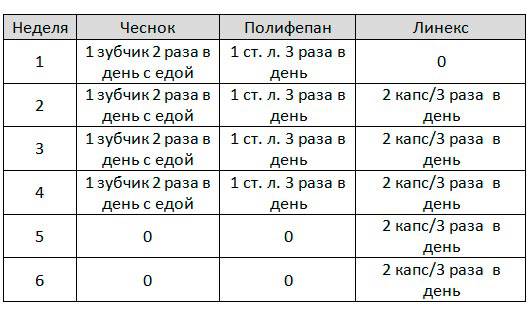 It is important to remember that this treatment without a diet will not produce lasting and strong effects. Fatigue and depletion of GIT resources. This is often observed in athletes trying to gain weight on a high-calorie diet. It can also happen after holidays, especially those accompanied by alcohol consumption. The reason is simple – the digestive organs cannot continuously operate under overload, leading to a decrease in the production of gastric juice, enzymes, bile, and intestinal mucus, as well as thinning of the epithelium. Prevention 1. Consumption of mucilaginous foods – milk, jelly, and mucilaginous soups. More mucus means less wear on the epithelium. 2. Eat small portions frequently, which will reduce the load on the GIT, and try to chew your food more thoroughly. 3. Avoid cold food and do not wash food down with cold drinks. When cold liquid enters the stomach, its contents are immediately sent to the intestines (not properly digested), where it begins to rot. 4. It is necessary to assist the pancreas by taking enzyme preparations, such as pancreatin, Kreon, Festal, and others. All of these contain the three enzymes produced by the pancreas – lipase (for fats), amylase (for carbohydrates), and protease (for proteins), but in different amounts and proportions. Accordingly, certain enzyme preparations are better suited for specific types of diets. 5. To increase the bile production rate, it’s essential not only to consume enough animal fats and proteins but also to switch to more frequent meals. This will cause the gallbladder to empty more often, prompting the liver to fill it with fresh bile more quickly. Treatment. In essence, the depletion of the GIT is not a disease; it is a condition akin to overtraining. It is very simple to treat – you need to reduce the load on the GIT. This is achieved by reducing the amount of food eaten by 50-80% for a period ranging from 1 to 7 days. That is, you eat the same foods as usual, but in 2-5 times smaller portions. Many athletes fear such unloading, thinking they will lose a lot of muscle and strength during this time. In fact, there is nothing to fear, as the losses will be minimal (especially if one does not train intensely during this period). During this time, your GIT will normalize, you will be able to eat a lot again and with pleasure, and you will gain much more than you lose. Dyskinesia of one or more sections of the intestines. The main symptom is regular constipation and abdominal pain. It is often seen in older individuals, and it can also arise due to a sedentary lifestyle or insufficient water intake. Treatment includes physical activity, especially exercises that change intra-abdominal pressure, such as squats, deadlifts, bends, and abdominal exercises. Jogging or walks in fresh air will also be beneficial. In the diet, it is essential to increase the amount of water consumed, limit the intake of flour and sugary products, and drink more milk and fermented dairy products (especially in the morning and at night). It is also helpful to take a tablespoon of vegetable oil in the morning and evening, as it will facilitate the passage of content through the intestines, with a combination of fresh kefir proving to be particularly effective. Increasing Appetite in Metabolic DisordersIf your poor appetite is caused by intoxication, infection, or an inflammatory process in the body, there is only one solution – seek treatment. The symptoms of these conditions are immediately noticeable – fever, body aches, weakness, nausea, and vomiting. To alleviate the state of intoxication, the most important thing is to drink as much pure water as possible. You may manage to eat somewhat but not much. The main thing in this situation is to consult a doctor in a timely manner and begin treatment. Overtraining. This is a very common occurrence among athletes. Symptoms include lack of progress, persistent muscle pain, elevated resting heart rate, frequent colds, high injury rates, irritability or depression, reduced appetite, sleep issues, and problems with libido and erectile function. Often it accompanies the depletion of GIT resources. The treatment is simple – for a period of 1 to 4 weeks, it is necessary to refrain from heavy loads, especially strength training. Only light exercise and walks in fresh air are recommended. Usually, 2 weeks of rest is sufficient. A good appetite will return sooner than you fully recover. Anemia, vitamin deficiencies – sometimes it is more challenging to identify these conditions than to treat them. Treatment consists of a balanced, complete diet and taking multivitamin complexes. In any case, to improve appetite and achieve excellent health, this is necessary anyway, so there’s no point in discussing this topic further, as the problem will resolve itself with a transition to the right nutrition. Endocrine System Issues. Symptoms include sweating, lethargy, irritability, rapid weight loss, or, conversely, sudden weight gain. These symptoms sometimes accompany overtraining. If there is suspicion of hormonal system disturbances, it is essential to consult an endocrinologist. SIMILAR ARTICLES
COMMENTS |