|
»
Facebuilding: training the muscles of the nose and ears
Author: Kristina Bondareva - facebuilding coach. All articles by the author ➤
Each of us has an acquaintance who can move their ears wonderfully. This fun activity turns out to be quite an effective workout. If you can wiggle your ears and nose, I congratulate you; these skills are very useful for keeping the muscles toned. Structure of the Nose1. The nasal muscle (m.nasalis) consists of two parts: the transverse and the alar. 2. The transverse part (pars transversa) narrows the wings of the nose and the nostril opening. 3. The alar part (pars alaris) pulls the wing of the nose down and laterally, widening the nostril opening. 4. There is also a muscle that lowers the nasal septum. 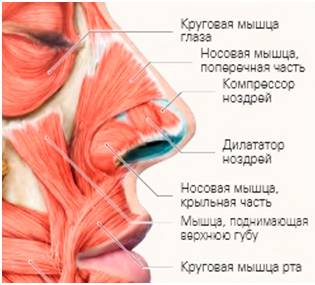
The nose is also made up of bones and cartilage; with age, the muscles weaken, and under the influence of gravity, the tip of the nose drops and becomes bulky. Therefore, exercising the nose muscles can help maintain its shape, improve its outline, reduce the width of the wings, and lift the tip. How to Wiggle the NoseAll the exercises below are shown in this video: 1. Try to suck air in through your nostrils; repeat several times. Now look closely in the mirror and try to move only the nostrils without involving the forehead and other muscles. If your forehead moves anyway, try to reduce the amplitude of the movements. Do not clench your lips. 2. Use the fingers of both hands, with the index and middle fingers, to fix the skin around the nose in the nasolabial area and wiggle your nose. Repeat 30 times. On the last count, hold a static pause for 5 seconds and relax. 3. Place a finger under the tip of your nose and try to press against it using the tip of your nose. Repeat 30 times. On the last count, hold a static pause for 5 seconds and relax. Structure of the Ear MusclesThe ear muscles are divided into three: the anterior, superior, and posterior muscles.
Typically, the ear moves upward due to the tension of the superior auricular muscle. Sometimes, the posterior auricular muscle can also engage, causing the ear to move backward. The ear muscles are also referred to as "muscles of youth" because their activity naturally lifts the entire central part of the face. As people age, the ear changes shape, becoming larger, and there may be vertical wrinkles near the ear. To prevent this age-related change or correct an existing one, it is enough to learn to wiggle your ears. How to Wiggle the Ear Muscles1. Try to wear glasses, resting them on the tip of your nose. Subconsciously, try to push the glasses back into place with your ears. 2. Look in the mirror and smile. Do your ears move? When smiling, people often raise their ears or wiggle them along with the smile. 3. Try to raise your eyebrows. 4. Try not to focus on both ears at once; try to wiggle them one at a time. 5. Press your ears against your skull with your fingers and move them up and down 20-30 times. With each movement of the ears upward, mentally visualize the contraction of the superior auricular muscle, and try to feel it. Work with the anterior and posterior auricular muscles in a similar manner, respectively changing direction. P.S. I develop individual programs for face-building training and conduct classes via Skype. If you are interested – here you go. SIMILAR ARTICLES
COMMENTS |