|
»
Facebuilding: the relationship between face and body
Author: Kristina Bondareva - facebuilding coach. All articles by the author ➤
Face-building involves not only exercises for the facial muscles but also back exercises that are tailored individually. Some of you may wonder how body workouts relate to facial training. The connection is direct; proper posture is the key to a proportional, non-deformed face. The relationship between the face and the body with posture:
WHAT IS POSTURE?Posture refers to the relaxed, comfortable position that a person takes during movement and at rest. Good, proper posture involves a natural position where the back remains straight, the head is held high, the shoulders are relaxed and wide apart, the abdomen is pulled in, and the knees are straight. Check your posture: 1. Normal posture involves four curves in the spine: two concave (cervical and lumbar) and two convex (thoracic and sacral). To assess the presence and depth of these curves, stand against a wall, pressing your head, shoulder blades, buttocks, and heels against it. Ideally, your torso should not be leaning forward or backward relative to your legs. Your fingers or palm should fit between your neck curve and the wall, and your palm should fit freely between your lower back and the wall, while two palms should fit with effort. From the starting position, you should be able to touch the floor with your fingertips without much effort. 2. Diagnosing pelvic position. There is a concept known as the "Michaelis diamond" (sacral diamond) – a depression in the sacral area limited above and outside by the protruding edges of the large back muscles, and below and outside by the protruding edges of the gluteal muscles. The shape of the diamond may change with certain pathological changes in the pelvis. 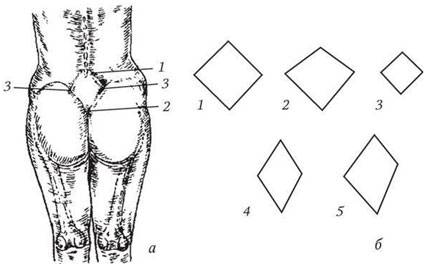
a — General view:
b — The shapes of the Michaelis diamond with normal and various anomalies of the pelvic bones (diagram):
The connection between the face and the bodyDid you check your posture? Now look in the mirror at your face. First, pay attention to visible “problems.” 1. Nasolabial wrinkle or fold If you have it, try to avoid slouching. From experience, I can say that the nasolabial fold follows people with "sedentary" jobs. It's rare to find those who do not rest their elbows on the table or raise their shoulders to their ears while looking at a computer monitor. Ideally, the monitor screen should be at eye level, then the head position will be correct, and the neck will stretch upward. 2. Double chin The problem of the "double chin" occurs in those who raise their shoulders. In this position, the center of gravity shifts, the head tilts slightly downward, and the muscles of the submental area (under the chin) stretch and weaken under the force of gravity. 3. Sagging facial oval, neck wrinkles People leading an active lifestyle and exercising almost do not have problems such as an unclear, "sagging" facial oval or "Venus rings" – wrinkles on the neck. When you are physically active, such as doing crunches or running, your neck muscles also engage and strengthen. 4. Facial asymmetry I’ll say right away that there are several variants of asymmetry, which I will discuss in a separate article. Asymmetry is always visually apparent and is directly related to correct posture. One side of the face may be higher than the other. The corners of the mouth, the eyes, and the ears serve as points for determining facial symmetry. Therefore, if you draw horizontal lines between these points, you can assess the symmetry of your face. Minor deviations are considered normal. During the day, take small breaks for a mini warm-up to relieve tension in the neck and shoulders:
P.S. I develop individual programs for face-building training and conduct classes via Skype. If you are interested – click here. SIMILAR ARTICLES
COMMENTS |