|
» »
How to build forearms: techniques, exercises, nuances
Author: Timko Ilya - master of the whole project and fitness trainer. All articles by the author ➤
Forearms are always in sight. Perhaps, on par with biceps and chest, forearm muscles represent the embodiment of male strength. Powerful forearms mean a strong man: many think so. However, few pay them enough attention. There are several reasons for this:
All three statements are true. But there are plenty of people who want to build impressive forearms, either due to the sport they engage in or simply for aesthetics. That's why I wrote this article. A bit of anatomy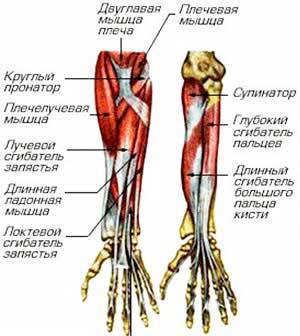
As you can see, the forearm consists of dozens of small muscles. Only the main ones are labeled in the picture. All muscles that move the wrist and fingers are located in this area. Each hand has 5 fingers. Each finger is moved by about the same number of muscles. Plus, there are muscles that move the wrist. So it turns out – several dozen thin muscles in one area. That is, to pump up the forearms, you need to train not only the wrists but also the fingers. I think this is clear. Now let's take a closer look at each exercise, starting with the fingers. Exercises for forearms (fingers)Exercises with a wrist expander Everyone knows what an expander is. This is perhaps not only the main exercise for your fingers but also the most convenient one. You need a small expander, which easily fits into your pocket. The video below shows several techniques with this device. From my side, I will say that the expander should be of such strength that you can do a maximum of 15 full repetitions at a time. No more. Simply bending it hundreds of times will not increase the volume of your forearms. Moreover, there are quite a few really powerful models for fingers of any strength on the market today. It's also undesirable to train your forearms ONLY with the expander. It serves as a supplement to the basic exercises for the wrists, which will be discussed below. Holding weights This exercise trains the static strength of the forearms very well. You won't build much volume with this exercise, but you will develop strength effectively. The essence of it is that you simply take a weight plate with your fingers and stand with it (you can hold one plate in each hand). This exercise is demonstrated in the video below. I will say right away, that 50 kg plates are already advanced level. Start with 20 – 25 kg plates initially. The plate's weight is not the only factor; its thickness and coating (rubber or completely metal plate) also matter. Exercises for Forearms (Wrist)These are the most common exercises for the forearms. During seated wrist curls, you train the part of the forearm on the bicep side. And while performing wrist extensions, you target the side near the elbow. Whether to do these exercises with a barbell or dumbbells is up to you. However, personally, I find it less convenient to use dumbbells than a barbell. To additionally engage the fingers, you can roll the barbell onto your fingers at the bottom point of the wrist curls. This way, you will hit two birds with one stone: training both the wrists and fingers. Lateral Wrist Curls and Extensions with Dumbbells These are performed just like the previously described exercise with dumbbells, except the forearm is positioned sideways (I couldn’t find a video). This way, you train the lateral part of the forearm. However, this exercise is quite specific and targeted. It is mainly performed by those involved in arm wrestling. This exercise is performed just like the regular one: Only with a top grip. Here, the forearms receive a good static load. It makes sense to do this exercise at the end of a bicep and forearm workout. The biceps won't grow much from it, but the forearms will receive a significant load. Standing Wrist Curls with Barbell This exercise is popular among weightlifters. During a clean and jerk, it’s necessary to curl the wrist to ensure the barbell goes up instead of forwards. Therefore, they often perform it. Essentially, it is a variation of seated wrist curls with a barbell. The technique for this exercise is shown in the video below (watch from 2:00). Barbell Wrist Curls Behind the Back This is done the same way as the previous exercise, except the barbell is behind the back. Personally, I don’t understand the appeal or the benefits this provides. But there are enthusiasts for this exercise. Though, I don’t see a fundamental difference (besides the inconvenience). Rope Winding An old and somewhat forgotten exercise. It works almost the entire forearm. You can do it on a stationary machine (as in the video below) or by holding a stick in the air (which is much harder). Making such a machine for yourself is quite simple (you need a round stick and rope) and this exercise is extremely effective. The forearms get fully pumped!Conclusion1. You need to train not only the wrists but also the fingers. I personally recommend doing all of this in one workout. Start with the wrists, then move on to the fingers. 2. Regardless of the exercise you are doing, the weight or resistance should be such that you can do a maximum of 15 repetitions per set. And if it's rope winding, then a maximum of 3-4 complete lifts per set. 3. Forearm muscles are quite resilient and recover quickly (just like calves and trapezius), so you can easily train them twice a week. 4. Train the forearms only at the end of the workout, as they are engaged in many exercises. Training them at the beginning will significantly complicate your workout. 5. It is advisable to train forearms on bicep day or back day. This is because they (forearms) receive most of the indirect load from bicep and back exercises. I can suggest a combination of exercises:
Or, here’s another option:
These options are provided just as examples. I think you understand the essence: it is advisable to combine 3-5 forearm exercises throughout the week. I hope my article has been helpful to many. I wish you to build forearms like Popeye. Good luck! SIMILAR ARTICLES
COMMENTS |