|
» »
How to do more pull-ups: methods and techniques
Author: Timko Ilya - master of the whole project and fitness trainer. All articles by the author ➤
Pull-ups are a very important exercise. I believe that various pull-up variants are fundamental for developing the latissimus dorsi, biceps, rear deltoids, and the entire upper back. Therefore, pull-ups are a mandatory element in almost all of my training plans. In this article, I want to share my methods that will help you improve your pull-up performance. 1. Combination of Various Pull-Up Variants This is a very important point. Typically, I use 4 variants of pull-ups in my arsenal: You can combine these variants within the training week or within a single workout. For example, on Monday, you can do reverse grip pull-ups to the chest, and on Friday – wide grip pull-ups behind the head. Generally, 2 pull-up sessions per week are sufficient for improvement. When combining pull-ups within one workout, I use two variants. The first is the so-called "assorted" pull-ups. In one set, you perform reverse narrow grip pull-ups to the chest. In the second set, you do wide grip to the chest. And in the third set, you perform wide grip behind the head. It's essential to do each set for the maximum possible repetitions. This method works all muscles involved in pull-ups during a single exercise. Another combination is alternating 2 variants within one set. For instance, the first repetition can be wide grip behind the head, and the second repetition can be to the chest. Continue alternating for the entire set without changing the grip width. I believe that if you want to excel at pull-ups, you must include several methods of pulling into your training plan. How you combine them is another issue. 2. Use a Partner's Assistance This method is mainly relevant for those who cannot perform a pull-up at all or can do 5 or fewer. As you might have guessed, the essence of this technique is that your partner takes you by the shins and pushes you up. Generally, if a person can only do 1 pull-up, with this assistance they can perform about 6. 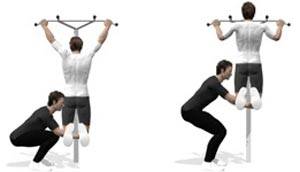
A significant advantage of this method is that the muscles work just as they would during regular pull-ups. Your body weight is effectively decreased due to the assistance. This allows you to learn to do full pull-ups much faster than, for example, using machines. 3. Weighted Pull-Ups I start using weights when a person can already perform at least 10 pull-ups. Usually, this involves a special belt to which weights can be attached. When you do pull-ups with weights a small number of times, you are training your strength. As you become stronger, you will be able to perform more repetitions. It's essential to constantly alternate between strength-focused pull-ups and those focusing on the number of repetitions. For instance, one week you do pull-ups without weights for maximum reps, and the next week you do weighted pull-ups for 3 – 4 repetitions. My athletes perform pull-ups with weights for as few as 1 – 2 repetitions. You can also use a technique of reducing weight within one set. For example, you do pull-ups with a 20 kg weight for 6 repetitions until failure. Then you immediately attach 10 kg and, without resting, attempt to do as many as possible again (another 2 – 4 repetitions). Next, again without resting, do pull-ups until failure without weight (another 2 – 4 repetitions). 4. Negative Pull-Ups This method is suitable for individuals who can already perform 15 or more pull-ups. The essence is that you attach a weight equal to what you can do for 1 repetition, or 5 – 10 kg more. You perform a pull-up unaided or with assistance and try to hold the position for as long as possible before fully extending your arms. You should start not from the final phase (when your chin is above the bar) but from the phase when your chin is just below the bar. It is crucial not to cheat and to hold on until your arms are fully extended. The weight should be such that you can hang for 15 – 30 seconds. This exercise greatly increases muscle strength. Practice shows that after 4 – 5 weeks of this method, the number of pull-ups increases by approximately 25% – 30%. If you are interested in the topic of using straps during pull-ups, you can read more here. That’s all for now! If you enjoyed the article, please "like" it and subscribe for more. Good luck! SIMILAR ARTICLES
COMMENTS |