|
» »
Muscle contractions between sets: how to accelerate strength and mass growth
Author: Mikhail Ziborov - author of the site makefitness.pro. All articles by the author ➤
It turns out that if you flex your muscles right after performing an exercise, muscle mass increases faster, and strength indicators improve. Of course, there are nuances, but more on that below. We have many such tips in our Telegram: come and learn how else you can improve your results. What is Muscle Flexing and How Does It Improve ResultsMuscle flexing after exercise is static tension of the muscles that have just been worked. That is, if we dynamically (actively) tense our muscles during the exercise, we need to tense them statically (passively) after the exercise is complete. What does this mean? Everyone knows how to flex their biceps to show the greatest volume, right? You just need to bend your arms at the elbows, raise them to head level, and flex as much as possible. 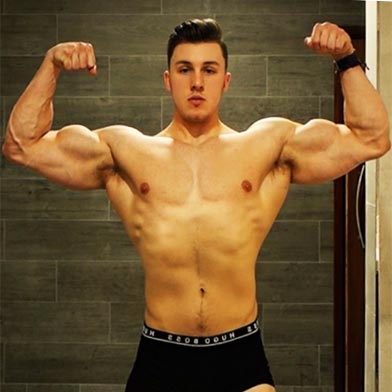
This is static muscle tension (also known as isometric muscle tension or isometric holds). This is pure posing. If you look at bodybuilders' performances, you'll see that posing with maximum muscle tension (to increase muscle volume and show detail) is part of their competition program. And that tension is exactly what we need. By the way, abroad, muscle flexing is referred to as flex (flex). Who knows why, as "flex" translates from English as "bending." In short, muscle flexing is posing or flexing (isometric muscle tension without weights). You need to flex the muscle group that has just worked in the exercise. But let's move on to the scientific data (see this study). They divided 27 trained men into two groups: - one group simply rested between sets; - and the other group performed muscle flexing for 30 seconds, followed by rest. All the guys trained the same: for 2 months with 3 workouts a week. They did a standard set: 3 sets of 8-12 repetitions in each exercise. There was a 2-minute rest between sets. The only difference was that: - in the flexing group, they flexed for 30 seconds and then had 90 seconds of passive rest (which equals 2 minutes); - in the group without flexing, people just rested for 2 minutes (120 seconds). The results showed that people who used the method of isometric muscle tension significantly gained more muscle tissue than those who simply rested. Specifically: - biceps and triceps increased by almost 1.5 times more; - the rectus femoris (part of the quadriceps) increased by 1.7 times more; - strength results in the bench press increased (the strength indicators were higher in the flexing group: 9.4 vs. 8.9). Free, yet among the best training programs for gaining mass – here. Detailed nutrition for muscle growth – here. Isometric Muscle Tension: How and Why It WorksMuscle tissue and strength gains are achieved through the production of a greater number of byproducts (for example, hydrogen ions and lactate): isometric muscle tension is also physical work that consumes energy with subsequent production of breakdown products. Breakdown products, broadly speaking, indicate the degree of stress experienced, which causes the body to adapt (gaining more muscle tissue to be stronger in the next workout). In short, isometric holds lead to more breakdown products, more stress, and more muscle mass gain. However, there are nuances to all of this! It turns out that muscle flexing positively affects only the upper body (torso, arms) but negatively affects the lower body (legs). While strength improved in the bench press, strength in the leg press was less. Also, although strength in the bench press increased (1RM improved), endurance in the same bench press was worse than in the group that simply rested. Additionally, the lateral thigh muscles (part of the quadriceps) grew less than in the passive rest group. In short, the method of isometric muscle tension is suitable for increasing strength (explosive strength or power) in the upper body but is not suitable for developing the same strength in the lower body. Simply put, for accelerating muscle growth, we flex only the arms, chest muscles, back, and shoulders, but we don’t flex the legs and glutes. By the way! Perhaps if the guys who used muscle flexing were given more rest (the same 2 minutes), the results in bicep and tricep growth, as well as in the bench press, would have been better. How to Flex Muscles?For 20-30 seconds, you need to tense the muscles that have just been engaged in the exercise. And it’s better to see how to do it once than to read about it 100 times. Here’s a good example: SIMILAR ARTICLES
COMMENTS |