|
»
How to train correctly with diastasis
Author: Tkachenko Sergey - Master of sport in bodybuilding. All articles by the author ➤
Let's Start with Some Anatomy1. The rectus abdominis. It runs vertically down along the entire line of the abdomen: it extends from the rib cage and stretches to the pubic bone. The main abdominal muscle is divided by a tendon into two parts, left and right. Other tendons are arranged horizontally, thereby dividing our abdomen into cubes. The rectus abdominis serves as the flexor of our torso. The rectus abdominis is not divided into different parts, as it is a single muscle sheet divided into areas shaped like cubes by tendons. Other abdominal muscles consisting of three parts are the lateral walls of our abdomen: 2. External obliques. These superficial abdominal muscles begin at the side of our rib cage and continue from the superficial intercostal muscles, covering the ribs. These muscles attach to the eight lower ribs with serrations, and they run from top to bottom diagonally. The external oblique muscles flex our spine and also allow for rotation of our torso to the right or left. 3. Internal obliques are located under the external oblique muscles. These muscles cross the abdomen from the pelvis to the rib cage, and their fibers run diagonally. The function of these muscles is the same as that of the externals. They also participate in the rotation of the torso to the sides. 4. Transverse muscles are located under the main layer of abdominal muscles; they serve to protect the internal organs and do not influence the external muscles. The aponeurosis is the tendon tissue that holds all the muscles of our abdomen together. In short, it is connective tissue. It is the same for both women and men and does not differ at all. 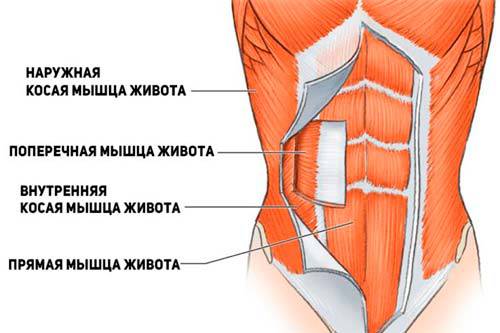
Now Let's Discuss What Diastasis IsMany women face the problem of diastasis of the rectus abdominal muscles — it is the separation of connective tissue in the middle of the core muscles. That is, just above the navel a gap forms; the separation can occur along the entire line. As a result, digestive tract organs can be pushed into it. This phenomenon is similar to an umbilical hernia, which most often occurs in men as a result of heavy physical exertion and lifting heavy weights. In both cases, the problem is usually solved surgically. However, if a woman has a small separation of 1-2 cm, there is a chance it may tighten on its own, but this is not guaranteed. With this problem, regular workouts are not suitable for women; it is necessary to perform specialized exercises to avoid injury. Otherwise, if you continue to train as usual and lift weights, you risk serious complications, and then surgery will be unavoidable. Diagnosing diastasis is very simple: just press your fingers against the connective tissue vertically along the entire line of the abdomen in the middle. If your fingers push into the tissue, you will feel it immediately; if they sink in without any resistance, then you have a problem. 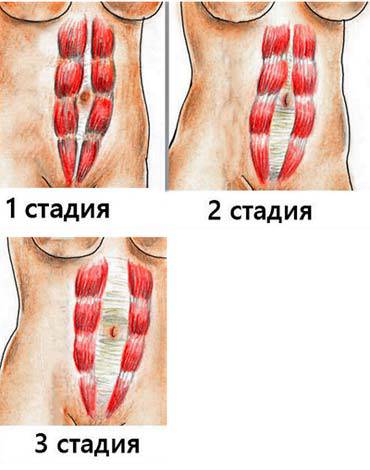
There are 3 stages of diastasis:
In the third case, surgery is unavoidable; the symptoms are clearly noticeable — this manifests as a protruding abdomen, and even at 10 cm it will also be visibly apparent. Exercises to AvoidAllowed Exercises1. Static Twists Perform static twists by lying on your back and alternately raising your legs; the limbs should be bent at the knees. Slightly twist your head and the upper part of your torso as if you are trying to perform regular twists, but without lifting your back off the floor. In the video, I do the exercise quite quickly, but that is just an example of how to perform the exercise. You need to hold your legs at the top for a few seconds to maintain static tension. 2. Pelvic Bridge This exercise is performed basically the same way as a regular bridge, except that our hands are on the floor and cannot be lifted while performing the exercise. When we raise the pelvis, we maximize the load on the glutes, and when going down, we focus on the abs. 3. Cat Exercise The "cat" exercise is performed on all fours, with palms straightened, and we begin to move the torso up and down, tensing the abs at the top and the back at the bottom. Perform carefully and without excessive effort. 4. Abdominal Vacuum in Lying Position Perform the vacuum as in the classic standing or sitting variant; lie on the floor and start pulling in your belly, but not too hard — just slightly tense, then relax. 5. Alternating Leg Raises from Lying Position This exercise involves raising your legs alternately while lying down; the legs should be bent at the knees. The exercise is similar to twists, but here we work only the legs and lower abs. 6. Stretching on All Fours Position yourself on all fours, straighten your palms and rest them firmly on the ground, and start extending your legs backward alternately so that they are parallel to your torso and the floor. 7. Leg Folding while Lying with Foot Sliding From a lying position on your back, bend your legs without lifting your feet off the floor. Perform this alternately. 8. Static Hyperextension This exercise is performed similarly to the classic one over a horse, except we do it lying on our stomachs, so there is no load on the abdomen, working instead on the lower back as we push back. Hold the movement for a few seconds at the top position. You can order a training or nutrition program from me, the author of this article.
SIMILAR ARTICLES
COMMENTS |