|
» »
ALL about whey protein!
Author: Timko Ilya - master of the whole project and fitness trainer. All articles by the author ➤
Table of Contents:
Whey protein is a protein obtained by purifying whey from milk. That is, water and most of the fat and carbohydrates are removed from it. It is purified roughly as shown in the picture below. However, there are different degrees and methods of purification. We will talk about them below. 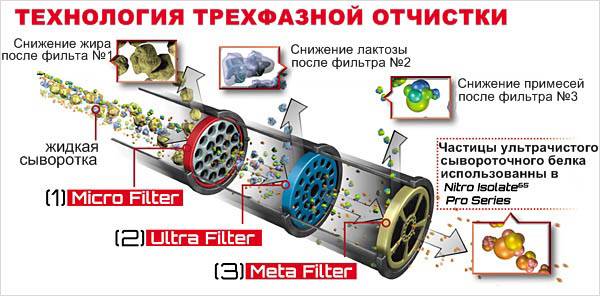
What Types of Whey Protein Are ThereWhey protein types are divided into degrees and methods of purification. There are three types in total: 1. Whey Concentrate. It contains approximately 75% - 85% protein and about 5% fat and carbohydrates (on average). Finished proteins based on concentrate typically contain 60% - 75% protein, 10% carbohydrates, and 5% fat. Effectiveness: this is a basic protein. It is equally suitable for any purpose. However, for weight loss, it is less suitable than for mass gain due to the fat and carbohydrates content. 2. Whey Isolate. This is a higher degree of purification. It contains approximately 90% - 95% protein and about 0% - 2% fat and carbohydrates. Finished proteins based on isolate usually contain 85% - 90% protein, 1% - 2% carbohydrates, and 0% - 2% fat. Isolate is about 1.5 times more expensive than concentrate. Effectiveness: it is ideal for weight loss and cutting due to the lack of fats and carbohydrates. 3. Whey Hydrolysate. It differs not by the degree but by the method of purification. It contains approximately the same amount of protein as concentrate (75% - 85%), almost no fat, and about 7% - 10% carbohydrates. But the main difference is not in that. The difference lies in the fact that this type of protein is already partially broken down into amino acids and peptides. That is, it is more amino acids than protein. It also costs more than isolate. Effectiveness: it is absorbed almost instantly. It is well-suited for those who have trouble digesting protein foods, as this type of protein requires the least digestion. Differences in Amino Acids from Other ProteinsIn the table below, the amount of amino acids per 100 grams of protein is indicated. I would like to emphasize: not per 100 grams of the product, but specifically per 100 grams of pure protein. The data is presented in grams.
As can be seen from the table, whey protein contains all 18 amino acids. Additionally, it is the leader in the number of essential amino acids. They make up about 50% of the total mass of amino acids. Whey protein also excels in the amount of BCAAs (specifically isoleucine, leucine, and valine). These three amino acids account for approximately 24% of the total amino mass. As you can see, it has 7 top positions against 4 bottom ones. The downside of this protein is that it has the least amount of such an important amino acid for bodybuilding as Arginine. But who cares? You can purchase it separately )) In general, it can be said that whey protein is better balanced in terms of amino acid composition than all other proteins. I would like to emphasize again that we compared specifically 100% protein without considering fats and carbohydrates. When, how much, and for what purposes to takeWhey protein is used for two directly opposite goals:
So what’s the catch? There isn't one. Your muscles need protein regardless of whether you are losing weight or gaining mass. The amount of protein you need daily and the timing of intake do not change based on your goals. How to take protein 1. It is advisable to take it twice a day, every day: in the morning and in the evening. 2. You should take it not with food but between meals. 3. If you have a workout, then drink the protein after training. So, you need to follow these three rules. The only difference is that when you are losing weight, all of this should happen against the backdrop of a calorie deficit, while when gaining weight, it should occur against a calorie surplus. That’s the entire difference. When losing weight, protein helps preserve your muscles. And during mass gain, it helps build them. The data you received is based on grams of dry powder for the entire day. To find out how much you need to take at a time, simply divide this by 2 (if you are taking it twice a day). What to mix with and howTo prepare a milkshake, milk, water, or (less commonly) juice is usually used. For 50 grams of powder, 200 ml of liquid is sufficient. The amount of liquid doesn't matter much. You can make a thin or thick shake; it’s merely a matter of taste. This shake can last as long as the milk doesn’t sour. If made with water, it can last even longer. Therefore, you can easily prepare a shake in the morning and drink it in the evening. Contraindications1. Problems with digesting protein foods, for example, pancreatitis. However, even in this case, it is perfectly safe to consume whey hydrolysate in small portions of 30 grams. 2. Lactose intolerance. If you are allergic to lactose, whey protein will simply make you nauseous. However, some manufacturers produce lactose-free proteins. But practice shows that this doesn't always help. There are no more contraindications. As for pregnant women, children, and nursing mothers — they can drink it without problems. I repeat for the skeptics: whey protein is made from dairy whey. Average Market PriceAttention! All prices stated in this article are relevant as of August 2016, when the article was written. If you stumbled upon this article much later, even though prices may be outdated, you will still see the ratio of prices among themselves. Table of average price per 1 kg of protein (in rubles)
How to Choose Correctly1. If you are losing weight, try to buy a protein that contains at least 80% protein and no more than (in total) 10% fat and carbohydrates. Mainly, isolates fall under this category. 2. If you are gaining mass, you can suffice with a protein that has at least 60% protein. 3. If you have gastrointestinal issues and find it hard to digest protein, opt for hydrolysate. This will be cheaper than if you were to buy amino acids in tablets. Essentially, it is the same thing, as many amino acids are simply compressed hydrolysate. 4. Check the ingredient list. If there is soy protein in the composition, that’s a red flag, as whey protein becomes diluted. If there are casein or egg proteins, that’s not bad, but it could make the product more expensive. If there is milk protein present, it’s essentially the same as whey. 5. It’s quite common to find a mixture of all three types of whey protein in a product. This doesn’t provide any significant advantages but manufacturers do this to increase sales. Which Proteins Do I Recommend?Below, I will list two proteins from each type that, in my opinion, have high quality and relatively low prices:
Now you know everything about whey protein! Don’t let yourself be deceived. Good luck! SIMILAR ARTICLES
COMMENTS | |||||||||||||||||||||||||||||||||||||||||||||||||||||||||||||||||||||||||||||||||||||||||||||||||||||||||||||||||||||||||||||||||||||||||||||||||||||||